


Tony Blair was never keen on the idea of the “100 days”. That sort of thing, he said, usually ends in tears. He stressed he wasn’t promising the Earth, and that making a real difference takes time.
That was Blair talking shortly before his landslide election triumph in 1997, trying to dampen expectations. As it turned out his first 100 days as prime minister were a triumph, with policies and personnel changes coming thick and fast, most of them for the best — even the Tories had to acknowledge begrudgingly.
We had independence for the Bank of England, the announcement of the “welfare-to-work “programme and billions used from reserves to boost state education. He assembled a government of talents, appointing Liberal Democrats into senior positions and a Labour thinker, Frank Field, was brought into the fold. On it went, at a canter, putting down a marker for what we could expect from the new prime minister and his colleagues in the years ahead.
If Blair’s 100 days were the high-water mark of recent premierships, then Rishi Sunak’s, reaching his landmark this week, surely represent the lowest. To be fair, the Labour leader did not become prime minister against a world backdrop of a cost-of-living crisis, soaring energy bills, supply chain weaknesses and a war in mainland Europe.
But Sunak completes his 100 days having just fired the Conservative party chairman for breaking the ministerial code of conduct and the Tories’ poll ratings are desperately low and refusing to move upwards.
If anything, Sunak’s 100 days reinforce the impression of a caretaker minding Number 10 for the next occupant who is likely to be Keir Starmer but may, just may, be Boris Johnson.
That’s how bad things are. Sunak is displaying so little promise, that even after 50 MPs resigned from his administration, there are plenty of Tories at Westminster who crave an urgent Johnson comeback. They see their former chief as their one great hope; that on the evidence to date, Sunak fails to excite and convince.
He did not get off to the best of starts. Not only was the global picture bleak but his predecessor had pressed the self-destruct button. For a period, Liz Truss had threatened to collapse the economy.
Sunak took charge, pledging financial stability and an end to the chaos that had so spooked the markets. That, he has delivered, and credit to him for doing so.
In addition, he said he would draw a line under Tory sleaze and restore integrity to public office. That, he has completely failed to do. The chairman, Nadhim Zahawi, has gone, but Sunak could have sacked him weeks ago. Meanwhile, the Deputy PM, Dominic Raab, is under investigation for bullying. And the BBC chairman, Richard Sharp, is also facing scrutiny after it emerged that before his appointment he was advising on Johnson’s financial affairs, helping the former prime minister secure a personal loan.
If those inquiries conclude that Raab did bully and Sharp was conflicted, then questions will be asked as to why Sunak did not respond more firmly as soon as the stories about them first emerged.
Sunak’s slowness has got him into trouble. He took an age to appoint Laurie Angus as the new adviser on ministerial conduct. In his defence, Sunak’s supporters maintain he likes to think through a decision. That would be fine if his decisions were right but they’re not, certainly where personnel are concerned.
Appointing Gavin Williamson to the Cabinet, even though Williamson had twice resigned from previous Cabinets, was not smart. Williamson duly went, for a third time. Neither, arguably, was bringing back Suella Braverman as Home Secretary soon after she was forced to quit over security breaches contrary to the ministerial code. Braverman haunts him still. There were also red flags about the unpopular Raab.
While the markets are reassured that Britain is being led by grown-ups again, that grip has come at a price. Sunak is facing union unrest on a scale not seen since the industrial strife of the 1970s. Keen to be regarded as the tough guy, responsible with the nation’s money, he has been reluctant to make concessions. What this has meant in practice is an unwillingness to engage. That’s backfired, as on strike days the country seems alarmingly rudderless.
Likewise, the NHS is battling unprecedented difficulties. But here again, we’ve not seen Sunak leading from the front, knocking NHS management heads together, demanding solutions and pushing through reform.
Rishi Sunak's first 100 days as prime minister — in pictures
-

Rishi Sunak has been British Prime Minister for 100 days. Here The National looks back at his time in No 10 Downing Street. Getty Images -
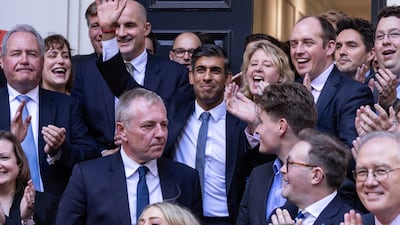
Mr Sunak after being announced as winner of the Conservative Party leadership contest on October 24. Getty Images -
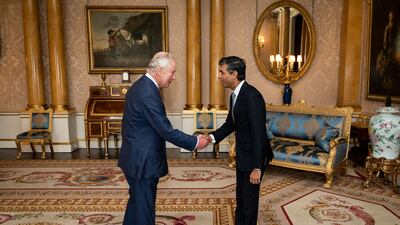
King Charles III welcomes Mr Sunak to Buckingham Palace where he invited him to become Prime Minister and form a new government. Getty Images -
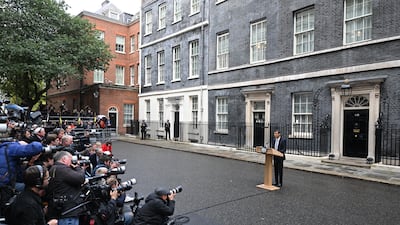
The new Prime Minister makes a speech outside No 10. Getty Images -
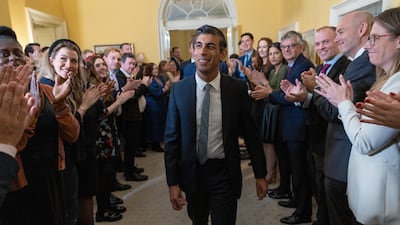
Mr Sunak arrives at No 10 for the first time as Prime Minister. Photo: Simon Walker/ No 10 Downing Street -
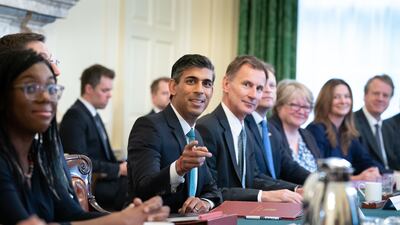
Mr Sunak holds his first cabinet meeting. Getty Images -
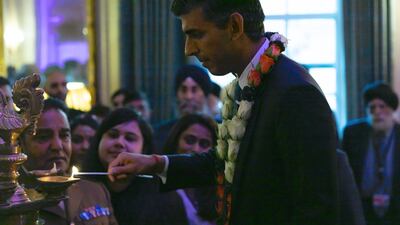
Hosting a reception to celebrate Diwali at No 10. Photo: Simon Walker / No 10 Downing Street -
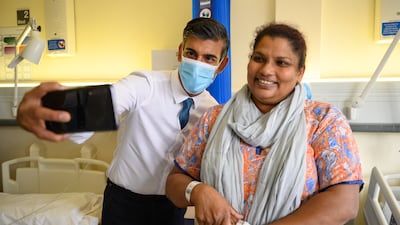
A visit to Croydon University Hospital, south London. Getty Images -
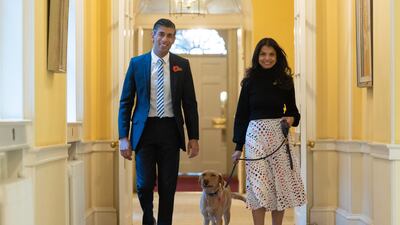
Mr Sunak and his wife Akshata Murty wearing poppies, with a special poppy collar for their pet Labrador Nova. Photo: Simon Walker / No 10 Downing Street -
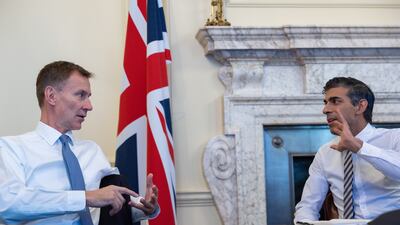
The Prime Minister with Chancellor Jeremy Hunt in the Cabinet Room at No 10. Photo: Simon Walker / No 10 Downing Street -
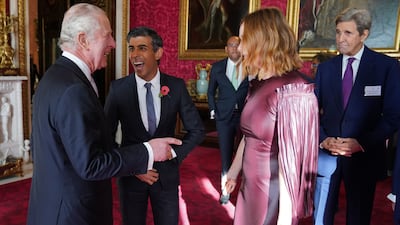
King Charles, Mr Sunak, fashion designer Stella McCartney and US climate envoy John Kerry at Buckingham Palace before Cop27. Getty Images -

French President Emmanuel Macron and Mr Sunak at Cop27 in Sharm El Sheikh, Egypt. Getty Images -
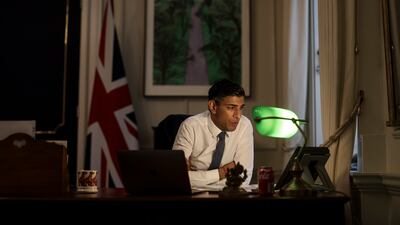
Mr Sunak during a call to Ukraine President Volodymyr Zelenskyy from his office. Photo: Simon Dawson / No 10 Downing Street -
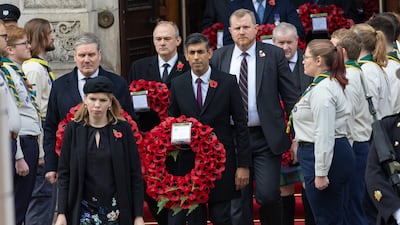
On Remembrance Sunday at the Cenotaph in London. Photo: Simon Walker / No 10 Downing Street -
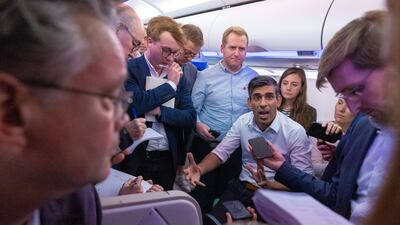
Mr Sunak with journalists on a flight to Bali and the G20 meeting. Photo: Simon Walker / No 10 Downing Street -

With Saudi Arabia's Crown Prince Mohammed bin Salman during a meeting at the G20 in Nusa Dua, Indonesia. Getty Images -
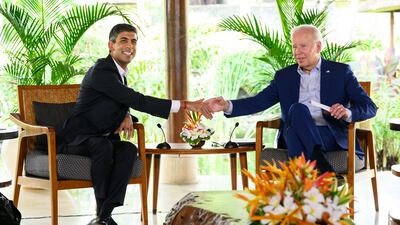
Mr Sunak with US President Joe Biden at the G20 summit. Getty Images -
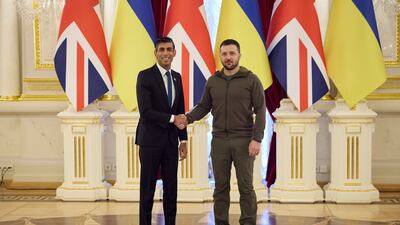
Mr Sunak and Ukrainian President Volodymyr Zelenskyy. Getty Images -

Mr Sunak meets rescue teams during his visit to Ukraine. Photo: No 10 Downing Street -
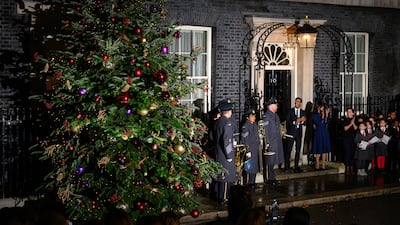
Mr Sunak and his wife outside No 10 as the Christmas lights are turned on. Getty Images -
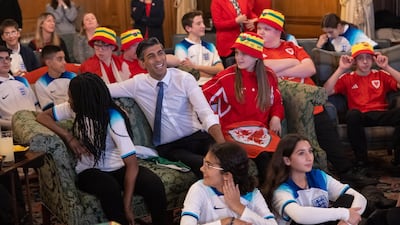
Mr Sunak joins youth footballers from Wales and England to watch the World Cup match between the two nations. Photo: Simon Walker / No 10 Downing Street -
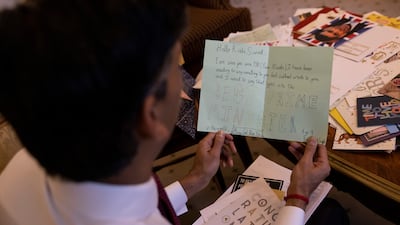
The Prime Minister reading congratulations cards from members of the public after being appointed. Photo: Simon Dawson / No 10 Downing Street -

On a visit to RAF Coningsby in Lincolnshire after the announcement that Britain will develop next-generation fighter jets with Italy and Japan. Getty Images -
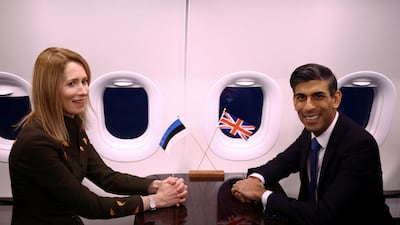
Mr Sunak and Estonian Prime Minister Kaja Kallas on a plane to Tallinn. Getty Images -
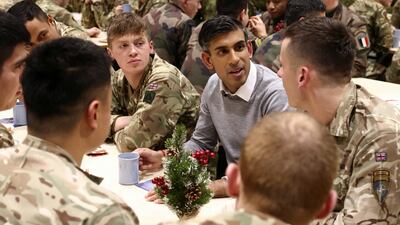
The Prime Minister with troops at the Tapa military base, Estonia. Getty Images -

The photo on Mr Sunak's official Christmas card. Photo: Simon Walker / No 10 Downing Street -

Mr Sunak prepares and serves breakfast on a visit to The Passage homeless shelter in London just before Christmas. Photo: Simon Dawson / No 10 Downing Street -
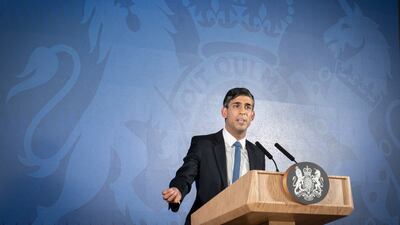
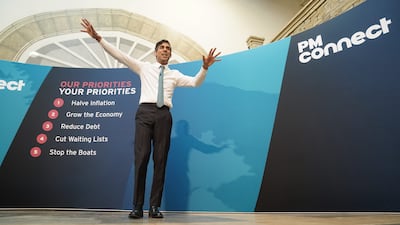
Making his first major domestic speech of the year. Getty Images -
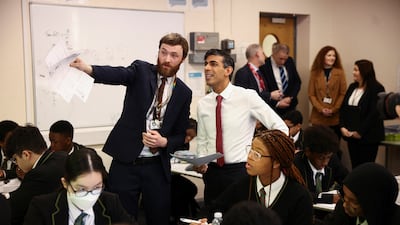
On a visit to Harris Academy in Battersea, London. Getty Images -
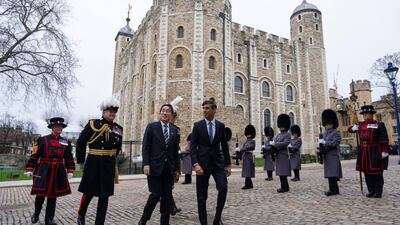
Mr Sunak and Japan's Prime Minister Fumio Kishida arrive at the Tower of London for a meeting. Getty Images -
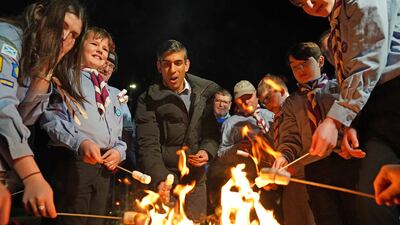
Toasting marshmallows on a visit to the Sea Scouts community group in Muirtown near Inverness. Getty Images -
A Q&A session at The Platform in Morecambe, Lancashire, after a community visit to the Eden Project North. Getty Images -
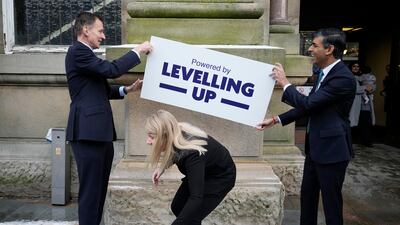
Mr Sunak and Mr Hunt at Accrington Market Hall with local MP Sara Britcliffe to announce projects under the levelling-up fund. Getty Images


His answer to restoring economic credibility has also been to pursue tax rises — an approach that has brought Sunak into direct conflict with many of his own MPs. They are becoming increasingly vociferous in seeking lower taxes. What’s driving them, apart from ideology, is a craving for good news, for an upbeat tone — more so with an election in the offing.
In 100 days, positivity was in short supply. The closest was regular photo calls, showing Sunak and his trademark, gleaming white teeth smile. They were on full display when he made his tour of the North of England, dispensing levelling up grants. What was noticeable, however, was the accompanying negativity — his performance came across as tiresome and disingenuous, handing out pots of cash for individual projects, as if that will close the North-South divide.
On the foreign policy side, Sunak cannot point to any significant achievements. He’s supported Ukraine but it’s Johnson who has stolen his thunder and coverage. Johnson’s staged visits to meet President Volodymyr Zelenskyy can only have grated with Sunak.
Relations with the US remain fragile. Crucially, there’s no sign of the much-heralded trade deal. They would receive a lift if there was a breakthrough in the talks with the EU over the Northern Ireland border arrangements. Progress is said to be being made, but it’s slow and invisible. That applies, too, to a possible rapprochement with Brussels. Business is desperate for simpler protocols for the import and export of goods, and also of people to fill UK job vacancies. In a marked shift, Sunak’s 100 days have witnessed growing disillusionment, even among once ardent Brexiteers, with the look of the UK’s post-EU landscape.
So, little cause for celebration. At least, Sunak has been prime minister for 100 days, which is 56 days longer than Truss. He came in at the lowest of ebbs and there has been improvement — the ship is no longer sinking. But whether Sunak can go on to notch up hundreds of days, that is a big “if”.

