


Syria might not have almost 7 million internally displaced people if global diplomacy worked as it should. But despite a great deal of foreign interest, more than a decade on from the beginning of its civil war, a solution strong enough to begin a meaningful, inclusive rebuild remains distant.
While not quite as devastated, Iraq, a neighbour, also faces dangerous levels of instability. Domestically, corruption is rife, the economy is stagnant and the environment is failing. Politicians seem unable, or unwilling, to change course. Externally, the country is the target of crippling foreign interference, particularly in the case of Iranian-backed militias.
Now, both countries appear to be entering a particularly dangerous phase, which only high-level, focused diplomacy can solve safely and lastingly.
Although slightly different in nature, they revolve around neighbours' concerns about security threats posed by Kurdish groups that are present in Iraq and Syria.
-

People inspect the damage after Turkish air strikes hit a power station in Taql Baql, Syria. AP -

A fire rages at an oil installation hit by a Turkish air strike in Tal Awdah, in north-eastern Syria's Hasakah province. AFP -
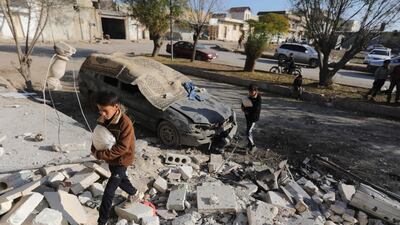
Residents walk over the rubble of a building destroyed by a rocket in the town of Azaz, Aleppo province. AFP -
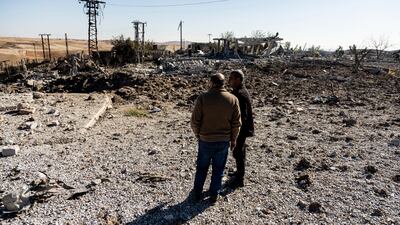
People look at a site damaged by Turkish air strikes in Taql Baql, Hasakah province. AP -
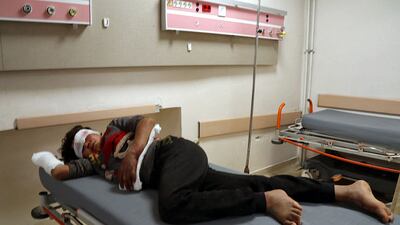
A person wounded in a rocket attack in the town of Azaz receives medical care at a clinic. AFP -
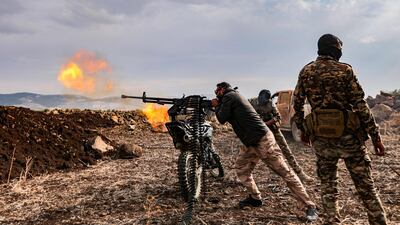
A Syrian fighter fires a machinegun mounted on the back of motorcycle during military drills by the Turkish-backed Suleiman Shah Division in the opposition-held Afrin region of northern Syria. AFP -
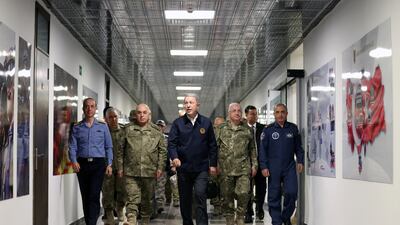
Turkey's Defence Minister Hulusi Akar visits the Land Forces Operation Centre, in Ankara. Reuters -
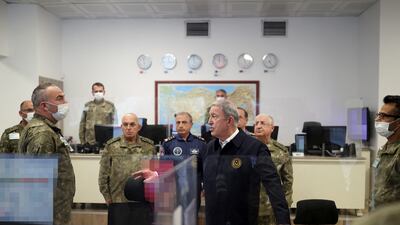
Mr Akar is briefed on the operations. Reuters -

Kurds attend a funeral of people killed in Turkish air strikes in the village of Al Malikiyah, northern Syria. AP -
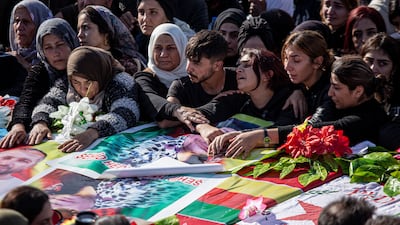
Women mourn during the funeral service. AP -
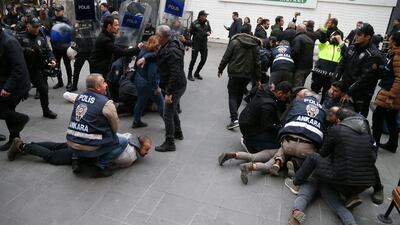
Police arrest members of the Peoples' Democratic Party (HDP) during a protest against the Turkish Armed Forces' (TSK) air campaign in the northern regions of Iraq and Syria, in Ankara. AFP


On Wednesday, Iraq said it would send border guards to its borders with Turkey and Iran, an attempt to stop ongoing attacks by them against dissident Kurdish groups. Turkey’s Kurdistan Workers' Party, or PKK, and the Kurdish Democratic Party of Iran have bases in Iraq's Kurdistan region and have recently been the targets of almost daily attacks by Ankara and Tehran.
In Syria, the situation is perhaps even more urgent. On Wednesday, Turkish President Recep Tayyip Erdogan said that his country would escalate current air strikes against Kurdish targets in Syria by launching a ground operation "at the most convenient time for us". The comments came after a bomb attack in Istanbul that killed six people. No one has claimed responsibility, but Turkey blames the YPG, a primarily Kurdish militia in Syria.
That same day, the US said that Turkish strikes in northern Syria had put some of its personnel in danger. There are roughly 900 US troops currently embedded with the Syrian Democratic Forces, a group fighting remnants of ISIS, and which is led by Kurdish fighters. It is an early warning of how complex and costly a Turkish ground invasion would be, and why it must be avoided at all costs.
There are two starkly different options for how matters could develop from here. One is to carry on the years-long habit of inaction and maintain a dangerous status quo in which major players tolerate dangerous power vacuums and lingering tensions that should have been solved years ago.
The other is that the prospect of a new, particularly dangerous round of hostilities in Syria and Iraq re-energises diplomacy. This is a vastly more constructive and regulated process than military action.
A frequent paradox of diplomacy is that it is often only fully pressed into action during the final stages before violence. This is not ideal and often does not work by late stages; the ongoing war in Ukraine is an example. But now that the situation is as bad as it is, perhaps sufficient desire to find peaceful solutions might finally be realised. In what might seem like a hopeless time for regional security, this should be the hope that policymakers cling on to. Those in power only have to look at the world around them today to see how devastating and drawn out the other option is.

