Insight and opinion from The National’s editorial leadership
July 25, 2022
On Saturday, WHO Director General Dr Tedros Adhanom Ghebreyesus made the extraordinary decision to declare the rapidly expanding monkeypox outbreak as a global emergency.
He did so despite a lack of consensus among colleagues, the first time such a process has been followed in the organisation’s history. It is a sign of quite how worrying he and many other medics deem the situation. Other illnesses to have merited emergency designation include coronavirus, ebola and polio.
Monkeypox involves similar symptoms to smallpox, such as fever, rashes and lesions. Recently, about 65 countries where monkeypox is not endemic have reported outbreaks. The US Centres for Disease Control and Prevention says that more than 16,000 cases of the viral disease have been reported in 74 countries since May, although deaths have only been recorded in Africa, particularly Nigeria and the Democratic Republic of Congo, where the disease was first discovered in the 1970.
Declaring a global emergency means the WHO fears the outbreak could now spread internationally, therefore requiring a co-ordinated response. In the wake of such an intense warning, it is hard not to think back to the troubling early days of Covid-19, when medics around the world began to understand the scale of the emergency, and, indeed, when Dr Ghebreyesus’s organisation faced accusations that it did not act swiftly enough.
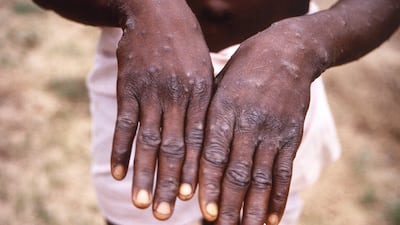
A man's hands are covered in a rash caused by the monkeypox virus that swept through the Democratic Republic of the Congo from 1996 to 1997. Reuters
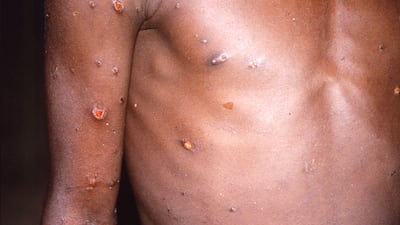
An image taken during an outbreak of monkeypox in the Democratic Republic of the Congo in 1996 and 1997 shows the arms and torso of a patient with skin lesions due to monkeypox. Reuters
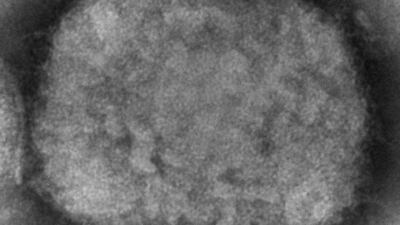
This 2003 electron microscope image made available by the Centres for Disease Control and Prevention shows a monkeypox virion, obtained from a sample associated with the 2003 prairie dog outbreak. AP
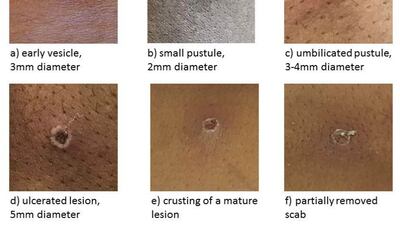
Images issued by the UK Health Security Agency show the stages of monkeypox. UK Health Security Agency
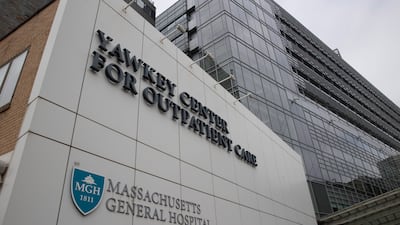
The Massachusetts Department of Public Health confirmed a single case of monkeypox in an adult male who had recently travelled to Canada. EPA
Roman Woelfel, head of the Institute of Microbiology of the German Armed Forces in Munich, gets to work after Germany detected its first case of monkeypox. Reuters
But his warning last week is different, and there are no reasons yet to fear monkeypox becoming as devastating as Covid-19. Temporary recommendations given by the organisation relate mostly to the need for international collaboration and co-operation to prevent the situation deteriorating. This ranges from establishing global disease surveillance to increasing awareness among medical staff all over the world. Co-ordination between medical communities around the world will be vital.
Much of what experts are demanding goes wider than just monkeypox itself. For example, Dr Placide Mbala of the global health department at Congo’s Institute of National Biomedical Research stresses the need for overcoming inequality in global vaccine distribution: “Vaccination in the West might help stop the outbreak there, but there will still be cases in Africa. Unless the problem is solved here, the risk to the rest of the world will remain.”
A new vaccine has been approved for monkeypox, but other well-established ones used for years to suppress smallpox are also effective. But the outlook for global vaccination campaigns – when vital doses such as these are administered – is currently bleak. The week before its monkeypox designation, the WHO highlighted data that shows how global vaccination coverage continued to decline throughout 2021 due to the Covid-19 pandemic. This means that 25 million infants missed out on lifesaving vaccines, the kind that will ultimately protect the world from resurgent, previously contained diseases such as monkeypox, as well as new ones. A senior Unicef official called it the warning “a red alert for child health”.
As monkeypox spreads, its significant medical dangers are clear. But perhaps more consequential is the way governments around the world do or do not respond to it. There are no expectations that it will rival the devastation of Covid-19. But if the international community does not act now, it may, like the pandemic, turn out to be another deadly burden that could have been stopped, or at least significantly mitigated.

Desert Warrior
Starring: Anthony Mackie, Aiysha Hart, Ben Kingsley
Director: Rupert Wyatt
Rating: 3/5
The burning issue
The internal combustion engine is facing a watershed moment – major manufacturer Volvo is to stop producing petroleum-powered vehicles by 2021 and countries in Europe, including the UK, have vowed to ban their sale before 2040. The National takes a look at the story of one of the most successful technologies of the last 100 years and how it has impacted life in the UAE.
The company offers payments/bribes to win key contracts in the Middle East
May 2017
The UK SFO officially opens investigation into Petrofac’s use of agents, corruption, and potential bribery to secure contracts
September 2021
Petrofac pleads guilty to seven counts of failing to prevent bribery under the UK Bribery Act
October 2021
Court fines Petrofac £77 million for bribery. Former executive receives a two-year suspended sentence
December 2024
Petrofac enters into comprehensive restructuring to strengthen the financial position of the group
May 2025
The High Court of England and Wales approves the company’s restructuring plan
July 2025
The Court of Appeal issues a judgment challenging parts of the restructuring plan
August 2025
Petrofac issues a business update to execute the restructuring and confirms it will appeal the Court of Appeal decision
October 2025
Petrofac loses a major TenneT offshore wind contract worth €13 billion. Holding company files for administration in the UK. Petrofac delisted from the London Stock Exchange
UN Panel of Experts found regime secretly sold a fifth of the country's gold reserves.
The panel’s 2017 report followed a trail to West Africa where large sums of cash and gold were hidden by Abdullah Al Senussi, Qaddafi’s former intelligence chief, in 2011.
Cases filled with cash that was said to amount to $560m in 100 dollar notes, that was kept by a group of Libyans in Ouagadougou, Burkina Faso.
A second stash was said to have been held in Accra, Ghana, inside boxes at the local offices of an international human rights organisation based in France.
Mercer, the investment consulting arm of US services company Marsh & McLennan, expects its wealth division to at least double its assets under management (AUM) in the Middle East as wealth in the region continues to grow despite economic headwinds, a company official said.
Mercer Wealth, which globally has $160 billion in AUM, plans to boost its AUM in the region to $2-$3bn in the next 2-3 years from the present $1bn, said Yasir AbuShaban, a Dubai-based principal with Mercer Wealth.
“Within the next two to three years, we are looking at reaching $2 to $3 billion as a conservative estimate and we do see an opportunity to do so,” said Mr AbuShaban.
Mercer does not directly make investments, but allocates clients’ money they have discretion to, to professional asset managers. They also provide advice to clients.
“We have buying power. We can negotiate on their (client’s) behalf with asset managers to provide them lower fees than they otherwise would have to get on their own,” he added.
Mercer Wealth’s clients include sovereign wealth funds, family offices, and insurance companies among others.
From its office in Dubai, Mercer also looks after Africa, India and Turkey, where they also see opportunity for growth.
Wealth creation in Middle East and Africa (MEA) grew 8.5 per cent to $8.1 trillion last year from $7.5tn in 2015, higher than last year’s global average of 6 per cent and the second-highest growth in a region after Asia-Pacific which grew 9.9 per cent, according to consultancy Boston Consulting Group (BCG). In the region, where wealth grew just 1.9 per cent in 2015 compared with 2014, a pickup in oil prices has helped in wealth generation.
BCG is forecasting MEA wealth will rise to $12tn by 2021, growing at an annual average of 8 per cent.
Drivers of wealth generation in the region will be split evenly between new wealth creation and growth of performance of existing assets, according to BCG.
Another general trend in the region is clients’ looking for a comprehensive approach to investing, according to Mr AbuShaban.
“Institutional investors or some of the families are seeing a slowdown in the available capital they have to invest and in that sense they are looking at optimizing the way they manage their portfolios and making sure they are not investing haphazardly and different parts of their investment are working together,” said Mr AbuShaban.
Some clients also have a higher appetite for risk, given the low interest-rate environment that does not provide enough yield for some institutional investors. These clients are keen to invest in illiquid assets, such as private equity and infrastructure.
“What we have seen is a desire for higher returns in what has been a low-return environment specifically in various fixed income or bonds,” he said.
“In this environment, we have seen a de facto increase in the risk that clients are taking in things like illiquid investments, private equity investments, infrastructure and private debt, those kind of investments were higher illiquidity results in incrementally higher returns.”
The Abu Dhabi Investment Authority, one of the largest sovereign wealth funds, said in its 2016 report that has gradually increased its exposure in direct private equity and private credit transactions, mainly in Asian markets and especially in China and India. The authority’s private equity department focused on structured equities owing to “their defensive characteristics.”