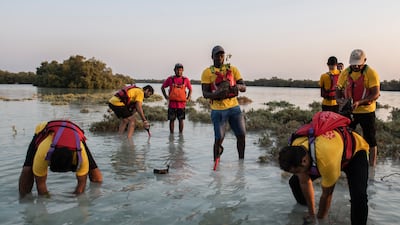
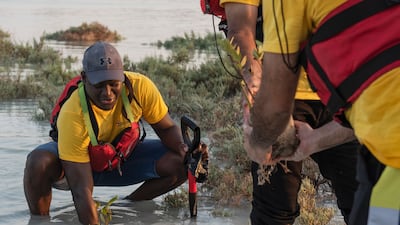
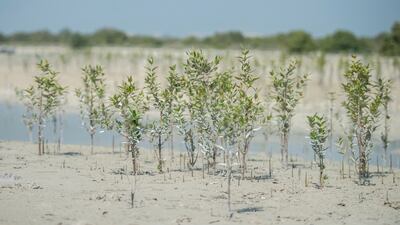
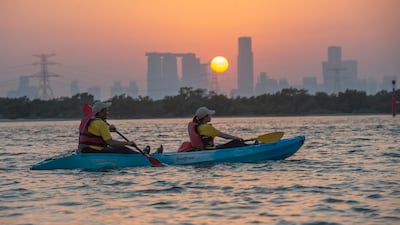
Prince William plants mangrove seedlings with children at Jubail Mangrove Park in Abu Dhabi. Victor Besa / The National


The UAE is committed to preserving its mangroves


  • English
  • Arabic

February 14, 2022

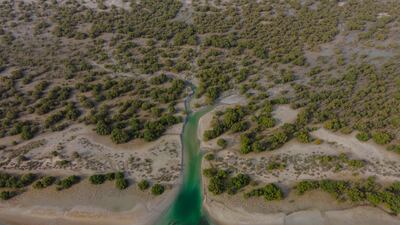
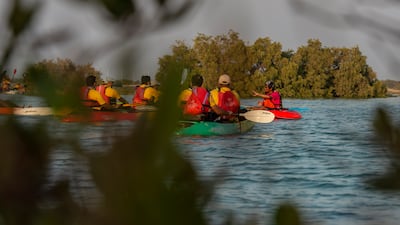
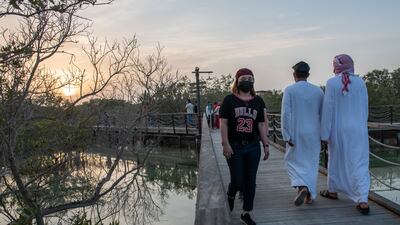
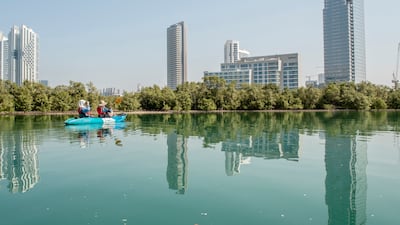
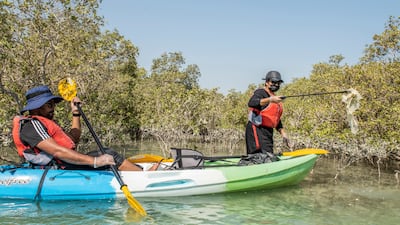
A little more than two years ago, when the Jubail Mangrove Park opened to the public in Abu Dhabi, visitors flocked to the island to soak in the environment. In being able to explore the park, with the intertidal trees on both sides of the winding two-kilometre boardwalk, visitors learnt how these trees provide an indispensable natural habitat for numerous marine species.

Last week, during Prince William's visit to the UAE, and due to the time he spent addressing key conservation issues, including notably, planting mangrove saplings, the critical importance of these trees and the support they lend to the marine ecosystem was once again highlighted. With Abu Dhabi launching an ambitious mangrove conservation project, people were reminded about the characteristic benefits of mangroves and why it is essential to take good care of them.

The UAE's vast nature conservation programmes have already been at work. Just last month, the UAE Cabinet agreed the country would join the Leaders' Pledge for Nature, an international effort to increase protection of the planet’s land and oceans.

Last week, Mariam Al Mheiri, Minister of Climate Change and Environment, spoke of the UAE's "marine wealth", emphasising the point that protecting marine resources and biodiversity are some of the key priorities of the UAE, where mangroves cover an estimated 150 square kilometres of the country's coastline. With such dedicated effort at conservation, it is every bit conceivable that the UAE will reach its stated goal of planting 100 million mangroves by 2030.

As in tropics and sub-tropical areas all over the world, in the UAE, too, mangroves protect the Emirates from rising sea levels and storms. Since they are found where sea meets land, mangroves can act as natural defences from waves and the wind. Peter Thomson, the UN's special envoy for oceans, wrote in a report on the state of the world's mangroves that they are especially useful in the world's goal to achieve net-zero carbon emissions by 2050, as they have the remarkable ability to sequester carbon at a rate four times that of terrestrial forests.

In a time when the news about climate change is cause for worry, there are aspects of mangrove regeneration that evoke a sense of optimism: in the past 20 years, across the world, mangrove forests have shifted from being one of the fastest-diminishing habitats on Earth to being among the best protected.

The hardiness and natural resilience of these trees, which have adapted to live in salty, tropical climes, and in stressful environments, are among their most prominent features. A report co-authored by The Nature Conservancy, a global environment organisation, showed that mangroves have been a crucial defence to mitigate natural disasters in the US state of Florida. The report also said that during Hurricane Irma in 2017 in the Eastern Caribbean, mangroves protected more than half a million people and prevented $1.5 billion in direct flood damages.

Over centuries, they have acted as a flood defence, fortified coastlines and provided immeasurable benefits to colonies of sea life across the world, species both small and large – molluscs, crabs, crustaceans, but even larger life, be it dugongs, porpoises, crocodiles and even tigers – in the Sundarbans, one of the world's largest continuous mangrove forests, shared by Bangladesh and India. In many countries, coastal communities and fishers depend on the healthy proliferation of mangroves.

Here, in the UAE, with so much awareness of their importance, the pride of place of these remarkable trees, and a mangrove park that is easily accessible, their value is apparent. The priority that is accorded to them at the highest levels indicates that the country is an example of what can be achieved when, at the heart of national efforts, is a commitment to being good stewards of its marine wealth and the natural world.

THE BIO

Favourite author - Paulo Coelho 

Favourite holiday destination - Cuba 

New York Times or Jordan Times? NYT is a school and JT was my practice field

Role model - My Grandfather 

Dream interviewee - Che Guevara

Global state-owned investor ranking by size

1.

United States

2.

China

3.

UAE

4.

Japan

5

Norway

6.

Canada

7.

Singapore

8.

Australia

9.

Saudi Arabia

10.

South Korea

The biog

Hometown: Cairo

Age: 37

Favourite TV series: The Handmaid’s Tale, Black Mirror

Favourite anime series: Death Note, One Piece and Hellsing

Favourite book: Designing Brand Identity, Fifth Edition

Dubai World Cup factbox

Most wins by a trainer: Godolphin’s Saeed bin Suroor(9)

Most wins by a jockey: Jerry Bailey(4)

Most wins by an owner: Godolphin(9)

Most wins by a horse: Godolphin’s Thunder Snow(2)

Heather, the Totality
Matthew Weiner,
Canongate 

Unresolved crisis

Russia and Ukraine have been locked in a bitter conflict since 2014, when Ukraine’s Kremlin-friendly president was ousted, Moscow annexed Crimea and then backed a separatist insurgency in the east.

Fighting between the Russia-backed rebels and Ukrainian forces has killed more than 14,000 people. In 2015, France and Germany helped broker a peace deal, known as the Minsk agreements, that ended large-scale hostilities but failed to bring a political settlement of the conflict.

The Kremlin has repeatedly accused Kiev of sabotaging the deal, and Ukrainian officials in recent weeks said that implementing it in full would hurt Ukraine.

UAE currency: the story behind the money in your pockets
Key features of new policy

Pupils to learn coding and other vocational skills from Grade 6

Exams to test critical thinking and application of knowledge

A new National Assessment Centre, PARAKH (Performance, Assessment, Review and Analysis for Holistic Development) will form the standard for schools

Schools to implement online system to encouraging transparency and accountability

Mercer, the investment consulting arm of US services company Marsh & McLennan, expects its wealth division to at least double its assets under management (AUM) in the Middle East as wealth in the region continues to grow despite economic headwinds, a company official said.

Mercer Wealth, which globally has $160 billion in AUM, plans to boost its AUM in the region to $2-$3bn in the next 2-3 years from the present $1bn, said Yasir AbuShaban, a Dubai-based principal with Mercer Wealth.

Within the next two to three years, we are looking at reaching $2 to $3 billion as a conservative estimate and we do see an opportunity to do so,” said Mr AbuShaban.

Mercer does not directly make investments, but allocates clients’ money they have discretion to, to professional asset managers. They also provide advice to clients.

“We have buying power. We can negotiate on their (client’s) behalf with asset managers to provide them lower fees than they otherwise would have to get on their own,” he added.

Mercer Wealth’s clients include sovereign wealth funds, family offices, and insurance companies among others.

From its office in Dubai, Mercer also looks after Africa, India and Turkey, where they also see opportunity for growth.

Wealth creation in Middle East and Africa (MEA) grew 8.5 per cent to $8.1 trillion last year from $7.5tn in 2015, higher than last year’s global average of 6 per cent and the second-highest growth in a region after Asia-Pacific which grew 9.9 per cent, according to consultancy Boston Consulting Group (BCG). In the region, where wealth grew just 1.9 per cent in 2015 compared with 2014, a pickup in oil prices has helped in wealth generation.

BCG is forecasting MEA wealth will rise to $12tn by 2021, growing at an annual average of 8 per cent.

Drivers of wealth generation in the region will be split evenly between new wealth creation and growth of performance of existing assets, according to BCG.

Another general trend in the region is clients’ looking for a comprehensive approach to investing, according to Mr AbuShaban.

“Institutional investors or some of the families are seeing a slowdown in the available capital they have to invest and in that sense they are looking at optimizing the way they manage their portfolios and making sure they are not investing haphazardly and different parts of their investment are working together,” said Mr AbuShaban.

Some clients also have a higher appetite for risk, given the low interest-rate environment that does not provide enough yield for some institutional investors. These clients are keen to invest in illiquid assets, such as private equity and infrastructure.

“What we have seen is a desire for higher returns in what has been a low-return environment specifically in various fixed income or bonds,” he said.

“In this environment, we have seen a de facto increase in the risk that clients are taking in things like illiquid investments, private equity investments, infrastructure and private debt, those kind of investments were higher illiquidity results in incrementally higher returns.”

The Abu Dhabi Investment Authority, one of the largest sovereign wealth funds, said in its 2016 report that has gradually increased its exposure in direct private equity and private credit transactions, mainly in Asian markets and especially in China and India. The authority’s private equity department focused on structured equities owing to “their defensive characteristics.”

The bio

Favourite book: Peter Rabbit. I used to read it to my three children and still read it myself. If I am feeling down it brings back good memories.

Best thing about your job: Getting to help people. My mum always told me never to pass up an opportunity to do a good deed.

Best part of life in the UAE: The weather. The constant sunshine is amazing and there is always something to do, you have so many options when it comes to how to spend your day.

Favourite holiday destination: Malaysia. I went there for my honeymoon and ended up volunteering to teach local children for a few hours each day. It is such a special place and I plan to retire there one day.

Uefa Nations League: How it works

The Uefa Nations League, introduced last year, has reached its final stage, to be played over five days in northern Portugal. The format of its closing tournament is compact, spread over two semi-finals, with the first, Portugal versus Switzerland in Porto on Wednesday evening, and the second, England against the Netherlands, in Guimaraes, on Thursday.

The winners of each semi will then meet at Porto’s Dragao stadium on Sunday, with the losing semi-finalists contesting a third-place play-off in Guimaraes earlier that day.

Qualifying for the final stage was via League A of the inaugural Nations League, in which the top 12 European countries according to Uefa's co-efficient seeding system were divided into four groups, the teams playing each other twice between September and November. Portugal, who finished above Italy and Poland, successfully bid to host the finals.

PRO BASH

Thursday’s fixtures

6pm: Hyderabad Nawabs v Pakhtoon Warriors

10pm: Lahore Sikandars v Pakhtoon Blasters

Teams

Chennai Knights, Lahore Sikandars, Pakhtoon Blasters, Abu Dhabi Stars, Abu Dhabi Dragons, Pakhtoon Warriors and Hyderabad Nawabs.

Squad rules

All teams consist of 15-player squads that include those contracted in the diamond (3), platinum (2) and gold (2) categories, plus eight free to sign team members.

Tournament rules

The matches are of 25 over-a-side with an 8-over power play in which only two fielders allowed outside the 30-yard circle. Teams play in a single round robin league followed by the semi-finals and final. The league toppers will feature in the semi-final eliminator.

Fresh faces in UAE side

Khalifa Mubarak (24) An accomplished centre-back, the Al Nasr defender’s progress has been hampered in the past by injury. With not many options in central defence, he would bolster what can be a problem area.

Ali Salmeen (22) Has been superb at the heart of Al Wasl’s midfield these past two seasons, with the Dubai club flourishing under manager Rodolfo Arrubarrena. Would add workrate and composure to the centre of the park.

Mohammed Jamal (23) Enjoyed a stellar 2016/17 Arabian Gulf League campaign, proving integral to Al Jazira as the capital club sealed the championship for only a second time. A tenacious and disciplined central midfielder.

Khalfan Mubarak (22) One of the most exciting players in the UAE, the Al Jazira playmaker has been likened in style to Omar Abdulrahman. Has minimal international experience already, but there should be much more to come.

Jassim Yaqoub (20) Another incredibly exciting prospect, the Al Nasr winger is becoming a regular contributor at club level. Pacey, direct and with an eye for goal, he would provide the team’s attack an extra dimension.

A Long Way Home by Peter Carey
Faber & Faber

The President's Cake

Director: Hasan Hadi

Starring: Baneen Ahmad Nayyef, Waheed Thabet Khreibat, Sajad Mohamad Qasem 

Rating: 4/5

Updated: February 14, 2022, 2:00 AM