Saudi Arabia welcomed in the New Year with rare snow. Photo: @Sebusher via Twitter


Where progress on Saudi women's rights is heading in 2022


  • English
  • Arabic

January 13, 2022

In 2018, Saudi Crown Prince Mohammed bin Salman was asked in an interview with US news network CBS if women were equal to men. His answer was unambiguous, and rightly so: “Absolutely.”

He was asked this question because Saudi Arabia had long courted controversy regarding the public role of women in its society. Since the interview, he has put pen to paper. A series of major domestic reforms to strengthen women’s rights have been unveiled in the four years since, a key part of a wider programme to open up Saudi society. In 2018, the ban on Saudi women driving was lifted. This week, women were allowed to become taxi drivers.

Reforms appear to be working across a number of metrics. A crucial one is the employment rate of women, which rose from 66 per cent in 2016 to 75 per cent in 2020.

These measures are significant, but their implementation is even more so in light of the Covid-19 pandemic, the consequences of which the world will live with for years to come.

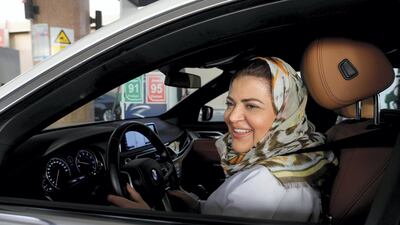
  • Dr Samira Al Ghamdi, a psychologist, drives to work in Jeddah, Saudi Arabia. Reuters
    Dr Samira Al Ghamdi, a psychologist, drives to work in Jeddah, Saudi Arabia. Reuters
  • Ammal Farahat at work as a captain with ride-hailing app Careem. AP
    Ammal Farahat at work as a captain with ride-hailing app Careem. AP
  • Majdooleen was among the first Saudi women to drive when the three-decade ban on female motorists was lifted. She is shown refuelling her car on her way to work in Riyadh. Reuters
    Majdooleen was among the first Saudi women to drive when the three-decade ban on female motorists was lifted. She is shown refuelling her car on her way to work in Riyadh. Reuters
  • Amira, who is Saudi and works for Aramco, refuels her car on her way to the office in Dammam, Saudi Arabia. Reuters
    Amira, who is Saudi and works for Aramco, refuels her car on her way to the office in Dammam, Saudi Arabia. Reuters
  • Nada Edlibi holds her Saudi Arabian driving licence on the day, in 2018, when she was legally permitted to drive in the country. Getty
    Nada Edlibi holds her Saudi Arabian driving licence on the day, in 2018, when she was legally permitted to drive in the country. Getty
  • Saudi Arabian comedienne Amy Roko, as featured in fashion book ‘Under the Abaya’. Lina Mo
    Saudi Arabian comedienne Amy Roko, as featured in fashion book ‘Under the Abaya’. Lina Mo
  • An actress, presenter and social media influencer, Khairiah Abulaban is passionate about acting and having a positive effect on women in her region. Ghaly Wedinly
    An actress, presenter and social media influencer, Khairiah Abulaban is passionate about acting and having a positive effect on women in her region. Ghaly Wedinly
  • Huda Al Badri, 30, poses behind a steering wheel in Riyadh in 2018, when women were permitted to drive in Saudi Arabia for the first time in decades. EPA
    Huda Al Badri, 30, poses behind a steering wheel in Riyadh in 2018, when women were permitted to drive in Saudi Arabia for the first time in decades. EPA
  • An advertising billboard for Japanese carmaker Nissan shows a woman about to get into a vehicle. It was photographed on the day women were legally allowed to drive in Saudi Arabia. Getty
    An advertising billboard for Japanese carmaker Nissan shows a woman about to get into a vehicle. It was photographed on the day women were legally allowed to drive in Saudi Arabia. Getty
  • This embroidered jacket by Saudi label Hindamme celebrates women being allowed to drive in the kingdom. It is now in the V&A museum in London. Hindamme
    This embroidered jacket by Saudi label Hindamme celebrates women being allowed to drive in the kingdom. It is now in the V&A museum in London. Hindamme
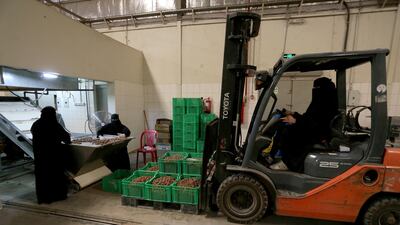
  • A Saudi woman drives a forklift to transport dates at a factory in Al Ahsa, Saudi Arabia, on September 10, 2020. Reuters
    A Saudi woman drives a forklift to transport dates at a factory in Al Ahsa, Saudi Arabia, on September 10, 2020. Reuters

As with any crisis, the pandemic has hit certain groups in society harder than others. The largest group to be affected disproportionately is women. McKinsey, a global consultancy firm, estimates that, worldwide, their jobs are 1.8 times more vulnerable to the pandemic than men’s, largely because women are taking on an unequal share of unpaid care, whether it be of children out of education or sick relatives.

It is even a grave threat to their safety. UN Women lists cramped conditions, isolation with abusers and empty streets, all a result of the pandemic, as factors that have exacerbated gender-based violence in the past two years.

The Middle East is no different. Indeed, it is perhaps worse, given the already-disadvantaged position of women in some of its countries. Forty per cent experience some form of violence during their lifetime, according to UN Women, which also suggests that the real rates might be significantly higher.

In a country as large as Saudi Arabia, reform in favour of women’s rights will make a big difference. Last January, it amended anti-harassment laws to include provisions for publishing the names of the offenders. This week, a court did just that, ruling to name and shame a man convicted of verbally abusing a woman. The man, Yasser Mussalam Al Arwe, will serve eight months in prison. His conviction and sentencing will illustrate to women that their concerns are being heard, while also showing men that the government is serious about clamping down on such behaviour.

These measures, from allowing taxi driving to enforcing anti-harassment laws, have been implemented in a matter of days since the beginning of the New Year by the government of Saudi Arabia. Its society is progressing towards both more opportunities for women but, also changes to its economy that can benefit all members of society.


Mercer, the investment consulting arm of US services company Marsh & McLennan, expects its wealth division to at least double its assets under management (AUM) in the Middle East as wealth in the region continues to grow despite economic headwinds, a company official said.

Mercer Wealth, which globally has $160 billion in AUM, plans to boost its AUM in the region to $2-$3bn in the next 2-3 years from the present $1bn, said Yasir AbuShaban, a Dubai-based principal with Mercer Wealth.

Within the next two to three years, we are looking at reaching $2 to $3 billion as a conservative estimate and we do see an opportunity to do so,” said Mr AbuShaban.

Mercer does not directly make investments, but allocates clients’ money they have discretion to, to professional asset managers. They also provide advice to clients.

“We have buying power. We can negotiate on their (client’s) behalf with asset managers to provide them lower fees than they otherwise would have to get on their own,” he added.

Mercer Wealth’s clients include sovereign wealth funds, family offices, and insurance companies among others.

From its office in Dubai, Mercer also looks after Africa, India and Turkey, where they also see opportunity for growth.

Wealth creation in Middle East and Africa (MEA) grew 8.5 per cent to $8.1 trillion last year from $7.5tn in 2015, higher than last year’s global average of 6 per cent and the second-highest growth in a region after Asia-Pacific which grew 9.9 per cent, according to consultancy Boston Consulting Group (BCG). In the region, where wealth grew just 1.9 per cent in 2015 compared with 2014, a pickup in oil prices has helped in wealth generation.

BCG is forecasting MEA wealth will rise to $12tn by 2021, growing at an annual average of 8 per cent.

Drivers of wealth generation in the region will be split evenly between new wealth creation and growth of performance of existing assets, according to BCG.

Another general trend in the region is clients’ looking for a comprehensive approach to investing, according to Mr AbuShaban.

“Institutional investors or some of the families are seeing a slowdown in the available capital they have to invest and in that sense they are looking at optimizing the way they manage their portfolios and making sure they are not investing haphazardly and different parts of their investment are working together,” said Mr AbuShaban.

Some clients also have a higher appetite for risk, given the low interest-rate environment that does not provide enough yield for some institutional investors. These clients are keen to invest in illiquid assets, such as private equity and infrastructure.

“What we have seen is a desire for higher returns in what has been a low-return environment specifically in various fixed income or bonds,” he said.

“In this environment, we have seen a de facto increase in the risk that clients are taking in things like illiquid investments, private equity investments, infrastructure and private debt, those kind of investments were higher illiquidity results in incrementally higher returns.”

The Abu Dhabi Investment Authority, one of the largest sovereign wealth funds, said in its 2016 report that has gradually increased its exposure in direct private equity and private credit transactions, mainly in Asian markets and especially in China and India. The authority’s private equity department focused on structured equities owing to “their defensive characteristics.”

TOUR RESULTS AND FIXTURES

June 3: NZ Provincial Barbarians 7 Lions 13
June 7: Blues 22 Lions 16
June 10: Crusaders 3 Lions 12
June 13: Highlanders 23 Lions 22
June 17: Maori All Blacks 10 Lions 32
June 20: Chiefs 6 Lions 34
June 24: New Zealand 30 Lions 15 (First Test)
June 27: Hurricanes 31 Lions 31
July 1: New Zealand 21 Lions 24 (Second Test)
July 8: New Zealand v Lions (Third Test) - kick-off 11.30am (UAE)

Updated: January 13, 2022, 3:00 AM