Insight and opinion from The National’s editorial leadership
October 13, 2021
Understanding a problem in as much detail as possible is key to solving it. The ASDA’A BCW Arab Youth Survey does just that on one of the most important issues the Middle East faces in the 21st century: giving its young people hope and prosperity. Released yesterday, this year's results are remarkable.
They matter so much because the Arab world is a very young place. Sixty per cent of its inhabitants are under 25. For the most part, young people have faced incredible challenges. A decade after the Arab uprisings, driven in large part by youth dissatisfaction, Covid-19 poses the biggest threat to regional prosperity in generations.
So far it has killed almost 200,000 people in the Middle East and North Africa, costing its economy almost $230 billion. Already in a precarious situation, the crisis has disproportionately affected the prosperity of young Arabs. One in three lost a job, or had a family member lose one due to Covid-19. Unsurprisingly then, almost 90 per cent of those surveyed gave the pandemic as a key concern for the future.
But the survey measures more than worries, and that is why 2021's results have been so interesting; the wider situation appears to be more optimistic than expected, and six in 10 young Arabs believe their best days are ahead.
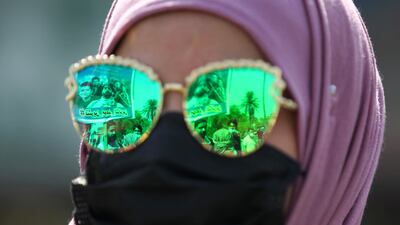
Israa, a graduate engineer, protests about a lack of jobs in Baghdad. Reuters
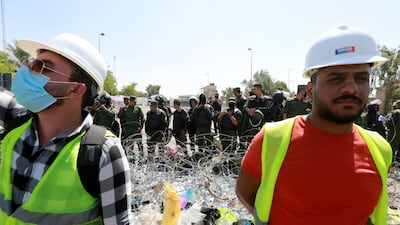
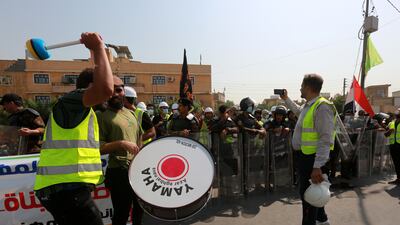
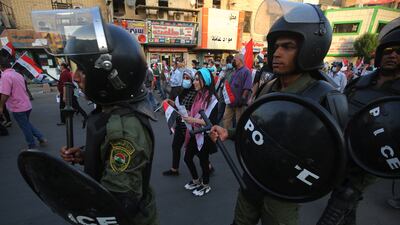
Iraqi anti-riot police take up positions as Jobless graduates stage a protest near the green zone in Baghdad. EPA
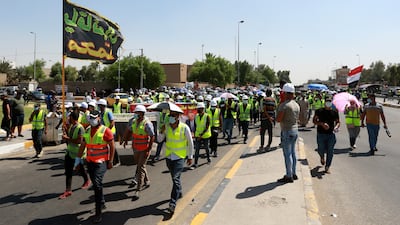
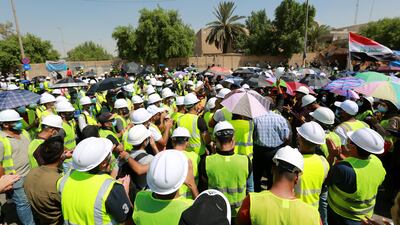
Jobless graduates wear hard hats and fluorescent vests during the protest. EPA
The heavily fortified green zone houses the Iraqi government offices. EPA
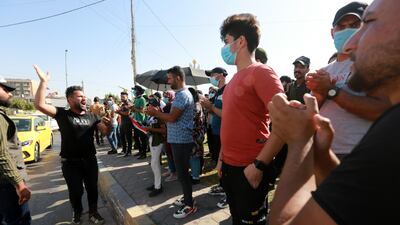
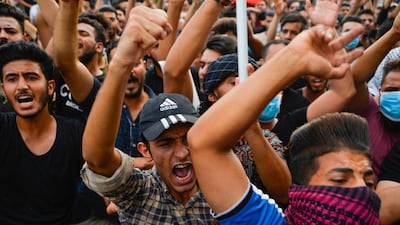
Unemployed Iraqi graduates chant slogans during the demonstration. EPA
The demo takes place to the beat of a drum as riot police take up positions nearby. EPA
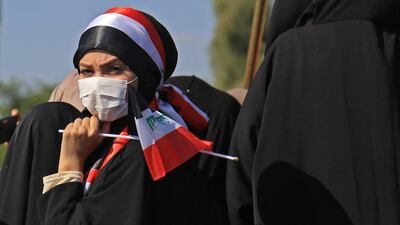
Wearing masks and holding umbrellas, graduates gather during the protest. Reuters
Protesters sit in front of the Ministry of Electricity building in Baghdad. Reuters
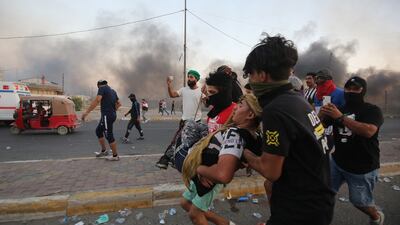
Violence flares during the demonstration against state corruption, failing public services and unemployment. AFP
Iraqis take part in anti-government protests in Karbala. AFP
Iraqi security forces in Baghdad's Fardous Square, where demonstrations took place. AFP
An Iraqi protester attends a demonstration in Tahrir Square. AFP
Demonstrators protest against state corruption, failing public services and unemployment in the central Iraqi shrine city of Najaf. AFP
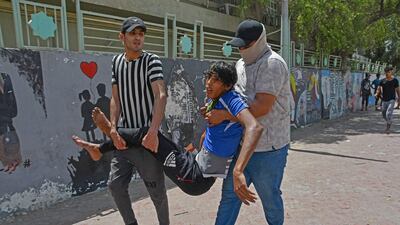
Iraqi protesters carry an injured fellow demonstrator amid clashes with security forces in Nasiriyah. AFP
Such optimism about the future is highest in the Gulf. Kuwait takes the top spot, with 92 per cent of young people feeling this way. Second is the UAE, at 90 per cent. More surprising is that it has risen in many of the region's more unstable countries. In Syria, last year's survey registered just 12 per cent as optimistic about the future. This time round, the result is 36 per cent. Other increases have been recorded in Lebanon, Palestine and Yemen, among others. While many are still too low to celebrate, this uniform positive trajectory is remarkable.
But there is still much to overcome in day-to-day life. More than two thirds of participants are worried about personal debt. This year, far more Arab women believe that male counterparts have greater rights. And almost 90 per cent put quality of education as a key concern.
After a year of huge disruption it is no surprise that young people's material issues have compounded. What is surprising is that the drive and spirit needed to keep going in the face of this hardship, and ultimately overcome it, is on the rise. Much of this energy will be funnelled into the Emirates. For the 10th year running, participants said that the UAE is the country they would most like to live in globally and have their own country emulate, ahead of the US and Canada. Experts point to the country's burgeoning economy, particularly in terms of trade, transport, tourism and tech.
The Arab Youth Survey has been going since 2008. So much has changed for the region since then. But what remains stubbornly backed up data is the resilience of one of the region's most fragile demographics. Covid-19 might have taken jobs, money and sometimes even their loved ones, but it has not taken young people's hope.

The burning issue
The internal combustion engine is facing a watershed moment – major manufacturer Volvo is to stop producing petroleum-powered vehicles by 2021 and countries in Europe, including the UK, have vowed to ban their sale before 2040. The National takes a look at the story of one of the most successful technologies of the last 100 years and how it has impacted life in the UAE.
1. Domestic VAT refund amendments: request your refund within five years
If a business does not apply for the refund on time, they lose their credit.
2. E-invoicing in the UAE
Businesses should continue preparing for the implementation of e-invoicing in the UAE, with 2026 a preparation and transition period ahead of phased mandatory adoption.
3. More tax audits
Tax authorities are increasingly using data already available across multiple filings to identify audit risks.
4. More beneficial VAT and excise tax penalty regime
Tax disputes are expected to become more frequent and more structured, with clearer administrative objection and appeal processes. The UAE has adopted a new penalty regime for VAT and excise disputes, which now mirrors the penalty regime for corporate tax.
5. Greater emphasis on statutory audit
There is a greater need for the accuracy of financial statements. The International Financial Reporting Standards standards need to be strictly adhered to and, as a result, the quality of the audits will need to increase.
6. Further transfer pricing enforcement
Transfer pricing enforcement, which refers to the practice of establishing prices for internal transactions between related entities, is expected to broaden in scope. The UAE will shortly open the possibility to negotiate advance pricing agreements, or essentially rulings for transfer pricing purposes.
7. Limited time periods for audits
Recent amendments also introduce a default five-year limitation period for tax audits and assessments, subject to specific statutory exceptions. While the standard audit and assessment period is five years, this may be extended to up to 15 years in cases involving fraud or tax evasion.
8. Pillar 2 implementation
Many multinational groups will begin to feel the practical effect of the Domestic Minimum Top-Up Tax (DMTT), the UAE's implementation of the OECD’s global minimum tax under Pillar 2. While the rules apply for financial years starting on or after January 1, 2025, it is 2026 that marks the transition to an operational phase.
9. Reduced compliance obligations for imported goods and services
Businesses that apply the reverse-charge mechanism for VAT purposes in the UAE may benefit from reduced compliance obligations.
10. Substance and CbC reporting focus
Tax authorities are expected to continue strengthening the enforcement of economic substance and Country-by-Country (CbC) reporting frameworks. In the UAE, these regimes are increasingly being used as risk-assessment tools, providing tax authorities with a comprehensive view of multinational groups’ global footprints and enabling them to assess whether profits are aligned with real economic activity.
Contributed by Thomas Vanhee and Hend Rashwan, Aurifer
Founders: Mike Dawson, Varuna Singh, and Benita Rowe
Based: Dubai
Sector: Education technology
Size: Five employees
Investment: $100,000 from the ExpoLive Innovation Grant programme in 2018 and an initial $30,000 pre-seed investment from the Turn8 Accelerator in 2014. Most of the projects are government funded.
Partners/incubators: Turn8 Accelerator; In5 Innovation Centre; Expo Live Innovation Impact Grant Programme; Dubai Future Accelerators; FHI 360; VSO and Consult and Coach for a Cause (C3)
Milestones on the road to union
1970
October 26: Bahrain withdraws from a proposal to create a federation of nine with the seven Trucial States and Qatar.
December: Ahmed Al Suwaidi visits New York to discuss potential UN membership.
1971
March 1: Alex Douglas Hume, Conservative foreign secretary confirms that Britain will leave the Gulf and “strongly supports” the creation of a Union of Arab Emirates.
July 12: Historic meeting at which Sheikh Zayed and Sheikh Rashid make a binding agreement to create what will become the UAE.
July 18: It is announced that the UAE will be formed from six emirates, with a proposed constitution signed. RAK is not yet part of the agreement.
August 6: The fifth anniversary of Sheikh Zayed becoming Ruler of Abu Dhabi, with official celebrations deferred until later in the year.
August 15: Bahrain becomes independent.
September 3: Qatar becomes independent.
November 23-25: Meeting with Sheikh Zayed and Sheikh Rashid and senior British officials to fix December 2 as date of creation of the UAE.
November 29: At 5.30pm Iranian forces seize the Greater and Lesser Tunbs by force.
November 30: Despite a power sharing agreement, Tehran takes full control of Abu Musa.
November 31: UK officials visit all six participating Emirates to formally end the Trucial States treaties
December 2: 11am, Dubai. New Supreme Council formally elects Sheikh Zayed as President. Treaty of Friendship signed with the UK. 11.30am. Flag raising ceremony at Union House and Al Manhal Palace in Abu Dhabi witnessed by Sheikh Khalifa, then Crown Prince of Abu Dhabi.
December 6: Arab League formally admits the UAE. The first British Ambassador presents his credentials to Sheikh Zayed.
2002: "Hezbollah supporters feared becoming a target of security services because of the effects of [9/11] ... discussions on Hezbollah policy moved from mosques into smaller circles in private homes." Supporters in Germany: 800
2013: "Financial and logistical support from Germany for Hezbollah in Lebanon supports the armed struggle against Israel ... Hezbollah supporters in Germany hold back from actions that would gain publicity." Supporters in Germany: 950
2023: "It must be reckoned with that Hezbollah will continue to plan terrorist actions outside the Middle East against Israel or Israeli interests." Supporters in Germany: 1,250
Source: Federal Office for the Protection of the Constitution
Key facilities
Olympic-size swimming pool with a split bulkhead for multi-use configurations, including water polo and 50m/25m training lanes
Premier League-standard football pitch
400m Olympic running track
NBA-spec basketball court with auditorium
600-seat auditorium
Spaces for historical and cultural exploration
An elevated football field that doubles as a helipad
Specialist robotics and science laboratories
AR and VR-enabled learning centres
Disruption Lab and Research Centre for developing entrepreneurial skills
Position: legal consultant with Al Rowaad Advocates and Legal Consultants.
Who has been sanctioned?
Daniella Weiss and Nachala Described as 'the grandmother of the settler movement', she has encouraged the expansion of settlements for decades. The 79 year old leads radical settler movement Nachala, whose aim is for Israel to annex Gaza and the occupied West Bank, where it helps settlers built outposts.
Harel Libi & Libi Construction and Infrastructure Libi has been involved in threatening and perpetuating acts of aggression and violence against Palestinians. His firm has provided logistical and financial support for the establishment of illegal outposts.
Zohar Sabah Runs a settler outpost named Zohar’s Farm and has previously faced charges of violence against Palestinians. He was indicted by Israel’s State Attorney’s Office in September for allegedly participating in a violent attack against Palestinians and activists in the West Bank village of Muarrajat.
Coco’s Farm and Neria’s Farm These are illegal outposts in the West Bank, which are at the vanguard of the settler movement. According to the UK, they are associated with people who have been involved in enabling, inciting, promoting or providing support for activities that amount to “serious abuse”.