Insight and opinion from The National’s editorial leadership
October 11, 2021
In 1881, Thomas Edison constructed the first central power plant, in New York, and it paved the way for the development of the modern world. Within 30 years, a commercial plant opened in Lebanon, to power Beirut’s tramways but also to “produce electricity to light up Beirut and act as a prime mover for industrial employment in the city”.
Now, more than a century later, Beirut finds itself often shrouded in darkness, and industrial jobs, or jobs in any other sector, for that matter, are increasingly scarce.
Lebanon’s two largest power plants shut down production on Saturday, after running out of fuel. The loss of central power led to nationwide blackouts, sparking fears that Lebanon’s ongoing severe economic crisis – one of the worst in modern human history – is set to deepen.
Some power was restored on Sunday, as Electricite du Liban (EDL), the state utility, secured last-minute assistance from the national army, which is providing oil from its own reserves. But those will not last forever.
This round of blackouts has not come from out of the blue. For months, people across Lebanon have had to make do with a few hours of government-provided power a day. Speaking to The National, a senior EDL employee summed up the situation: "I am shocked that people are shocked.”
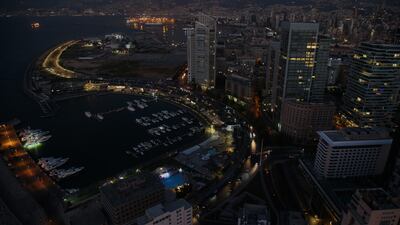
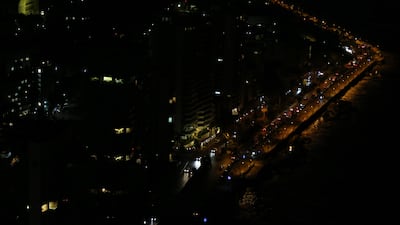
A view of Lebanon's capital, Beirut, with the lights on only in some buildings. Lebanese rely on highly polluting diesel generators run by private neighbourhood operators to make up for shortfalls in electricity supply from the state utility. EPA
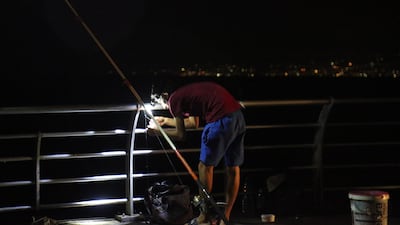
A fisherman uses a headlamp at the seaside corniche in Beirut, Lebanon. EPA
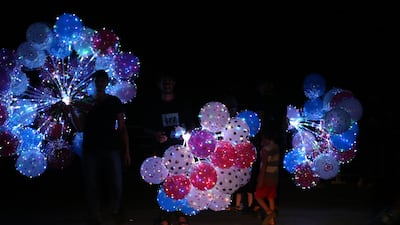
A vendor sells LED balloons in full darkness at the corniche in Beirut. EPA
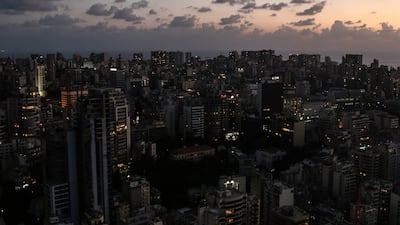
The near collapse of the national grid has increased the duration of power cuts across Lebanon. EPA
Residents of Beirut are experiencing power cuts of up to 20 hours a day. EPA
For residents trying to stabilise their lives after months of economic turmoil, a lack of power puts them into an impossible situation. And for the most vulnerable, it can be a life-threatening one. Until now, even the sickest hospital patients were having to source medication on their own due to shortages, and the facilities treating them already had to contend with unreliable power supply. In August, then head of Rafik Hariri University Hospital and surgeon, Firass Abiad, who is now the country's Minister of Public Health, told The National that "a hospital without electricity is like a car without petrol". Now, medical facilities across the country are at risk of becoming little more than field stations in Lebanon's wider battle to stay afloat.
Economic inequality, and all of the social issues that come with it, is also set to worsen. Many Lebanese have become increasingly reliant on private diesel generators – a short-term, highly polluting fix that has entrenched a black market for fuel that will now be difficult to eradicate. Shortages in global supply chains are only pushing prices up further. For the 80 per cent of Lebanese who now live in poverty, there is little to do but cling to hope.
Short of a complete overhaul of Lebanon’s dysfunctional political system, it is difficult to see how the country can emerge from its state of crisis. Should fuel be pumped into the country from abroad for the sake of ordinary residents, even if it will line the pockets of corrupt elites? Or, should the international community withhold assistance as a means to rid the country of the political rot that perpetually blocks progress?
Lebanon’s allies in the West and the Arab world are exasperated – at a loss for what to do. A popular protest movement calling for reform has achieved little. Last month, the European Parliament passed a resolution calling Lebanon’s economic crisis what it is: “a man-made disaster”.
It is unclear how Lebanon will navigate itself out of the darkness that has taken hold over the country. But it is clear that responsibility for this desperate situation lies with a small circle in Lebanon’s political class, particularly Hezbollah and organised criminal groups. They are the only ones left in the country with any power.

MATCH INFO
Manchester City 1 Chelsea 0 De Bruyne (70')
Man of the Match: Kevin de Bruyne (Manchester City)
If you’re going to go grey, a great style, well-cared for hair (in a sleek, classy style, like a bob), and a young spirit and attitude go a long way, says Maria Dowling, founder of the Maria Dowling Salon in Dubai.
It’s easier to go grey from a lighter colour, so you may want to do that first. And this is the time to try a shorter style, she advises. Then a stylist can introduce highlights, start lightening up the roots, and let it fade out. Once it’s entirely grey, a purple shampoo will prevent yellowing.
“Get professional help – there’s no other way to go around it,” she says. “And don’t just let it grow out because that looks really bad. Put effort into it: properly condition, straighten, get regular trims, make sure it’s glossy.”
The President's Cake
Director: Hasan Hadi
Starring: Baneen Ahmad Nayyef, Waheed Thabet Khreibat, Sajad Mohamad Qasem
Rating: 4/5
Islamophobia definition
A widely accepted definition was made by the All Party Parliamentary Group on British Muslims in 2019: “Islamophobia is rooted in racism and is a type of racism that targets expressions of Muslimness or perceived Muslimness.” It further defines it as “inciting hatred or violence against Muslims”.
Engine: Long-range single or dual motor with 200kW or 400kW battery
Power: 268bhp / 536bhp
Torque: 343Nm / 686Nm
Transmission: Single-speed automatic
Max touring range: 620km / 590km
Price: From Dh250,000 (estimated)
On sale: Later this year
Our legal columnist
Name: Yousef Al Bahar
Advocate at Al Bahar & Associate Advocates and Legal Consultants, established in 1994
Education: Mr Al Bahar was born in 1979 and graduated in 2008 from the Judicial Institute. He took after his father, who was one of the first Emirati lawyers
League D:
Azerbaijan, Macedonia, Belarus, Georgia, Armenia, Latvia, Faroe Islands, Luxembourg, Kazakhstan, Moldova, Liechtenstein, Malta, Andorra, Kosovo, San Marino, Gibraltar
Global Fungi Facts
• Scientists estimate there could be as many as 3 million fungal species globally • Only about 160,000 have been officially described leaving around 90% undiscovered • Fungi account for roughly 90% of Earth's unknown biodiversity • Forest fungi help tackle climate change, absorbing up to 36% of global fossil fuel emissions annually and storing around 5 billion tonnes of carbon in the planet's topsoil
When: The one-off Test starts on Friday, May 11 What time: Each day’s play is scheduled to start at 2pm UAE time. TV: The match will be broadcast on OSN Sports Cricket HD. Subscribers to the channel can also stream the action live on OSN Play.
Have an up-to-date, professional LinkedIn profile. If you don’t have a LinkedIn account, set one up today. Avoid poor-quality profile pictures with distracting backgrounds. Include a professional summary and begin to grow your network.
Keep track of the job trends in your sector through the news. Apply for job alerts at your dream organisations and the types of jobs you want – LinkedIn uses AI to share similar relevant jobs based on your selections.
Double check that you’ve highlighted relevant skills on your resume and LinkedIn profile.
For most entry-level jobs, your resume will first be filtered by an applicant tracking system for keywords. Look closely at the description of the job you are applying for and mirror the language as much as possible (while being honest and accurate about your skills and experience).
Keep your CV professional and in a simple format – make sure you tailor your cover letter and application to the company and role.
Go online and look for details on job specifications for your target position. Make a list of skills required and set yourself some learning goals to tick off all the necessary skills one by one.
Don’t be afraid to reach outside your immediate friends and family to other acquaintances and let them know you are looking for new opportunities.
Make sure you’ve set your LinkedIn profile to signal that you are “open to opportunities”. Also be sure to use LinkedIn to search for people who are still actively hiring by searching for those that have the headline “I’m hiring” or “We’re hiring” in their profile.
Prepare for online interviews using mock interview tools. Even before landing interviews, it can be useful to start practising.
Be professional and patient. Always be professional with whoever you are interacting with throughout your search process, this will be remembered. You need to be patient, dedicated and not give up on your search. Candidates need to make sure they are following up appropriately for roles they have applied.
Arda Atalay, head of Mena private sector at LinkedIn Talent Solutions, Rudy Bier, managing partner of Kinetic Business Solutions and Ben Kinerman Daltrey, co-founder of KinFitz