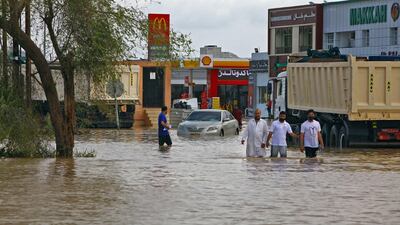
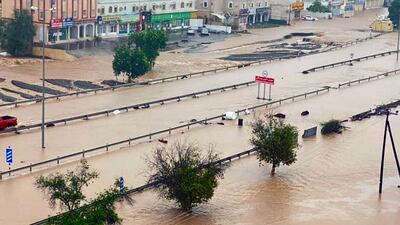
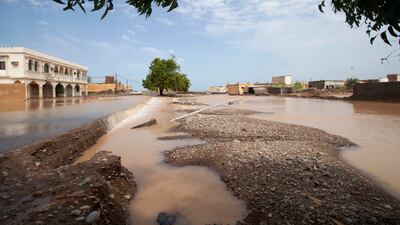
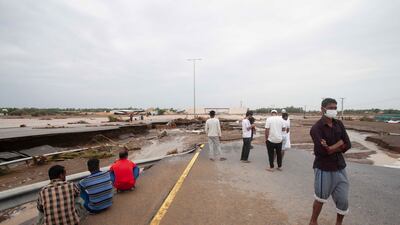
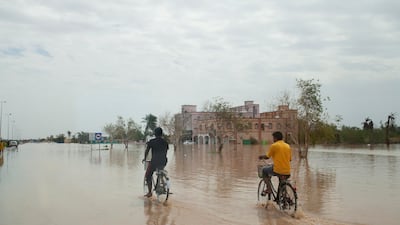
People ride bicycle at the flooded streets after Tropical Storm Shaheen hits the Welayat Al khaboora of capital Muscat in Oman, 04 October 2021. Shaheen a day earlier packed wind speeds of up to 116 kilometers per hour and is expected to strengthen into a category 1 tropical cyclone, authorities said. At least ten people have died due to flooding and another person was missing. EPA / HAMID ALQASIMI
People ride bicycle at the flooded streets after Tropical Storm Shaheen hits the Welayat Al khaboora of capital Muscat in Oman, 04 October 2021. Shaheen a day earlier packed wind speeds of up to 116 k
Insight and opinion from The National’s editorial leadership
October 06, 2021
Tropical storms are such a rare occurrence in the Gulf of Oman that until this week, the last one to make landfall there was recorded more than 130 years ago. While the kind of low-pressure weather systems that tend to breed cyclones are a common occurrence in the Indian Ocean and Arabian Sea, rarely do they venture very far north. But Cyclone Shaheen, which developed out of a weather system in the Bay of Bengal, arrived on the northern coast of Oman on Sunday, creating havoc of a kind unseen in years. Solidarity with Oman during this time is felt throughout the UAE.
Recovery is now underway, mostly in the worst-affected Batinah region, after the storm brought on heavy rain and winds of up to 120 kilometres an hour. It killed at least 11 people and forced more than 5,000 into temporary accommodation. The clean-up operation may cost more than $100m. Iranian rescuers have also retrieved the body of one of five fishermen who went missing in the waters surrounding the country’s border with Pakistan.
The approach of cyclone Shaheen put the UAE on high alert this week. Warning messages were broadcast in 19 languages, part of a strategy that involved more than 100 local and national entities. In Al Ain, residents were warned that they may have to work from home and schools briefly switched to distance learning, as part of precautionary measures. In the Northern Emirates, public gatherings on beaches were restricted. A broad social media campaign tried to reach as many residents as possible, reminding them of the danger that even slight rain poses; in downpours, police warn that accidents on the UAE's roads typically happen every two minutes.
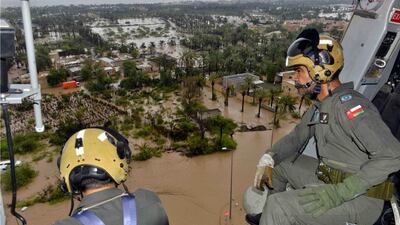
An Oman Air Force helicopter flies over Khaburah in Al Batinah district to assess damage caused by Cyclone Shaheen in October 2021. The government later said $500 million was required to repair infrastructure and homes. Photo: AP
Cyclone Shaheen caused widespread flooding and landslides in Oman. Climate change is predicted to make such weather events more frequent. Photo: AFP
In total 14 people in Oman died as a result of the cyclone. Photo: AFP
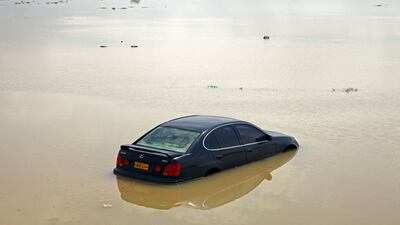
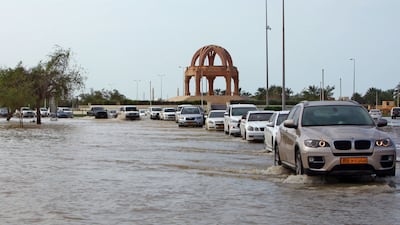
A car is stranded in flooded street in the Omani capital, Muscat. Photo: AFP
People wade through a flooded street in Muscat. Photo: AFP
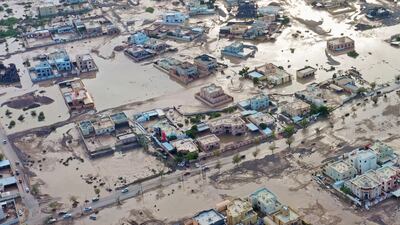
A flooded street in Al Khaburah. Photo: AP
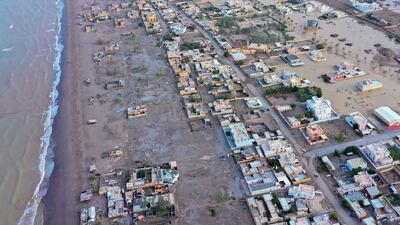
Flooded streets in Al Khaburah, one day after Cyclone Shaheen brought wind speeds of up to 116 kilometres an hour. Photo: EPA
Gloomy skies in Muscat. Photo: EPA
People cycle along a waterlogged road in Al Khaburah. Photo: EPA
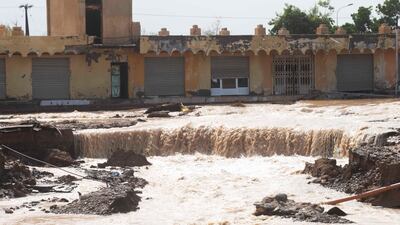
A torrent of floodwater runs through Al Khaburah. Photo: EPA
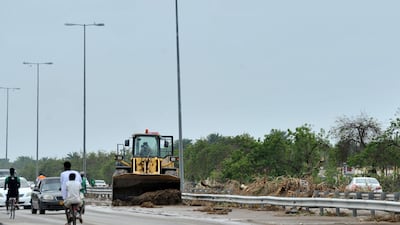
Workers in Al Musanna repair damage caused by Cyclone Shaheen. Photo: Reuters
Vehicles make their way along a flooded street in the aftermath of Cyclone Shaheen in Muscat. Photo: AFP
In the end, the Emirates avoided all but slightly increased winds and some wet weather. On Monday, the country's National Crisis & Emergency Management Authority (Ncema) announced that the storm had "faded", although it said it would continue to monitor the situation.
In 2007, category-five Cyclone Gonu – significantly stronger than Shaheen – hit the UAE after travelling overland across Oman from the Arabian Sea. In March 2016, schools were closed due to another major storm, which saw winds of up to 120kph. Other parts of the Arabian Peninsula experience extreme weather events, too. In 2018, cyclone Sagar, which formed in the Gulf of Aden, killed at least 31 people. It gave nearby Somalia a year's rain in a matter of days, displacing tens of thousands of people.
This underscores the need for bodies like Ncema, as well as Oman’s National Committee for Emergency Management (NCEM), to prepare for such situations, even when they are unlikely to happen. Ncema, moreover, has played a critical role in managing the Covid-19 crisis and showed its preparedness again during Shaheen.
The pandemic is still a bigger immediate concern than storms, which only rarely bring major disruption to the UAE. But after this week's difficulties, a silver lining is greater recognition of the country's ever-developing ability to not just respond to disasters, but prepare for them, too.

Roll of honour 2019-2020
Dubai Rugby Sevens
Winners: Dubai Hurricanes
Runnersup: Bahrain
West Asia Premiership
Winners: Bahrain
Runnersup: UAE Premiership
UAE Premiership
Winners: Dubai Exiles
Runnersup: Dubai Hurricanes
UAE Division One
Winners: Abu Dhabi Saracens
Runnersup: Dubai Hurricanes II
UAE Division Two
Winners: Barrelhouse
Runnersup: RAK Rugby
Real estate tokenisation project
Dubai launched the pilot phase of its real estate tokenisation project last month.
The initiative focuses on converting real estate assets into digital tokens recorded on blockchain technology and helps in streamlining the process of buying, selling and investing, the Dubai Land Department said.
Dubai’s real estate tokenisation market is projected to reach Dh60 billion ($16.33 billion) by 2033, representing 7 per cent of the emirate’s total property transactions, according to the DLD.
Benefits of first-time home buyers' scheme
Priority access to new homes from participating developers
Discounts on sales price of off-plan units
Flexible payment plans from developers
Mortgages with better interest rates, faster approval times and reduced fees
DLD registration fee can be paid through banks or credit cards at zero interest rates
Sukuk are Sharia-compliant financial certificates issued by governments, corporates and other entities. While as an asset class they resemble conventional bonds, there are some significant differences. As interest is prohibited under Sharia, sukuk must contain an underlying transaction, for example a leaseback agreement, and the income that is paid to investors is generated by the underlying asset. Investors must also be prepared to share in both the profits and losses of an enterprise. Nevertheless, sukuk are similar to conventional bonds in that they provide regular payments, and are considered less risky than equities. Most investors would not buy sukuk directly due to high minimum subscriptions, but invest via funds.
In the village of Mevagissey in southwest England the housing stock has doubled in the last century while the number of residents is half the historic high. The village's Neighbourhood Development Plan states that 26% of homes are holiday retreats. Prices are high, averaging around £300,000, £50,000 more than the Cornish average of £250,000. The local average wage is £15,458.
More than 2.2 million Indian tourists arrived in UAE in 2023 More than 3.5 million Indians reside in UAE Indian tourists can make purchases in UAE using rupee accounts in India through QR-code-based UPI real-time payment systems Indian residents in UAE can use their non-resident NRO and NRE accounts held in Indian banks linked to a UAE mobile number for UPI transactions
Founded 50 years ago as a nuclear research institute, scientists at the centre believed nuclear would be the “solution for everything”.
Although they still do, they discovered in 1955 that the Netherlands had a lot of natural gas. “We still had the idea that, by 2000, it would all be nuclear,” said Harm Jeeninga, director of business and programme development at the centre.
"In the 1990s, we found out about global warming so we focused on energy savings and tackling the greenhouse gas effect.”
The energy centre’s research focuses on biomass, energy efficiency, the environment, wind and solar, as well as energy engineering and socio-economic research.
European arms
Known EU weapons transfers to Ukraine since the war began: Germany 1,000 anti-tank weapons and 500 Stinger surface-to-air missiles. Luxembourg 100 NLAW anti-tank weapons, jeeps and 15 military tents as well as air transport capacity. Belgium 2,000 machine guns, 3,800 tons of fuel. Netherlands 200 Stinger missiles. Poland 100 mortars, 8 drones, Javelin anti-tank weapons, Grot assault rifles, munitions. Slovakia 12,000 pieces of artillery ammunition, 10 million litres of fuel, 2.4 million litres of aviation fuel and 2 Bozena de-mining systems. Estonia Javelin anti-tank weapons. Latvia Stinger surface to air missiles. Czech Republic machine guns, assault rifles, other light weapons and ammunition worth $8.57 million.