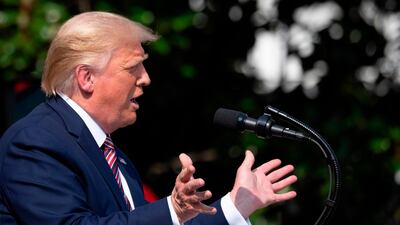

The American political system may be strongly influenced by a set of White House pronouncements that were issued on Friday. They were widely denounced as unconstitutional.
And if they aren’t unconstitutional, that is because they are so strikingly toothless that they clearly avoid crossing any constitutional lines.
Still, as even some of US President Donald Trump’s senior officials acknowledge, these directives dramatically flout the separation of powers between different branches of government.
They could even prove a watershed in the long-developing, but rapidly accelerating, transformation of the US into a functionally purely presidential system.
The announcements purport to provide additional payments to jobless workers, rhetorical support for extending eviction moratoriums, more student loan interest relief and the temporary suspension of collecting wage taxes. In reality, little or none of that may happen.
In May, Democrats in the House of Representatives passed a $3 trillion additional emergency bill. But Senate Republicans could not form a unified position and negotiations between Mr Trump and Democrats collapsed. So instead he issued these pronouncements, which will hardly meet the national emergency.
Republican senators incongruously proved the main obstacle to additional government efforts to salvage the US economy and living conditions, even though without such measures Mr Trump has little hope of being reelected.
Democrats could have been entirely obstructionist, since the president would be primarily blamed for insufficient action before the November 3 election. But because of their commitment to a large and active government, they supported another huge infusion of public spending into the economy. And of course both sides sought to use the opportunity to achieve long-standing goals, both relevant and extraneous, that are anathema to each other.
There are two obvious explanations for why Senate Republicans would not co-operate.
One is that long-standing hostility to government intervention and spending prevented many Senate Republicans from agreeing to another massive outlay, even if Mr Trump would be the main beneficiary.
But it is also possible they were cynically seeking to force Mr Trump to act unilaterally, which they mainly supported, in order to avoid taking responsibility themselves and compromising with Democratic proposals.
Although both the President and the Democrats wanted a major initiative, some huge sticking points proved insurmountable. Democrats demanded much more support for states and would not accept Mr Trump's insistence on eliminating the payroll tax, which is the main funding for two crucial programmes – social security retirement payments and Medicare health coverage – on which most older Americans rely.
In what is probably the most meaningful of these declarations, Mr Trump ordered a halt in collecting taxes on the pay of most workers. This is intended to have two effects.
Those with jobs are expected to be delighted that the government is apparently taking less of their money on a weekly basis. But it is also designed to put a potential future Democratic administration in an impossible position.
Since Mr Trump has pledged to try to eliminate the payroll tax altogether if he is reelected, it doesn't matter to him. But, as he notes, anyone who tries to collect rapidly mounting back taxes, which will still be owed unless there is new legislation, will be courting extreme public anger even if it is needed to fund extremely popular and essential programmes.
This is akin to other instances of sabotage-in-advance against a possible Democratic administration, laying political landmines designed to explode if anyone tries to tinker with them. Looming sanctions snapback against Iran and increasing efforts to gin up a new Cold War atmosphere with China are two obvious foreign policy examples.
Mr Trump cannot eliminate taxes by decree, but he can try to create a mess by refusing to collect them. Yet many businesses may balk, expecting that eventually the government will demand the back taxes. So their workers may see no changes to their take-home pay.
The three other pronouncements are even more dubious and ineffectual.

He says he will seize $44 billion in existing disaster relief funds to extend what had been $600 (Dh2,203) weekly support for jobless workers. That money will pay for $300 weekly payments, but only if states agree to contribute an additional $100 a week and create entirely new programmes to disperse the money, which could take weeks or months. The proposal is difficult at best, if not unworkable.
The last two proclamations waive student loan payments for the rest of the year and urge officials to consider extending an expiring moratorium on evictions.
These announcements show how limited presidential authority still is. Yet they also demonstrate how a president can, by flouting norms and expectations and manipulating existing authority, create faits accomplis and conundrums that marginalise Congressional authority, put opponents in impossible positions, and at least appear to take dramatic presidential actions.
Obviously, this is all taking place as election day hurtles towards Mr Trump with the coronavirus surging, the economy collapsing, his prospects for reelection steadily decreasing, and a growing sense that Republicans could lose control of the Senate.
-

People walk past a sign reading "Wear a Mask" displayed in a shop window in Hudson, New York this week. Bloomberg -

A worker wearing a protective mask grinds coffee at Breadfolks, a bakery and cafe, in Hudson, New York. Bloomberg -
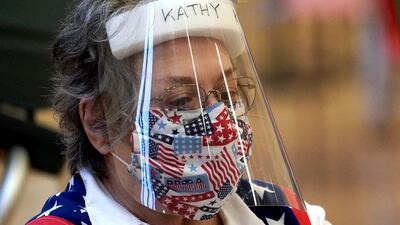
Harris County election clerk Kathy Kellen wears a mask and face shield while working at a polling site in Houston, Texas this week. AP Photo -

People protest against mandates to wear masks amid the coronavirus pandemic in Austin, Texas this week. Reuters -
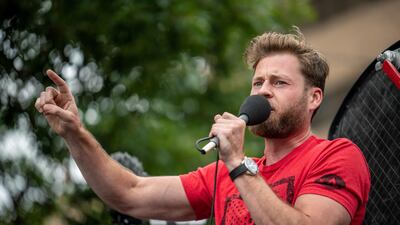
Infowars host Owen Shroyer arrives at a protest against mandates to wear masks in Austin. Reuters -

Black Lives Matter protesters confront people protesting against mandates to wear masks in Austin. Reuters -

A Black Lives Matter protester reacts towards people protesting against mandates to wear masks amid the pandemic in Austin, Texas this week. Reuters -
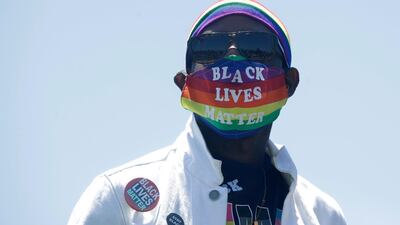
Erik Webb wears a rainbow face mask during the coronavirus outbreak in San Francisco, California this week. AP Photo -
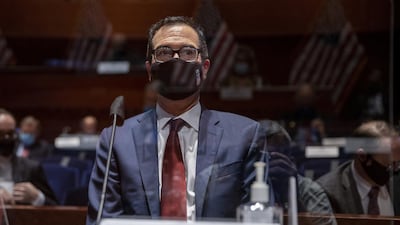
US Treasury Secretary Steven Mnuchin, wearing a face mask, prepares to testify before the House of Representatives Financial Services Committee in Washington this week. Reuters -
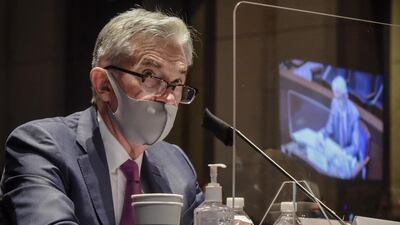
Jerome Powell, Chairman of the US Federal Reserve, sits behind a protective barrier while wearing a protective mask during a House Financial Services Committee hearing in Washington this week. Bloomberg -
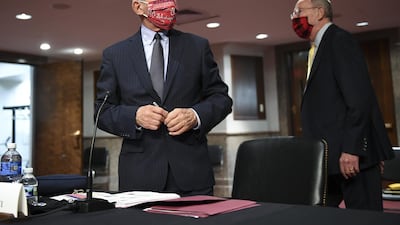
Anthony Fauci, Director of the National Institute of Allergy and Infectious Diseases, wears a Washington Nationals protective mask before a Senate Health, Education, Labor and Pensions Committee hearing in Washington this week. Bloomberg -

Democratic presidential candidate, former Vice President Joe Biden, removes a face mask to protect against the spread of the coronavirus in Wilmington, Delaware this week. AP Photo -
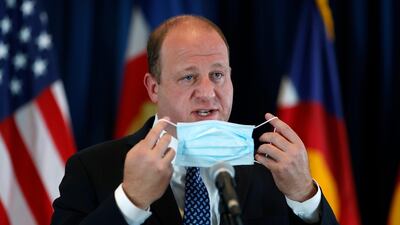
Colorado Governor Jared Polis puts on his face mask after a news conference about the state's efforts to cut the spread of the coronavirus in Denver this week. AP Photo -
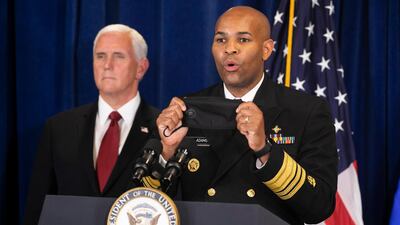
Holding up a mask, US Surgeon General Jerome Adams, right, urges the public to use masks as he speaks during a news conference with Vice President Mike Pence in Rockville, Mayland this week. AP Photo -

The lion statue in front of the 42nd street New York Public Library adorns a protective mask to remind the public to wear masks. EPA -

Meanwhile, US President Donald Trump continues to not wear a mask. Here. he speaks in the presence of Response coordinator for White House Coronavirus Task Force Deborah Birx, left, and Director of the National Institute of Allergy and Infectious Diseases Anthony Fauci in Washington. AFP


It is now entirely plausible that a Democratic "blue wave" could turn into a blue tidal wave. But Americans are fully on notice: this president does not understand or care about the bedrock norms or fundamental architecture of their system.
While publicly announcing them, he kept referring to these pronouncements, strikingly inaccurately, as "bills," which of course only Congress can pass. That is best viewed as a very revealing Freudian slip: he is indeed trying to unilaterally impose his own legislation. Bypassing Congress on spending, taxation and other fundamental measures clearly appeals to him.
Over recent decades, Congress has steadily ceded much of its authority to the presidency.
Presidents of both parties have been grabbing more, too. Former US president George W Bush relied on “signing statements” to redefine the meaning of new laws. Another former president, Barack Obama, issued an unprecedented number of far-reaching executive orders.
Mr Trump, though, goes much further. "When somebody is the president of the United States,” he says, “the authority is total. And that's the way it's got to be."
If a president who is willing to act unilaterally on taxation and spending gets another four years in the White House, despite the glaring inadequacy of these largely cosmetic proclamations, the US Congress may finally become a truly superfluous ornament.
Hussein Ibish is a senior resident scholar at the Arab Gulf States Institute in Washington

