• Former Lebanese prime minister Saad Hariri reacts and speaks to the press as he leaves the UN-backed Special Tribunal for Lebanon (STL) at Leidschendam after the expected verdict on the 2005 murder of his father, former Lebanese premier Rafik Hariri. AFP
    Former Lebanese prime minister Saad Hariri reacts and speaks to the press as he leaves the UN-backed Special Tribunal for Lebanon (STL) at Leidschendam after the expected verdict on the 2005 murder of his father, former Lebanese premier Rafik Hariri. AFP
  • Former Lebanese Prime Minister Saad Hariri reacts after a session of the United Nations-backed Lebanon Tribunal handing down a judgement in the case of four men being tried in absentia for the 2005 bombing that killed former prime minister Rafik Hariri. Reuters
    Former Lebanese Prime Minister Saad Hariri reacts after a session of the United Nations-backed Lebanon Tribunal handing down a judgement in the case of four men being tried in absentia for the 2005 bombing that killed former prime minister Rafik Hariri. Reuters
  • A security officer stands guard near the graves of people who were killed in the 2005 bombing that killed former Prime Minister Rafik Hariri, in Beirut, Lebanon. Reuters
    A security officer stands guard near the graves of people who were killed in the 2005 bombing that killed former Prime Minister Rafik Hariri, in Beirut, Lebanon. Reuters
  • Bahiya Hariri, the sister of Lebanon's former Prime Minister Rafik Hariri, reacts as she prays at his grave, in Beirut, Lebanon. Reuters
    Bahiya Hariri, the sister of Lebanon's former Prime Minister Rafik Hariri, reacts as she prays at his grave, in Beirut, Lebanon. Reuters
  • Former Lebanese Prime Minister Saad Hariri speaks after the United Nations-backed Lebanon Tribunal in Leidschendam, Netherlands handed down its judgement. AP
    Former Lebanese Prime Minister Saad Hariri speaks after the United Nations-backed Lebanon Tribunal in Leidschendam, Netherlands handed down its judgement. AP
  • Bahiya Hariri, the sister of Lebanon's former Prime Minister Rafik Hariri, prays at his grave in Beirut, Lebanon. Getty
    Bahiya Hariri, the sister of Lebanon's former Prime Minister Rafik Hariri, prays at his grave in Beirut, Lebanon. Getty
  • Members of security forces stand guard near a billboard depicting Lebanon's former Prime Minister Rafik Hariri, who was killed in a 2005 suicide bombing, in Sidon, southern Lebanon. Reuters
    Members of security forces stand guard near a billboard depicting Lebanon's former Prime Minister Rafik Hariri, who was killed in a 2005 suicide bombing, in Sidon, southern Lebanon. Reuters
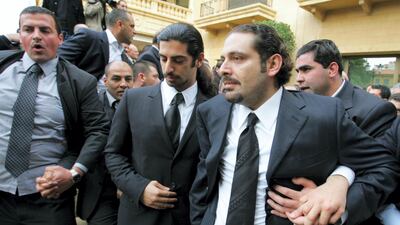
  • Former Lebanese prime minister Saad Hariri leaves the UN-backed Special Tribunal for Lebanon (STL) at Leidschendam after the expected verdict on the 2005 murder of his father former Lebanese premier Rafik Hariri. AFP
    Former Lebanese prime minister Saad Hariri leaves the UN-backed Special Tribunal for Lebanon (STL) at Leidschendam after the expected verdict on the 2005 murder of his father former Lebanese premier Rafik Hariri. AFP
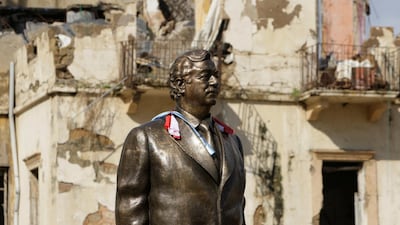
  • A statue of Lebanon's former prime minister Rafik Hariri is seen near the site of the 2005 bombing that killed him on August 18, 2020 in Beirut, Lebanon. Getty
    A statue of Lebanon's former prime minister Rafik Hariri is seen near the site of the 2005 bombing that killed him on August 18, 2020 in Beirut, Lebanon. Getty
  • Saad Hariri speaks to the press after leaving the Lebanon Tribunal after the ruling on the assassination of ex-Prime Minister Rafik Hariri of Lebanon in Leidschendam, The Netherlands. EPA
    Saad Hariri speaks to the press after leaving the Lebanon Tribunal after the ruling on the assassination of ex-Prime Minister Rafik Hariri of Lebanon in Leidschendam, The Netherlands. EPA

Rafik Hariri verdict: Nearly $1bn later, where is the justice?


  • English
  • Arabic

On Tuesday, the Special Tribunal for Lebanon issued its judgment in the case of former Lebanese Prime Minister Rafik Hariri's assassination. It took a little over 15 years of investigations, delays and hearings since the bombing that devastated downtown Beirut on Valentine's Day 2005 for the court to reach a decision. It found one member of Hezbollah guilty.

Full disclosure: I worked for the court for two years between 2011 and 2013.

The prosecution had indicted five members of the militant group in the case, which was built on a vast trove of telecommunications evidence and “co-location” to identify the suspects by tracking their mobile phones for days as they carried out surveillance of the Lebanese prime minister, bought the lorry that was laden with explosives and carried out the bombing.

The telecommunications evidence was built on the earlier work of Wissam Eid, a heroic Lebanese security officer who was murdered for his role in uncovering it.

The trial took place in absentia because Hezbollah refused to hand over the suspects, after carrying a broad propaganda campaign to discredit it as a tool of American and Israeli imperialism.

One of the suspects was Mustafa Badreddine, who was the overall military commander of Hezbollah at the time of his death under mysterious circumstances in Syria in 2016. I covered Badreddine's funeral in Beirut, which was carried out with great pomp and ceremony.

In addition to leading the party's campaign in support of Bashar Al Assad, he was also the brother-in-law of Imad Mughniyeh, his predecessor and the notorious Hezbollah commander who led the militia in its war with Israel in 2006, and was later assassinated in the heart of Damascus in a joint CIA and Mossad operation. It doesn't get much higher than this in the party's top echelons where its leader Hassan Nasrallah resides.

The other key suspect was Salim Ayyash, a Hezbollah member who led the assassination cell and was the main conduit to Badreddine, in addition to buying the truck that was used to attack Hariri's convoy. The three other suspects were allegedly involved in preparing a false claim of responsibility for the assassination.

The court found Ayyash guilty on all counts and refrained from making a detailed statement on Badreddine’s role, because he was dead and therefore no longer an accused. The other three suspects were declared not guilty due to lack of evidence. These decisions are of course all subject to appeal.

The court said it did not find evidence implicating Hezbollah as an organisation in the killing. It is, however, hard to conceive of an operation of such magnitude, sophistication, and with these political ramifications – and with the involvement of one of the party’s most senior and well-connected cadres – taking place without the knowledge of Hezbollah’s leaders and the party’s foreign sponsors.

The prosecution's biggest sin is perhaps that it never did figure out a motive for the assassination of Hariri

Many questions remain unanswered though. Who worked with Ayyash to carry out the assassination (most of the cell that carried out the murder on the day itself have not been identified)? Who did he and Badreddine answer to? Who ordered the assassination? Who made the false claim of responsibility? Were the same people involved in all the other political assassinations that took place in Lebanon around that time? Preparations for a trial in those connected cases are under way. What evidence existed to implicate Syria in the killing of Hariri and others within his political bloc? Who assassinated Eid and what were they worried about him revealing?

But the prosecution's biggest sin is perhaps that it never did figure out a motive for the killing. Hariri's assassination was not an isolated event. It came amid extremely high tensions with Bashar Al Assad, with pressure from foreign powers and Hariri's political bloc and growing popular demand for the departure of Syrian forces from Lebanon, which was under the tutelage of Damascus since the end of its civil war. Even after the Syrian army withdrew, a series of assassinations targeted politicians and thinkers from Hariri's political bloc in the aftermath of his death.

Minutes before an explosion killed him and 22 others, Rafik Hariri spoke to people outside the Lebanese Parliament, in Beirut, Lebanon, February 14, 2005 AP

Syria initially co-operated with the UN’s Hariri probe, and senior security officials were implicated in the initial phase of the investigation. It is unclear whether that evidence was up to the standards of an international tribunal. Prosecutors and investigators since then dithered and delayed, slowing down the pace of the investigation, perhaps in the hopes that more direct evidence would materialise, perhaps to retain their cushy UN jobs.

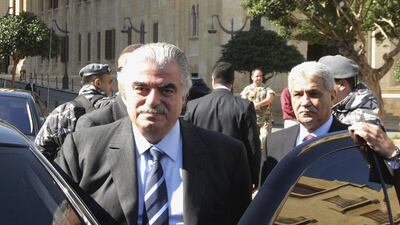
  • Rafik Hariri, left, and his bodyguard Yahya Arab, leave the Parliament in Beirut, Lebanon in 2005. Minutes later, Hariri and several of his bodyguards were killed in a massive bomb explosion. AP
    Rafik Hariri, left, and his bodyguard Yahya Arab, leave the Parliament in Beirut, Lebanon in 2005. Minutes later, Hariri and several of his bodyguards were killed in a massive bomb explosion. AP
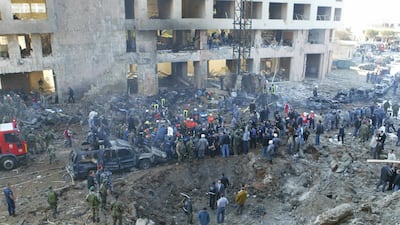
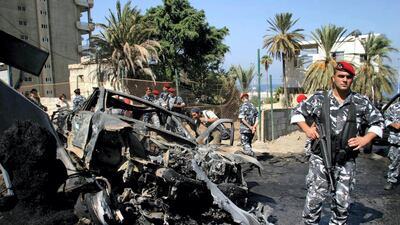
  • The site of devastation where former Lebanon prime minister Hariri was assassinated in the blast in Beirut on February 14, 2005. AFP
    The site of devastation where former Lebanon prime minister Hariri was assassinated in the blast in Beirut on February 14, 2005. AFP
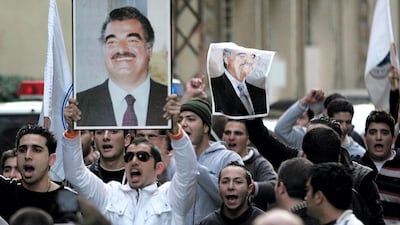
  • Supporters of former Lebanese prime minister Hariri after Hariri's death outside his house in Beirut. AFP
    Supporters of former Lebanese prime minister Hariri after Hariri's death outside his house in Beirut. AFP
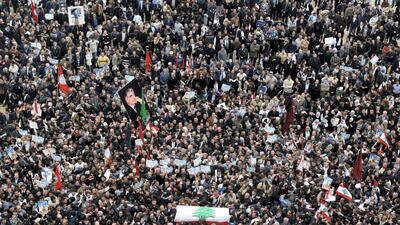
  • The national flag-draped coffin of Hariri is carried to his final resting place in central Beirut two days after the killing. AFP
    The national flag-draped coffin of Hariri is carried to his final resting place in central Beirut two days after the killing. AFP
  • Saad Hariri and other family members leave their family home to join the funeral procession. AFP
    Saad Hariri and other family members leave their family home to join the funeral procession. AFP
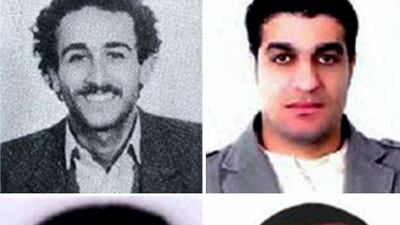
  • A combination of handout pictures obtained on July 29, 2011 from the website of the Special Tribunal for Lebanon shows four Hezbollah suspects indicted in the assassination case of Hariri, (from top left to right) Mustafa Amine Badreddine, Assad Hassan Sabra, Hussein Hassan Oneissi and Salim Jamil Ayyash. AFP
    A combination of handout pictures obtained on July 29, 2011 from the website of the Special Tribunal for Lebanon shows four Hezbollah suspects indicted in the assassination case of Hariri, (from top left to right) Mustafa Amine Badreddine, Assad Hassan Sabra, Hussein Hassan Oneissi and Salim Jamil Ayyash. AFP
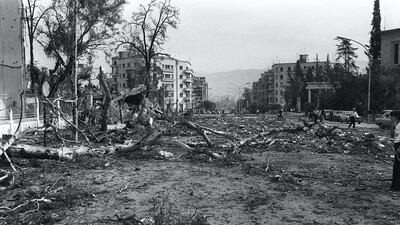
  • An avenue in central Beirut destroyed by 18 months of civil war is pictured, November 15, 1976. AFP
    An avenue in central Beirut destroyed by 18 months of civil war is pictured, November 15, 1976. AFP
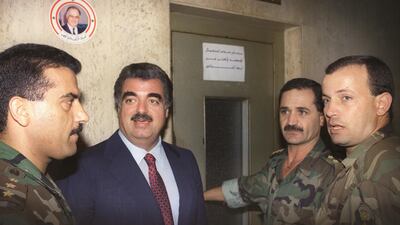
  • Hariri on October 22, 1992 in Beirut, after being nominated as prime minister by then president Elias Hrawi. AFP
    Hariri on October 22, 1992 in Beirut, after being nominated as prime minister by then president Elias Hrawi. AFP
  • Hariri and his wife Nazic on September 1, 1996 in their villa in Beirut. AFP
    Hariri and his wife Nazic on September 1, 1996 in their villa in Beirut. AFP
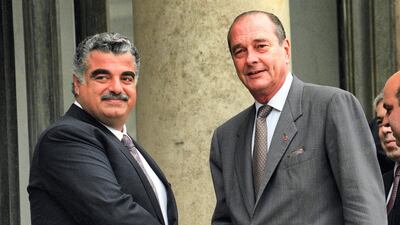
  • Then French president Jacques Chirac greets Hariri at the Elysee Palace in Paris, September 28, 1996. AFP
    Then French president Jacques Chirac greets Hariri at the Elysee Palace in Paris, September 28, 1996. AFP
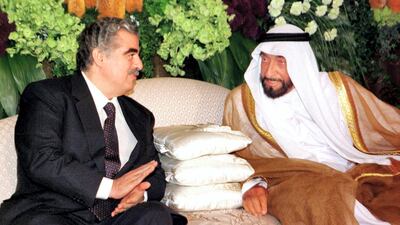
  • Sheikh Zayed, the Founding Father, meets Hariri in Dubai on March 17, 1999. Hariri was in Dubai for a three-day official visit. AFP
    Sheikh Zayed, the Founding Father, meets Hariri in Dubai on March 17, 1999. Hariri was in Dubai for a three-day official visit. AFP
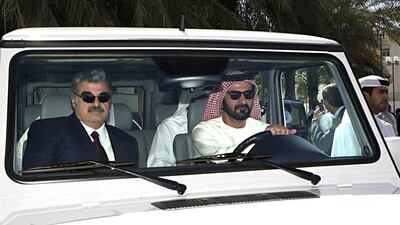
  • Sheikh Mohammed bin Rashed, then Crown Prince of Dubai, drives Hariri in Dubai on March 6, 2000. AFP
    Sheikh Mohammed bin Rashed, then Crown Prince of Dubai, drives Hariri in Dubai on March 6, 2000. AFP
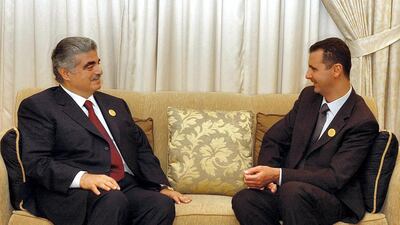
  • Hariri meets Syrian President Bashar al Assad on the sidelines of the Arab summit in Beirut, March 27, 2002. AFP
    Hariri meets Syrian President Bashar al Assad on the sidelines of the Arab summit in Beirut, March 27, 2002. AFP
  • Lebanese policemen gather at the site where outgoing economy and trade minister Marwan Hamadeh's car was targeted by a bomb in Beirut on October 1, 2004. AFP
    Lebanese policemen gather at the site where outgoing economy and trade minister Marwan Hamadeh's car was targeted by a bomb in Beirut on October 1, 2004. AFP
  • The Hariri monument in Beirut. Reuters
    The Hariri monument in Beirut. Reuters

But justice delayed is justice denied. Hariri’s killers and the murderers of two dozen Lebanese who died in the blast deserve justice and accountability.

But Lebanon and the region have seen great atrocities since that political earthquake: all the subsequent political assassinations and bombings in Lebanon, the war in Syria, the brutality with which the region's strongmen suppressed dissent and protests during the uprisings. And of course, the explosion in Beirut on August 4, a result of sheer criminal negligence, which killed at least 177 people, wounded thousands and levelled an entire city.

The Tribunal’s goal was to put an end to impunity in Lebanon, to put an end to the use of political assassinations as a tool for regional powers and local militias to impose their will. That desire for justice permeates and underlines much of the region’s suffering. At least somebody tried to find out who was responsible and somebody was found responsible, even if he may never face justice.

But perhaps the surest sign of the Tribunal’s failure is that 15 years after Hariri’s death, the perpetrators of the explosion in Beirut are not in the slightest danger of being held accountable. After hundreds of millions of dollars and 15 years of pain, impunity still reigns supreme in Lebanon.

Kareem Shaheen is a former Middle East correspondent based in Canada

RESULTS

5pm: Maiden (PA) Dh80,000 1,600m
Winner: Omania, Saif Al Balushi (jockey), Ibrahim Al Hadhrami (trainer)
5.30pm: Conditions (PA) Dh85,000 1,600m
Winner: Brehaan, Richard Mullen, Ana Mendez
6pm: Handicap (TB) Dh100,000 1,600m
Winner: Craving, Connor Beasley, Simon Crisford
6.30pm: The President’s Cup Prep (PA) Dh100,000 2,200m
Winner: Rmmas, Tadhg O’Shea, Jean de Roualle
7pm: Wathba Stallions Cup (PA) Dh70,000 1,200m
Winner: Dahess D’Arabie, Connor Beasley, Helal Al Alawi
7.30pm: Handicap (PA) Dh80,000 1,400m
Winner: Fertile De Croate, Sam Hitchcott, Ibrahim Aseel

Race card

4pm Al Bastakiya Listed US$300,000 (Dirt) 1,900m

4.35pm Mahab Al Shimaal Group 3 $350,000 (D) 1,200m

5.10pm Nad Al Sheba Turf Group 3 $350,000 (Turf) 1,200m

5.45pm Burj Nahaar Group 3 $350,000 (D) 1,600m

6.20pm Jebel Hatta Group 1 $400,000 (T) 1,800m

6.55pm Al Maktoum Challenge Round-3 Group 1 $600,000 (D) 2,000m

7.30pm Dubai City Of Gold Group 2 $350,000 (T) 2,410m

The National selections:

4pm Zabardast

4.35pm Ibn Malik

5.10pm Space Blues

5.45pm Kimbear

6.20pm Barney Roy

6.55pm Matterhorn

7.30pm Defoe

Results

5.30pm: Maiden (TB) Dh82,500 (Turf) 1,400m; Winner: Mcmanaman, Sam Hitchcock (jockey), Doug Watson (trainer)

6.05pm: Handicap (TB) Dh87,500 (T) 1,400m; Winner: Bawaasil, Sam Hitchcott, Doug Watson

6.40pm: Handicap (TB) Dh105,000 (Dirt) 1,400m; Winner: Bochart, Fabrice Veron, Satish Seemar

7.15pm: Handicap (TB) Dh105,000 (T) 1,200m; Winner: Mutaraffa, Antonio Fresu, Musabah Al Muhairi

7.50pm: Longines Stakes – Conditions (TB) Dh120,00 (D) 1,900m; Winner: Rare Ninja, Royston Ffrench, Salem bin Ghadayer

8.25pm: Zabeel Trophy – Rated Conditions (TB) Dh120,000 (T) 1,600m; Winner: Alfareeq, Antonio Fresu, Musabah Al Muhairi

9pm: Handicap (TB) Dh105,000 (T) 2,410m; Winner: Good Tidings, Antonio Fresu, Musabah Al Muhairi

9.35pm: Handicap (TB) Dh92,500 (T) 2,000m; Winner: Zorion, Abdul Aziz Al Balushi, Helal Al Alawi