

The numbers are as shameful as they are shocking. A report by an alliance of UN agencies, NGOs and government bodies, released around the beginning of Ramadan, offers a sweeping look at the food security crisis around the globe.
By the end of 2019, before the ongoing pandemic, around 135 million people in 55 countries were suffering from acute food insecurity – a state in which a person's inability to eat puts his or her life in immediate danger. It is more severe than chronic hunger, a signal of the desperation wrought by war and economic collapse.
In Syria, 6.6 million people, more than a third of the country's population of around 18 million, are suffering from acute food insecurity. In addition, 27.5 per cent of children under the age of five are stunted because of insufficient food.
These numbers, and those of the crisis at large, are a stain on the world's conscience. But it is likely to be so much worse if we do not act now to head off the expected impact of the coronavirus pandemic.
There are many obvious drivers for this crisis of hunger. A government offensive in Idlib – one of the last remaining enclaves where rebels hold sway – displaced around a million civilians. They had fled Syrian President Bashar Al Assad’s indiscriminate bombardment to the relative safety of the Turkish border, losing homes, livelihoods and sources of food. An economic crisis has devastated the Syrian pound.
Poverty and unemployment are rife in the country, leaving many without the purchasing power to buy basic staples. The state has struggled to support its citizens, its coffers depleted by nine years of war.
In Syria, humanitarian agencies have struggled to deliver aid to areas outside government control because it usually involves negotiating access across borders or government checkpoints to deliver assistance in hard-hit areas that often are not secure (either because of extremist groups present or because the government refuses to offer safety guarantees).
Now, travel restrictions and lockdowns further limit the ability of these aid agencies to deliver basic services like food or hygiene kits to people living in crowded refugee camps without the luxury of clean water to wash their hands or the ability to maintain social distancing or treat the sick.

The delivery of that aid is particularly crucial now. Syria’s healthcare system collapsed over the course of the conflict, whether as a result of hospitals being routinely and systematically destroyed by regime and Russian warplanes, the flight of doctors and other skilled workers abroad, or the stress on a system that is in constant crisis mode because of the war. There are few tests available to accurately determine coronavirus infections or facilities to isolate and treat patients.
But in addition to public health challenges, these are also desperate economic times. The Syrian pound collapsed against the dollar partly due to the economic collapse next door in Lebanon, as well as the lack of economic relief due to ongoing sanctions against Mr Al Assad’s regime. The prices of staples have soared and families are having to do without.
-
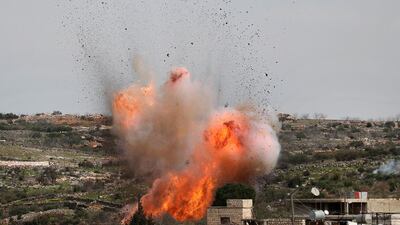
Warplanes attack the village of Al Bara in southern Idlib on March 5, 2020, a day before a ceasefire went into effect in the province. AFP -
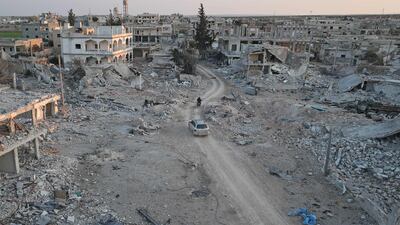
Destroyed buildings in Al Nayrab village, about 14 kilometres south-east of Idlib city. The city and its surroundings have suffered furious bombardment by Syrian forces and Russian jets since since December 2019. AFP -
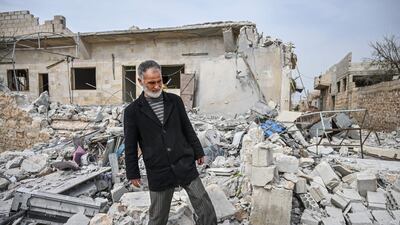
Malek Haj Khalil stands on the rubble of his home in Sarmin, about 8 kilometres south-east of Idlib city. AFP -
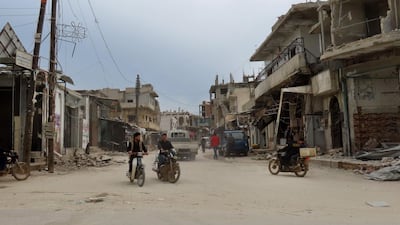
Syrians ride their motorcycles through a damaged neighbourhood in the town of Binnish in Idlib province. AFP -
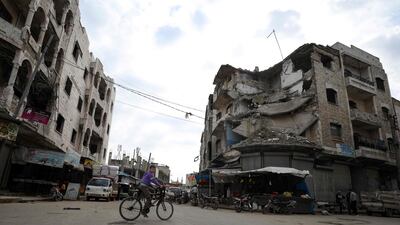
A boy rides his bicycle past damaged buildings in Idlib city. AFP -
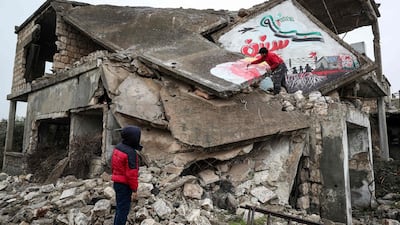
A boy watches as a man paints a mural on the roof of a collapsed building in Binnish to commemorate the ninth anniversary of the Syrian war. AFP -
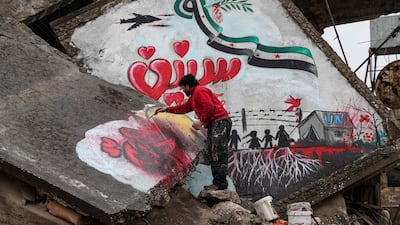
The mural shows a dove holding an olive branch in its beak flying over a Syrian opposition flag in the shape of the Arabic numeral 9, with the word 'years' below. AFP -

A mural on the wall of a destroyed school in Sarmin. The slogan refers to the Syrian government considering all rebels terrorists. AFP -

Like other towns in Idlib, Afis has sustained widespread destruction due to heavy fighting and air strikes. AFP -

A destroyed house in the village of Al Mastuma, about 7 kilometres south of Idlib city. AFP -
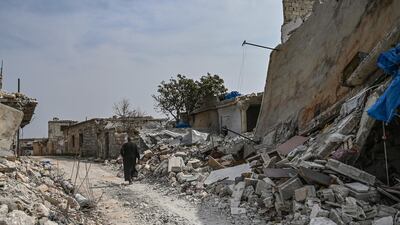
A man walks through a destroyed neighbourhood in Al Mastuma. AFP


The lockdowns will exacerbate these challenges. At a recent meeting of the government committee in charge of the coronavirus response, Mr Al Assad openly acknowledged that a full lockdown, as opposed to the partial curfew the authorities imposed, was not feasible because ordinary Syrians couldn’t afford it – a terrifying calculation to contemplate.
Many Syrians inside the country as well as refugees in neighbouring Lebanon and Turkey are also part of an informal economy that pays them in hourly or daily wages. Many work in seasonal agriculture, having to travel from place to place to earn a living. Entire families depend on their daily bread. The lockdowns take that away and the result can be deadly.
In April, right around the release of the report, Turkish police in Adana shot a Syrian teenager who had violated the coronavirus curfew – he was on his way to work, and tried to flee from the policemen because he wouldn’t be able to afford the fine.

The coronavirus pandemic showed us how deeply we are all connected, while triggering nativist impulses in those who wanted to keep the virus, and strangers, at bay. Many nations and strongmen are turning inward, favouring a new isolationism. The Covid-19 Global Humanitarian Response Plan, probably the single most important cause of our moment, is woefully underfunded – just $1.07 billion has been secured out of $6.7bn needed for the UN-backed plan.
But it does not have to be this way. Perhaps the pandemic ought to give way to a new consciousness – the knowledge that because events far away can have such an outsize impact on our lives, we should care about faraway places.
We should care if people halfway around the world are hungry. Not just because its echoes will inevitably reach us, but also because it is an opportunity to lift our fellow human beings along the way. Rather than hide in a box, we can all rise. That is the spirit that can address our most serious challenges – from a runaway virus to melting glaciers and rising tides.
Kareem Shaheen is a former Middle East correspondent based in Canada

