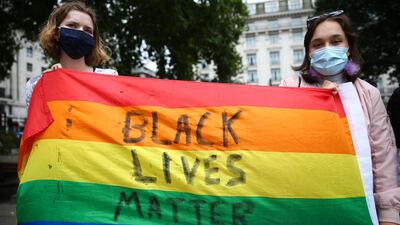
No single community is immune to racism and its effects. AFP

Other people of colour have much to learn from the black community


  • English
  • Arabic

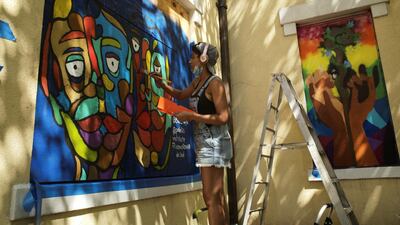
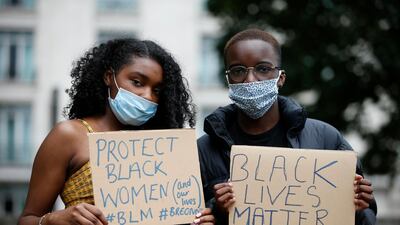
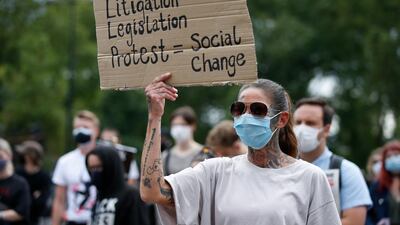
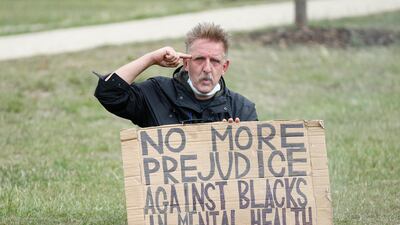
As protests following the murder of George Floyd started to gather momentum during the summer, I felt the compulsion to speak up for the anti-racism movement.

I have been publicly highlighting systemic racism for more than 15 years. As a Muslim, and as someone of South Asian heritage, I know what it feels like to be fooled into believing that you are simply imagining your oppression.

But the summer was not the moment to speak out about personal experiences. I held my tongue. This was the moment for black communities to speak about their experiences of racism. And while the movement began in the US, it quickly gathered global momentum.

I took the view that my role at that moment, as a Muslim and as a person of colour, was to stand as an ally with my black brothers and sisters. But it was also about more than that.

It was also about wanting to confront racism in my own communities. Because the truth is more people are racists than they admit or even realise, and it is not easy to talk about. Like everyone else, some people of colour and some Muslims, too, hold racist views. It is hard to say, but say it we must.

Remaining silent allows discrimination to advance. Silence from people in my positon makes us complicit of racism – regardless of skin colour, religion or ethnicity. By not speaking up, we show that we are either uncaring or oblivious to the fact that we are agents perpetuating racism.

When some Muslims are challenged about their own biases against people of colour, a familiar response is to hold up the example of the esteemed companion of Prophet Mohammed, Bilal, who was black, as supposed evidence of racial harmony among all Muslims. Or to state that Islam is a brotherhood that sees beyond colour and race, all the while continuing without irony to demean black people.

People who are of colour but not black bristle at the notion that we might be upholding racist structures – the very same structures that we complain oppress us.

My family heritage is East African Indian, so I know first hand the history of how Indians were established as intermediaries between white colonists and black ‘natives’.

This conferred a sense of superiority among some East African Indians, keen to believe that there is something inherently better about us, while oppressing black people. This hierarchy is exactly how racist structures are entrenched and proliferated.

The truth is more people are racists than they admit or even realise, and it is not easy to talk about

Regardless of their own skin colour, nobody wants to think of themselves as racist, particularly those who themselves may have been at the receiving end of  racism, sexism, Islamophobia and other discriminations. So I understand that these are difficult and sensitive conversations.

October is Black History Month in the UK and parts of Europe, which makes it a perfect time to have these discussions with honesty and respect.

Dating back to the 1980s, the month’s aim was to offer a fresh perspective on the history that dominated British school teaching, with the goal of challenging racism.

It has broadened out since then to celebrate the contribution of black people and to nurture a deeper insight into black history. It drew on the American institution of Black History Month, which dates back to the 1920s and takes place in February every year.

Any other people of colour inclined to react to this takeover of the upcoming month with "what about me and my heritage" need to realise that it is not about us, but about black people and starting on a journey to equality and humanisation.

And if we can’t do it for altruistic reasons or the fact that it is intrinsically right, then we should understand that it is in our own interests to destabilise racist hierarchies. This is exactly what Black History Month sets out to do. That is why I will be soaking up all the cultural events in the coming weeks.

I was brought up with only a little knowledge of the history of East Africa, where my family lived for over a century. And shamefully, my knowledge of black British history is more limited than I would like – even though, in recent years, I have been working to rectify this.

I am only speaking for myself here, but I have found that by listening with an open heart and mind to the experience of black communities, one develops a stronger sense of humanity and a sharpened sense of one's own identity and place in the world.

Shelina Janmohamed is an author and a culture columnist for The National

Company Fact Box

Company name/date started: Abwaab Technologies / September 2019

Founders: Hamdi Tabbaa, co-founder and CEO. Hussein Alsarabi, co-founder and CTO

Based: Amman, Jordan

Sector: Education Technology

Size (employees/revenue): Total team size: 65. Full-time employees: 25. Revenue undisclosed

Stage: early-stage startup 

Investors: Adam Tech Ventures, Endure Capital, Equitrust, the World Bank-backed Innovative Startups SMEs Fund, a London investment fund, a number of former and current executives from Uber and Netflix, among others.

The burning issue

The internal combustion engine is facing a watershed moment – major manufacturer Volvo is to stop producing petroleum-powered vehicles by 2021 and countries in Europe, including the UK, have vowed to ban their sale before 2040. The National takes a look at the story of one of the most successful technologies of the last 100 years and how it has impacted life in the UAE. 

Read part four: an affection for classic cars lives on

Read part three: the age of the electric vehicle begins

Read part two: how climate change drove the race for an alternative 

Mercer, the investment consulting arm of US services company Marsh & McLennan, expects its wealth division to at least double its assets under management (AUM) in the Middle East as wealth in the region continues to grow despite economic headwinds, a company official said.

Mercer Wealth, which globally has $160 billion in AUM, plans to boost its AUM in the region to $2-$3bn in the next 2-3 years from the present $1bn, said Yasir AbuShaban, a Dubai-based principal with Mercer Wealth.

Within the next two to three years, we are looking at reaching $2 to $3 billion as a conservative estimate and we do see an opportunity to do so,” said Mr AbuShaban.

Mercer does not directly make investments, but allocates clients’ money they have discretion to, to professional asset managers. They also provide advice to clients.

“We have buying power. We can negotiate on their (client’s) behalf with asset managers to provide them lower fees than they otherwise would have to get on their own,” he added.

Mercer Wealth’s clients include sovereign wealth funds, family offices, and insurance companies among others.

From its office in Dubai, Mercer also looks after Africa, India and Turkey, where they also see opportunity for growth.

Wealth creation in Middle East and Africa (MEA) grew 8.5 per cent to $8.1 trillion last year from $7.5tn in 2015, higher than last year’s global average of 6 per cent and the second-highest growth in a region after Asia-Pacific which grew 9.9 per cent, according to consultancy Boston Consulting Group (BCG). In the region, where wealth grew just 1.9 per cent in 2015 compared with 2014, a pickup in oil prices has helped in wealth generation.

BCG is forecasting MEA wealth will rise to $12tn by 2021, growing at an annual average of 8 per cent.

Drivers of wealth generation in the region will be split evenly between new wealth creation and growth of performance of existing assets, according to BCG.

Another general trend in the region is clients’ looking for a comprehensive approach to investing, according to Mr AbuShaban.

“Institutional investors or some of the families are seeing a slowdown in the available capital they have to invest and in that sense they are looking at optimizing the way they manage their portfolios and making sure they are not investing haphazardly and different parts of their investment are working together,” said Mr AbuShaban.

Some clients also have a higher appetite for risk, given the low interest-rate environment that does not provide enough yield for some institutional investors. These clients are keen to invest in illiquid assets, such as private equity and infrastructure.

“What we have seen is a desire for higher returns in what has been a low-return environment specifically in various fixed income or bonds,” he said.

“In this environment, we have seen a de facto increase in the risk that clients are taking in things like illiquid investments, private equity investments, infrastructure and private debt, those kind of investments were higher illiquidity results in incrementally higher returns.”

The Abu Dhabi Investment Authority, one of the largest sovereign wealth funds, said in its 2016 report that has gradually increased its exposure in direct private equity and private credit transactions, mainly in Asian markets and especially in China and India. The authority’s private equity department focused on structured equities owing to “their defensive characteristics.”

COMPANY%20PROFILE
%3Cp%3E%3Cstrong%3ECompany%3A%20%3C%2Fstrong%3EEducatly%3Cbr%3E%3Cstrong%3EStarted%3A%20%3C%2Fstrong%3E2020%3Cbr%3E%3Cstrong%3EBased%3A%20%3C%2Fstrong%3EUAE%3Cbr%3E%3Cstrong%3EFounders%3A%20%3C%2Fstrong%3EMohmmed%20El%20Sonbaty%2C%20Joan%20Manuel%20and%20Abdelrahman%20Ayman%3Cbr%3E%3Cstrong%3EIndustry%3A%20%3C%2Fstrong%3EEducation%20technology%3Cbr%3E%3Cstrong%3EFunding%20size%3A%20%3C%2Fstrong%3E%242%20million%3Cbr%3E%3Cstrong%3EInvestors%3A%20%3C%2Fstrong%3EEnterprise%20Ireland%2C%20Egypt%20venture%2C%20Plus%20VC%2C%20HBAN%2C%20Falak%20Startups%3C%2Fp%3E%0A
Will the pound fall to parity with the dollar?

The idea of pound parity now seems less far-fetched as the risk grows that Britain may split away from the European Union without a deal.

Rupert Harrison, a fund manager at BlackRock, sees the risk of it falling to trade level with the dollar on a no-deal Brexit. The view echoes Morgan Stanley’s recent forecast that the currency can plunge toward $1 (Dh3.67) on such an outcome. That isn’t the majority view yet – a Bloomberg survey this month estimated the pound will slide to $1.10 should the UK exit the bloc without an agreement.

New Prime Minister Boris Johnson has repeatedly said that Britain will leave the EU on the October 31 deadline with or without an agreement, fuelling concern the nation is headed for a disorderly departure and fanning pessimism toward the pound. Sterling has fallen more than 7 per cent in the past three months, the worst performance among major developed-market currencies.

“The pound is at a much lower level now but I still think a no-deal exit would lead to significant volatility and we could be testing parity on a really bad outcome,” said Mr Harrison, who manages more than $10 billion in assets at BlackRock. “We will see this game of chicken continue through August and that’s likely negative for sterling,” he said about the deadlocked Brexit talks.

The pound fell 0.8 per cent to $1.2033 on Friday, its weakest closing level since the 1980s, after a report on the second quarter showed the UK economy shrank for the first time in six years. The data means it is likely the Bank of England will cut interest rates, according to Mizuho Bank.

The BOE said in November that the currency could fall even below $1 in an analysis on possible worst-case Brexit scenarios. Options-based calculations showed around a 6.4 per cent chance of pound-dollar parity in the next one year, markedly higher than 0.2 per cent in early March when prospects of a no-deal outcome were seemingly off the table.

Bloomberg

The biog

Hometown: Cairo

Age: 37

Favourite TV series: The Handmaid’s Tale, Black Mirror

Favourite anime series: Death Note, One Piece and Hellsing

Favourite book: Designing Brand Identity, Fifth Edition

The rules on fostering in the UAE

A foster couple or family must:

  • be Muslim, Emirati and be residing in the UAE
  • not be younger than 25 years old
  • not have been convicted of offences or crimes involving moral turpitude
  • be free of infectious diseases or psychological and mental disorders
  • have the ability to support its members and the foster child financially
  • undertake to treat and raise the child in a proper manner and take care of his or her health and well-being
  • A single, divorced or widowed Muslim Emirati female, residing in the UAE may apply to foster a child if she is at least 30 years old and able to support the child financially
From exhibitions to the battlefield

In 2016, the Shaded Dome was awarded with the 'De Vernufteling' people's choice award, an annual prize by the Dutch Association of Consulting Engineers and the Royal Netherlands Society of Engineers for the most innovative project by a Dutch engineering firm.

It was assigned by the Dutch Ministry of Defence to modify the Shaded Dome to make it suitable for ballistic protection. Royal HaskoningDHV, one of the companies which designed the dome, is an independent international engineering and project management consultancy, leading the way in sustainable development and innovation.

It is driving positive change through innovation and technology, helping use resources more efficiently.

It aims to minimise the impact on the environment by leading by example in its projects in sustainable development and innovation, to become part of the solution to a more sustainable society now and into the future.