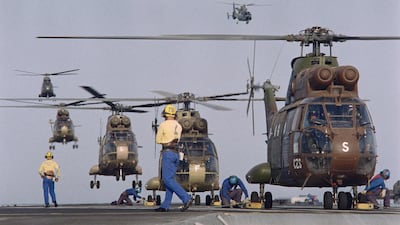

One of the more memorable features of the global reaction to Saddam Hussein's invasion of Kuwait 30 years ago, in August 1990, was the almost universal condemnation that followed.
In a response that would be almost unimaginable today, countries with diametrically opposed outlooks and political systems came together to form a truly multinational coalition – one that would eventually succeed in achieving its ultimate objective of liberating Kuwait from Saddam's brutal occupation.
Syria, which under former president Hafez Al Assad had been a staunch ally of Moscow during the Cold War, lined up alongside American forces in the Saudi Arabian desert, as did a host of other countries, including Britain and France.
The GCC, too, played a critical role in supporting both the formation of the military coalition, as well as the diplomatic offensive to secure backing for the operation at the UN. This demonstration of unity within the Arab world resulted in the UN Security Council passing a resolution demanding the immediate withdrawal of the Iraqi army and authorising the liberation of Kuwait by force if necessary.
-
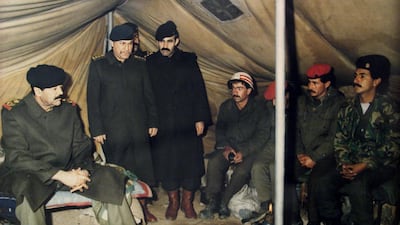
Saddam Hussein (L) with Iraqi troops in occupied Kuwait in 1990-1991. AFP -
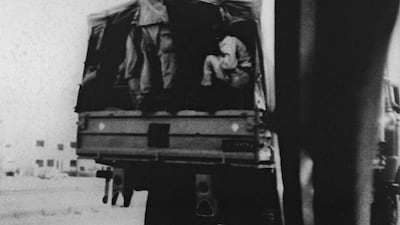
Iraqi soldiers in Kuwait City on August 3, 1990. AFP -

Sheikh Fahd Al Ahmed al-Sabah (C), brother of Emir of Kuwait, during the 1982 World Cup in Valladolid, Spain. He was killed by Iraqi troops during the invasion of Kuwait in 1990. AFP -
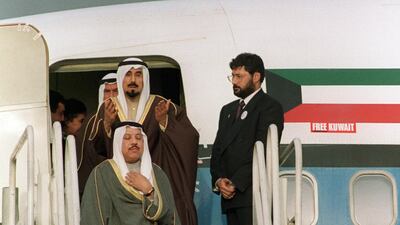
Sheikh Jaber Al Ahmad Al Sabah (top), Emir of Kuwait, disembarks on March 14, 1991 upon his arrival at Kuwait after seven months in exile during the Iraqi occupation of his country. AFP -
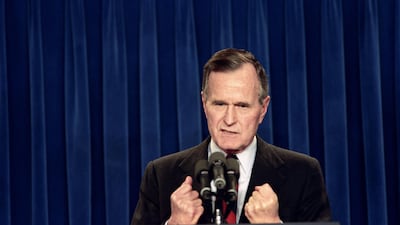
US President George Bush, the architect of the liberation of Kuwait, in Washington, on November 30, 1990. AFP -
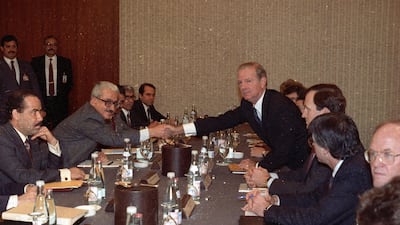
US Secretary of State James Baker (5th R) and Iraqi Foreign Minister Tariq Aziz in Geneva January 9, 1991. The meeting failed to convince Saddam to leave Kuwait, setting the scene for the Gulf War. Reuters -
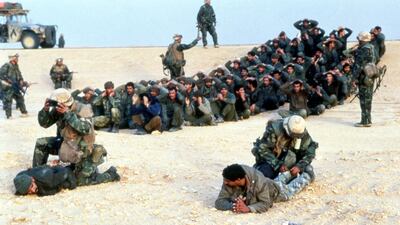
Iraqi prisoners of war in Saudi Arabian after giving themselves up to US troops in 1991. AP -
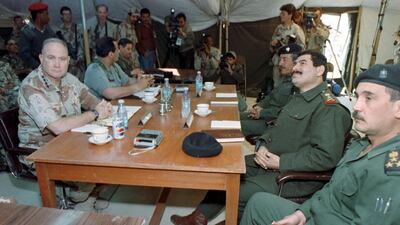
Allied Forces Commander Norman Schwarzkopf (L) meeting with Iraqi General Sultan Hashim (2nd R) in Safwan in Iraq on March 3, 1991, to set conditions for Iraq's surrender in the Gulf War. Reuters -
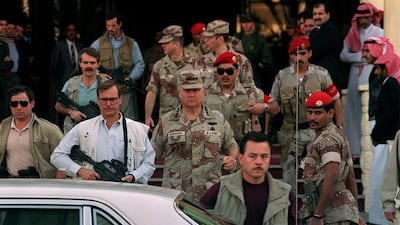
US General Norman Schwarzkopf (C), in Riyadh on February 10, 1991. AFP -
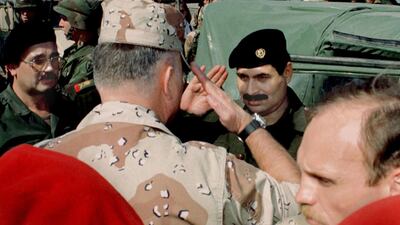
US General Norman Schwarzkopf (L), Allied Gulf War Commander, and General Sultan Hashim of Iraq (R) after talks to discuss Iraqi surrender terms in the Gulf War, in Safwan in south Iraq, on March 3, 1991. Reuters -
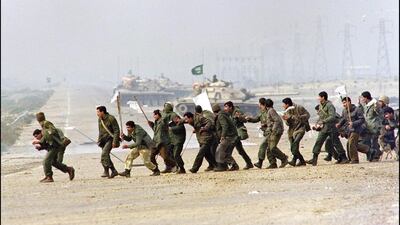
Iraqi soldiers carrying surrender flags on February 25, 1991 in Kuwait City. AFP -
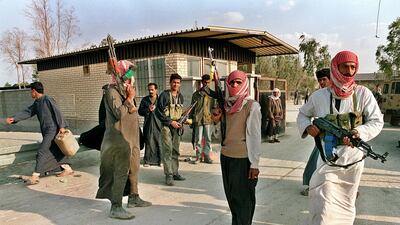
Shiite rebels on the outskirts of the southern Iraqi city of Nasiriyah on March 27, 1991. Saddam crushed the rebellion, although he was defeated in the Gulf War. AFP -
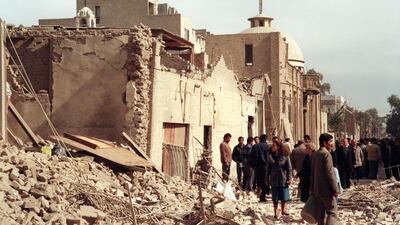
A photo dated February 16, 1991 showing damage near a church caused by an allied bombing raid in Baghdad. AFP -
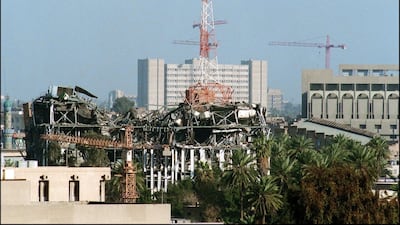
A view dated March 8, 1991 of damage in downtown Baghdad from an Allied air strike or missiles raid. AFP -
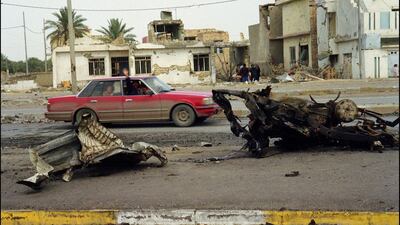
A car on February 7, 1991 in Samawa, south of Baghdad, after an allied bombing raid. AFP


As a correspondent attached to Britain’s legendary 7th Armoured Division – more commonly known as the Desert Rats – I saw for myself the close co-operation that was briefly established between the numerous countries participating in Operation Desert Storm, as the mission to liberate Kuwait was officially known.
After coalition forces eventually succeeded in inflicting a heavy defeat on the Iraqi forces through a carefully targeted campaign lasting just six weeks, I also witnessed the terrible destruction that had been wrought on the Gulf state under Saddam’s brief rule.
In common with everyone else witnessing the campaign, I felt a palpable sense that this was the start of a new beginning in the Middle East – one in which traditional rivalries would be set aside for the common good.
This was, after all, the period after the collapse of the Iron Curtain in 1989 had heralded the end of the Cold War between the Soviet Union and the West. There was an overwhelming desire to establish a new, rules-based, global framework that would work to prevent future conflict.
In what former US president George HW Bush dubbed the start of a “new world order”, countries around the globe committed themselves to the peaceful resolution of conflicts between states.
Thirty years later, the notion that the international community can summon the same level of global resolve that followed Saddam'sinvasion of Kuwait seems fanciful. You only have to look at the deep divisions that have arisen between major powers, such as the US and China, over their response to the coronavirus pandemic to see that, these days, the concept of global co-operation appears to be wishful thinking.
On the contrary, if an event similar to the invasion of Kuwait were to occur today, it would more likely result in the development of a wider conflict in which the deep-seated rivalries between the world’s major powers would be played out on the battlefield, rather than being resolved at the negotiating table.
The brutal civil war in Syria is a case in point. Rather than there being universal condemnation of the Assad regime for its brutal suppression of opposition, the world has become deeply divided between those who oppose the Baathist dictatorship in Damascus, and those who have helped it to survive in power.
Indeed, the ongoing controversy over Iran's nuclear programme could just as easily result in a similar stand-off between some of the world's major powers, with Washington determined to increase the pressure on Tehran to renegotiate the terms of its 2015 nuclear deal while other global powers support Iran.
Two key factors explain the fracture in international co-operation that has taken place in the 30 years since Kuwait was liberated.
The first evidence of a shift in attitude, particularly among the western powers, came in the aftermath of the September 11 attacks in 2001, when Washington's uncompromising approach, especially with regard to its determination to achieve regime change in Baghdad, caused serious friction, with countries like France and Germany voicing their bitter opposition to Saddam's overthrow.

Another important consideration that helps to explain the deep divisions that have emerged on the world stage is the resurgence of countries like Russia as major competitors to the US in regions like the Middle East, where Washington's long-standing dominance now finds itself under threat.
The decline in Washington's position in the region began under former US president Barack Obama, whose disinclination to become involved in some of its more challenging issues, such as the Syrian conflict and the emergence of ISIS, helped to create a dangerous vacuum. Moreover, the isolationist tendencies voiced by Donald Trump, the current incumbent, who makes no secret of his desire to scale down America's military presence, have exacerbated this trend, as has his unflinching support for the right-wing government of Israeli Prime Minister Benjamin Netanyahu and its plans to unilaterally annex large swathes of Palestinian territory.
The changing political landscape in the Middle East caused by the decline in American influence during the past three decades certainly provides a major challenge for the Arab world. Thirty years ago the spirit of unity fostered by Saddam's aggression resulted in a memorable victory for the multinational coalition. And it is vital that Arab leaders find a similar spirit of solidarity today if they are to prevail over the many challenges they are likely to face in the years to come.
Con Coughlin is the Telegraph’s defence and foreign affairs editor

