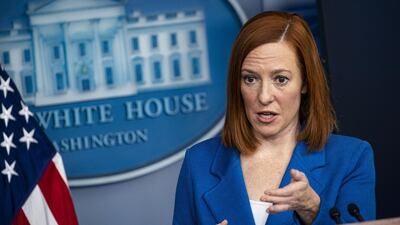

Social media has impacted politics and discourse so profoundly and suddenly that it's very difficult to gauge what it's doing in real time – especially when one participates in it. I had just such an experience last week when on Twitter I questioned the effectiveness of President Joe Biden's press secretary, Jen Psaki.
I have a mere 30,000 followers, but over 11,000 people replied. Most of them disagreed with me, some of them reasonably but others with outrage.
I found the novel experience interesting, and frequently amusing, but also instructive. My inclination is not to give it a second thought. Yet, at the request of the editors of this newspaper, I'm going to reflect on the lessons I drew from this rather minor, but truly surprising turn of events.
The first is that social media promotes, and almost requires, the instant response; a reliance on a "first thought, best thought" impulse that only works for certain creative artists – Andy Warhol, for example – who operate entirely by instinct.
The dangers for the rest of us are illustrated by the clumsy way I phrased the tweet in question: “Am I really the only one who can see Psaki isn’t up to this crucial role?” It's a reasonable question, but pretty badly posed. It suggests my opinion is a fact, and sounds arrogant.
Moreover, to some people the phrasing that she “isn't up to it" sounded misogynistic, as though any man passing judgment on the performance of any woman, even a senior public figure, is, by definition, re-enacting a sexist trope. I can understand wondering if that's the case, but leaping to such a conclusion immediately renders everyone a stereotype.

Still, bad phrasing on my end. I was aiming at my usual politically informed interlocutors who both know my views and remember her as State Department spokesperson. Instead, I ended up getting the attention of a good chunk of a far broader public, some very irate.
It's not clear how that happened, but it doesn't matter. About half of the responders simply disagreed or replied, very reasonably, "yes" or "yes, you are alone". But many others angrily assumed that I must be a passionate Donald Trump supporter, a notion likely to surprise readers of this newspaper. In addition, it was consistently asserted that I must have been satisfied with Mr Trump's four mouthpieces, when in fact each was worse than the next and all totally incompetent.
The most unhinged replies were naturally also the most amusing. My favourite was one asserting that I "look like a child molester", which I found as creative and magnificently off point as it was deranged. A good deal of creative abuse was hurled at me, but it's impossible to take such silliness seriously.
This overwrought degree of emotional investment is partly the result of so many Americans being profoundly traumatised by four years of Mr Trump's maladministration, endless lies and, eventually, effort to overturn a free and fair election. We are therefore now living in a moment, however fleeting, where questioning the performance of any aspect of the Biden administration can appear a wretched betrayal.
Moreover, because Ms Psaki is honest and probably about average for pre-Trump White House press secretaries, for many she is a breath of fresh air. My view is that, given the challenges they face, this administration needs exceptional talent, especially regarding outreach to a fractured nation. It was as if I had told people who hadn't eaten for four years that the pack of cheese crisps they just found isn't really all that nutritious.
In addition, many Americans have been drawn closely into the political realm because of the traumatic Trump experience. Many now paying close attention to Ms Psaki may not have paid much attention to White House press secretaries before four or five years ago. And even for those who do, or at least should, remember them, post-modern subjectivity – which is of course exemplified by Twitter – has a nasty habit of erasing historical memory like an overfilled hard drive.
All that matters is the here and now and our immediate reactions to that, and if it isn't on television or social media, it isn't happening at all. For adherents of QAnon and other conspiracy theories, although their collective delusions exist only on social media, they are more real than reality.

The evanescence of social media is the biggest argument against writing this column in the first place. By now, Twitter has moved on and it's as if the whole thing never happened.
Beyond even the illusion of intimacy – and the misleading rush of dopamine users get from quick flashes of anger at heretics, or the much more damaging long infusions of dopamine that come from the false revelations of conspiratorial delusion – social media seems increasingly bound up with the demise of the political.
It's been brewing for some time, but since the Trump presidency, what often passes for American civic engagement has become more emotional and affiliative than, strictly speaking, political on all sides. US politics is often called "tribal", but these tribes are largely defined symbolically – by adhering to certain icons, including leaders, various forms of virtue signalling and political correctness, and, above all, sharing the same enemies. That, of course, is why it was assumed I must be a Trump follower.
But politics is about power, which requires organising and, in a country like the US, voting and raising money, not emoting. Large numbers of Americans on both the left and the right are wasting enormous amounts of energy shouting into social media echo chambers and mistaking that for political engagement. It's not, because it won't make a bit of difference. It turns citizens into what Prof Eitan Hersh aptly dubs "political hobbyists".
The most extreme, horrifying example is the astonishingly large number of Trump supporters involved in the insurrectionary attack on Congress who, it turns out, didn't bother to vote in the election they were rampaging to overturn.
That's a million miles away from someone who simply mistakes outraged tweeting for political activism, and there is hardly any comparison. Yet both, in their own very different ways, demonstrate how umbrage can displace engagement, particularly when enveloped by the warm, narcissistic embrace of social media fantasies of intimacy, insight and empowerment.
Hussein Ibish is a senior resident scholar at the Arab Gulf States Institute and a US affairs columnist for The National

