
When the Special Tribunal for Lebanon issued its verdict last week, the court’s presiding judge, David Re, stated several times that not enough evidence was available to prove that certain suspects were guilty of the crimes for which they had been indicted. The accused were entitled to a presumption of innocence, but Mr Re’s clarifications were nonetheless very odd.
The reason was simple. In 2005, the United Nations had established a commission to investigate the assassination of the former Lebanese prime minister, Rafik Hariri. It worked for years to gather evidence. However, after 2006 the investigation had not advanced much, for reasons that remain unclear but are probably political in nature. Mr Re’s repeated assertions that evidence was lacking only confirmed this conclusion.

My own reporting on the investigation upheld such a view. In January 2008, I had interviewed the first commissioner of the UN investigative team, the German judge Detlev Mehlis. He had told me, speaking of his successor, the Belgian judge Serge Brammertz, “I haven’t seen a word in his reports during the past two years confirming that he has moved forward. When I left we were ready to name suspects, but [the investigation] seems not to have progressed from that stage.”
An initial UN inquiry of the Hariri assassination had concluded that the crime involved “considerable finance, military precision in its execution, [and] substantial logistical support”. Yet only one suspect, Salim Ayyash, was found guilty last week. Many Lebanese were angered by the paltry results of a trial that had begun in 2014. And the consequences should not have been be welcomed by the United Nations either, whose credibility was tied to the success of the Special Tribunal for Lebanon, the first court to deal with terrorism as a distinct crime.
That’s the theory at least. The reality appears to be different. While the UN hardly benefited from a botched investigation and a trial that ended with only one suspect being found guilty, everything about its actions indicated it was never very keen to be successful. For starters, the UN suspiciously promoted Mr Brammertz to the prestigious post of prosecutor for the former Yugoslavia at the International Criminal Court, despite – or perhaps because of – his lethargy in Beirut.
Mr Brammertz must have sensed early on that the UN did not want a thorough investigation of the type that Mr Mehlis had intended. In fact, when asked whether the UN had hindered his investigation, the German judge replied that the secretary general in 2005, Kofi Annan, while supportive of his work, “had made it clear to me that he did not want another trouble spot”. Perhaps Mr Brammertz had the professional drive to take Annan’s warnings more to heart.
In light of Annan’s comments, to what extent did the UN bureaucracy actually want the STL to succeed? As an organisation, the UN avoids conflicts between member states that may undermine its work. The Hariri assassination had all the makings of a major headache. Syria and Iran were likely involved and Hezbollah’s participation could have provoked a sectarian conflict in Lebanon. From the beginning, it seemed that the truth could come with a steep price tag.
Yet the investigation process and trial were played up as necessary to end immunity in political crimes. The UN did not tamp down such expectations, having to justify the nearly $1 billion needed to fund the tribunal, and the fifteen-year waiting period for the verdict. But the reality today is that the trial process has in no way ended immunity. The tribunal’s verdict betrayed the hopes of the Lebanese, but it also ensured that expectations about what the UN could achieve remained modest—a plus for a risk averse organisation that has much to be modest about.
-

Former Lebanese prime minister Saad Hariri reacts and speaks to the press as he leaves the UN-backed Special Tribunal for Lebanon (STL) at Leidschendam after the expected verdict on the 2005 murder of his father, former Lebanese premier Rafik Hariri. AFP -

Former Lebanese Prime Minister Saad Hariri reacts after a session of the United Nations-backed Lebanon Tribunal handing down a judgement in the case of four men being tried in absentia for the 2005 bombing that killed former prime minister Rafik Hariri. Reuters -

A security officer stands guard near the graves of people who were killed in the 2005 bombing that killed former Prime Minister Rafik Hariri, in Beirut, Lebanon. Reuters -
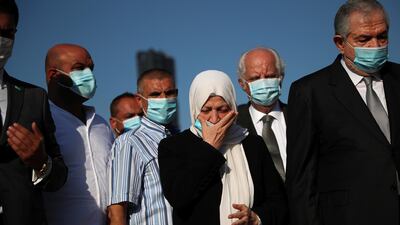
Bahiya Hariri, the sister of Lebanon's former Prime Minister Rafik Hariri, reacts as she prays at his grave, in Beirut, Lebanon. Reuters -
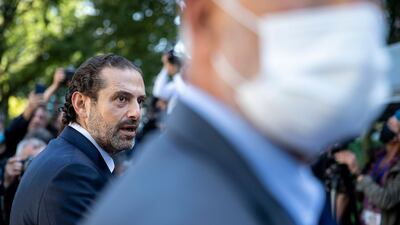
Former Lebanese Prime Minister Saad Hariri speaks after the United Nations-backed Lebanon Tribunal in Leidschendam, Netherlands handed down its judgement. AP -
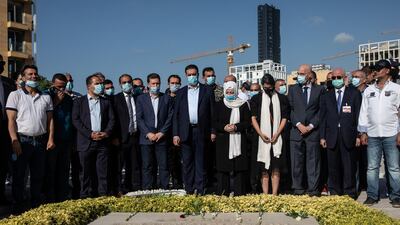
Bahiya Hariri, the sister of Lebanon's former Prime Minister Rafik Hariri, prays at his grave in Beirut, Lebanon. Getty -
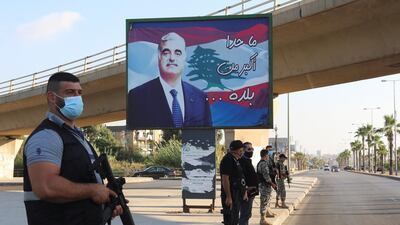
Members of security forces stand guard near a billboard depicting Lebanon's former Prime Minister Rafik Hariri, who was killed in a 2005 suicide bombing, in Sidon, southern Lebanon. Reuters -
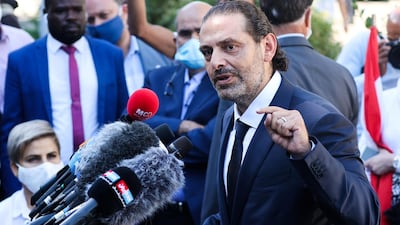
Former Lebanese prime minister Saad Hariri leaves the UN-backed Special Tribunal for Lebanon (STL) at Leidschendam after the expected verdict on the 2005 murder of his father former Lebanese premier Rafik Hariri. AFP -
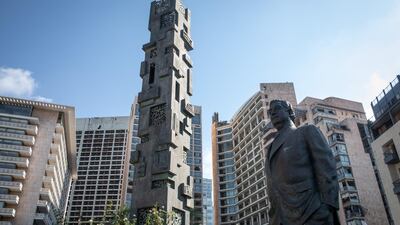
A statue of Lebanon's former prime minister Rafik Hariri is seen near the site of the 2005 bombing that killed him on August 18, 2020 in Beirut, Lebanon. Getty -
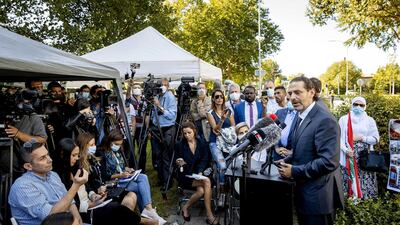
Saad Hariri speaks to the press after leaving the Lebanon Tribunal after the ruling on the assassination of ex-Prime Minister Rafik Hariri of Lebanon in Leidschendam, The Netherlands. EPA


But why blame the UN alone? In my research I came to realise that a large number of Lebanese politicians and regional governments who had been vocal supporters of the UN investigation process did not actually want it to find the guilty parties. It was as if they were adhering to a code of silence on criminal activity. As everyone assured us that justice was coming, they had already thought of ways to transcend the trial process and ignore the culpability of the killers.
Amid all this cynicism, the families of the victims merit a sympathetic thought. For a long time they were deceived into thinking that the trial would bring closure. Instead, they have been playing a part for a decade and a half in a charade orchestrated by the UN. Having lost loved ones once, they now have to come to grips with the fact that they have done so again.
Detlev Mehlis summed up the UN’s investigative process this way in 2008: “This can either be an example of efficient UN involvement or a one-time experiment. The UN’s image is at stake, particularly in Lebanon, where people put high hopes – perhaps too high – in the Hariri investigation.” In a sad way, that double-edged reading was on the money. The Lebanese simply hoped too much.
Michael Young is editor of Diwan, the blog of the Carnegie Middle East programme, in Beirut

