The Pope is welcomed by Iraq's prime minister Mustafa Al Kadhimi on arrival at Baghdad airport. Handout from the office of the Prime Minister of Iraq
Pope Francis smiles with Iraq's prime minister Mustafa Al Kadhimi on arrival at Baghdad airport. Handout from the office of the Prime Minister of Iraq
Pope Francis arrives in Baghdad on his first visit to Iraq. Pope Francis began his historic trip to war-scarred Iraq, defying security concerns and the coronavirus pandemic to comfort one of the world's oldest and most persecuted Christian communities.
Pope Francis is received by Iraqi Prime Minister Mustafa Al Kadhimi upon disembarking from his plane at Baghdad International Airport to start his historic tour in Baghdad, Iraq. Reuters
Pope Francis disembarks a plane as he arrives at Baghdad International Airport. Reuters
Pope Francis arrives in Baghdad on his first visit to Iraq. Pope Francis began his historic trip to war-scarred Iraq, defying security concerns and the coronavirus pandemic to comfort one of the world's oldest and most persecuted Christian communities.
Pope Francis arrives in Baghdad. Reuters
Pope Francis arrives in Baghdad on his first visit to Iraq. Pope Francis began his historic trip to war-scarred Iraq, defying security concerns and the coronavirus pandemic to comfort one of the world's oldest and most persecuted Christian communities.
Pope Francis speaks to journalists aboard the aeroplane heading to Iraq. AP Photo
A plane carrying Pope Francis arrives at Baghdad International Airport to start his historic tour ofIraq. Reuters
It was an emotive moment as Pope Francis landed in Baghdad airport last Friday in the first papal visit to the land of Mesopotamia. The Pope and Iraqi Prime Minister Mustafa Al Kadhimi were beaming as they were met with traditional music and dance. A historic visit that many thought impossible was made possible after all. The burst of colour and music that received the Pope was so familiar to Iraqis, even if they hadn't enjoyed it in quite some time. For some Iraqis it was like blowing the dust off their country and all its vibrancy, buried under years of war and trauma. The joyous reception for the Pope was largely unexpected for most foreign observers. Images of Iraq have usually been of destruction, tension and pain. Women playing musical instruments, young dancers and smiling faces were all too rare a sight.
As the motorcade left Baghdad International Airport, Pope Francis kept waving from his armoured car, showing his appreciation for the crowds lined along the heavily secured road leading from the airport to Baghdad Palace, the main presidential palace, where he received an official welcome.
The defining line of Pope Francis's speech upon his arrival in Iraq was his call to "let the guns fall silent". That call, essentially to stop the warfare that continues to plague the country, resonated with many Iraqis. However, in the hall listening to Pope Francis were some of the very men responsible for not allowing the guns to fall silent or for healing to begin in the country. Rayan Al Kildani, an infamous militia leader, was among those attending, as were a number of other militia leaders. But for that brief moment, they were under one dome, seeing the potential of Iraq, if they would allow the guns to fall silent.
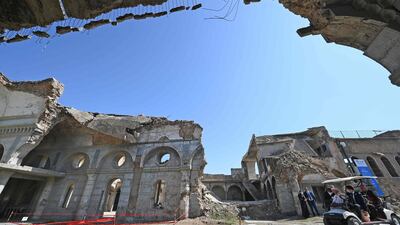
Pope Francis holds a minute of silence at the destroyed cathedral in Mosul's old city. Reuters
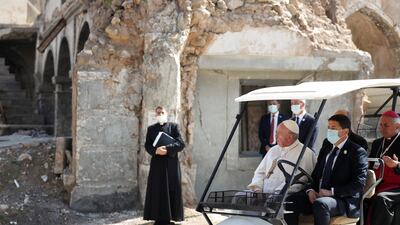
Pope Francis rides in a golf cart at the ruins of the Syriac Catholic Church of the Immaculate Conception. AFP
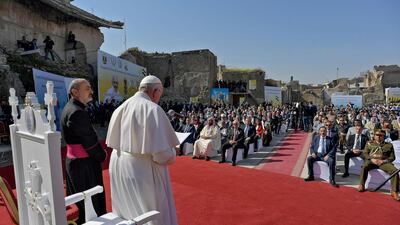
Pope Francis, surrounded by religious dignitaries at a square near the ruins of the Syriac Catholic Church of the Immaculate Conception. AFP
Pope Francis releasing a white dove at a square near the ruins of the Syriac Catholic Church of the Immaculate Conception. AFP
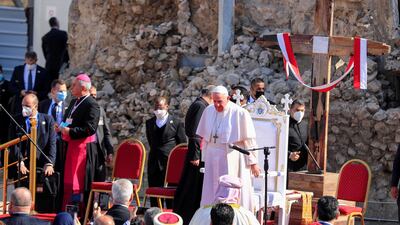
Pope Francis arrives to pray for war victims at 'Hosh al-Bieaa', Church Square, in Mosul's Old City. Reuters
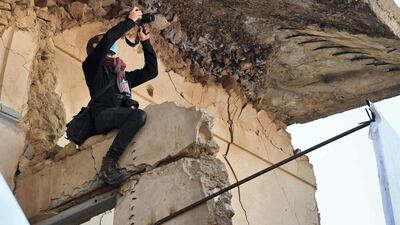
A photojournalist uses his camera from atop a broken wall near the ruins of the Syriac Catholic Church of the Immaculate Conception. AFP
Pope Francis arrives to pray for war victims at 'Hosh al-Bieaa', Church Square, in Mosul's old city, Iraq. Reuters
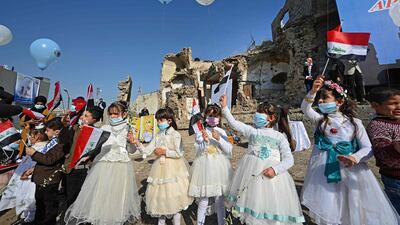
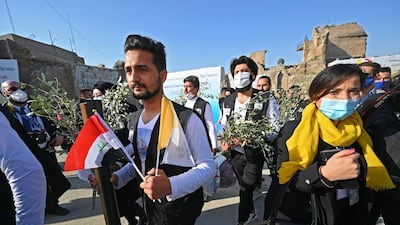
Iraqi children dressed in costumes wave national flags in the ruins of the Syriac Catholic Church of the Immaculate Conception. AFP
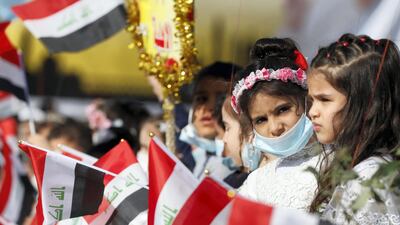
Girls wave national flags as they gather at Church square ahead of Pope Francis' arrival to visit Mosul. Reuters
A member of the Iraqi security forces stands guard as children dressed in costumes wave national flags in the ruins of the Syriac Catholic Church of the Immaculate Conception. AFP
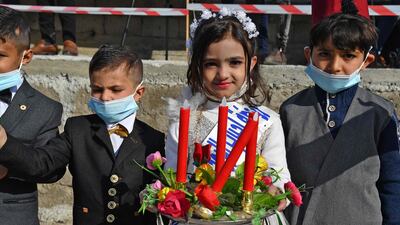
Iraqi children dressed in costumes are pictured in the ruins of the Syriac Catholic Church of the Immaculate Conception. AFP
Iraqis in the northern city of Mosul get ready to welcome Pope Francis. AFP
People prepare before Pope Francis arrives to hold a mass at 'Hosh al-Bieaa', Church Square. Reuters
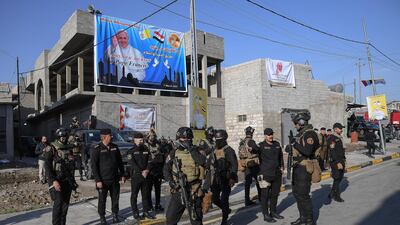
Iraqi soldiers keep watch before the prayer by Pope Francis for the victims of the war in Mosul. EPA
Iraqis gather in the ruins of the Syriac Catholic Church of the Immaculate Conception. AFP
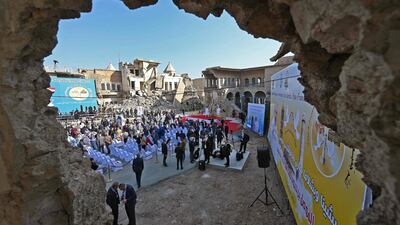
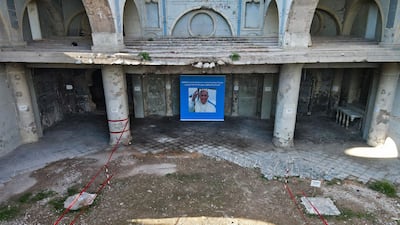
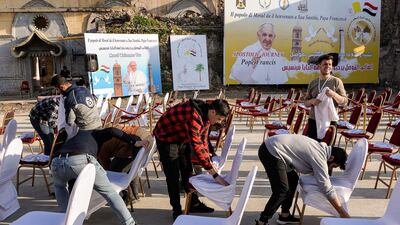
Preparations are under way at the ruins of Al Tahera Church in the Iraq's northern city of Mosul, a day before the arrival of the Pope. AFP
Pope Francis will say prayers for victims of ISIS and war at Al Tahera Church in Mosul’s Church Square, which is surrounded by several places of worship used by Iraq’s different Christian denominations. AFP
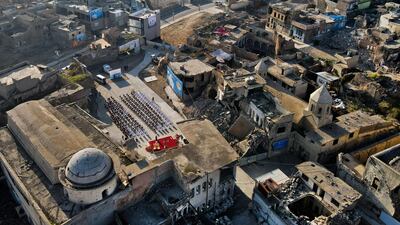
An aerial view of seating arrangements are being made at the ruins of Al Tahera Church. AFP
Syriac Catholic, Syriac Orthodox, Armenian Orthodox and Chaldean Catholic churches can be found in and around the small square that is locked in by low-rise houses in Mosul’s Old City. AFP
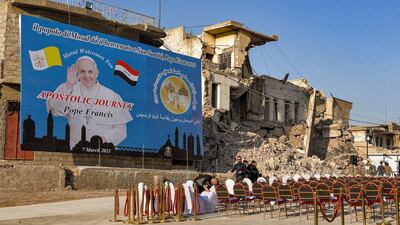
Organisers lay seats at the ruins of Al Tahera Church in the Old City of Mosul in northern Iraq. AFP
Al Tahera is a symbol of the diversity that has been the story of Mosul for centuries and represents Iraq’s once-flourishing Christian community. AFP
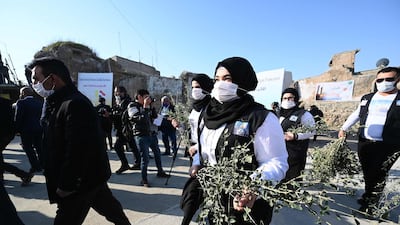
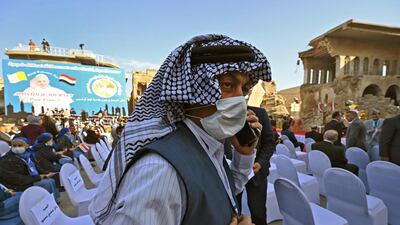
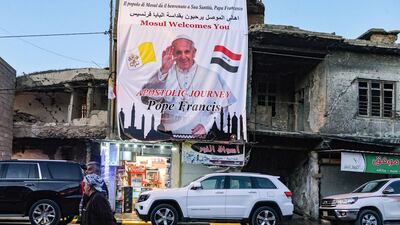
Men walk past a poster of Pope Francis hanging above a ruined building in the Old City of Mosul. AFP
Christians who fled from Mosul after the ISIS rampage have been hesitant to return because of the post-war situation as well as a lack of trust in the government to provide them with the protection they need. AFP
A small minority of extremists, such as those belonging to Kataib Hezbollah, publicly declared their rejection of the Pope’s visit. In a statement on the eve of his arrival, one of the leading voices of Kataib Hezbollah, Abu Ali Al Askari, denounced the visit and the specific call for unity among the followers of different religions. For militants, regardless of their sect, this visit threatened their ability to force reactionary and extremist views on the country. Seeing the ultimate Shia authority, Ayatollah Ali Al Sistani, receiving the Pope frustrated militants whose dogma relies on division.
The most poignant moment of the Pope's visit was his praying for Mosul and victims of ISIS. Standing in the Church Square in the Old City, Pope Francis surveyed the extensive damage to the historic site, at times silent in contemplation. The beauty of the old city was brought out with traditional Maslawi folklore songs, sung by jubilant young Iraqis, with the words changed to welcome the papal guests. And while Pope Francis appealed for love and forgiveness to curb extremism, he also called for the curtailing of corruption. For, it is that corruption that has impeded the rebuilding of the city close to four years after it was liberated from ISIS. Social injustice has become a threat as challenging as terrorism.
The visit to Ur reminded much of the world of the forgotten fact that Iraq is the cradle of civilisation, as the birthplace of the Prophet Abraham. A site that should be receiving millions of tourists annually is cut off from the world, miles away the troubled city of Nasiriya where young activists have been killed and kidnapped systematically for months.
From Baghdad to Ur, to Najaf to Mosul, to Qaraqosh to Erbil, the Pope was received with joy. Millions of Iraqis, inside the country and abroad, were glued to their television screens following his every word. And while there was joy with each sound of ululation, there were tears. The joy of the visit was laced with the sense of loss and pain, of the knowledge that what Iraq witnessed during the Pope’s historic four-day visit was a passing moment, as the elements of corruption and militancy have become entrenched in the system and would probably dominate the near future.
"Iraq will always remain in my heart. I ask all of you, dear brothers and sisters, to work together, united for a future of peace and prosperity that leaves no one behind and discriminates against no one. I assure you of my prayers for this beloved country." With those words, Pope Francis left Iraq. Soon after the papal plane departed to Rome on Monday morning, Prime Minister Al Kadhimi issued a call for an open dialogue between the different factions. He has long advocated for an Iraq rich in its diversity and multitude of identities but united under the banner of a sovereign nation. "In the atmosphere of love and tolerance promoted by the visit of His Holiness the Pope to Iraq, we call today for a national dialogue as a pathway for achieving the aspirations of our people," Mr Al Kadhimi said. "We invite all political forces, young protesters and opponents of the government to be part of a responsible dialogue." The invitation is a sincere one but unlikely to bring about the desired outcome, as vested interests of political and militant forces appear too strong.
In his letter inviting the Pope to Iraq, dated June 19, 2019, and two years after the liberation from ISIS, Iraqi President Barham Salih said: "It is my sincere hope that your Holiness' trip will be a milestone in the healing process, and Iraq can once more be a peaceful land, where the mosaic of religions and faiths can live together in harmony again, as they did for millennia." That is the hope of all Iraqis. The Pope did his part, accepting the invitation and visiting Iraq in the most challenging of circumstances. Now Iraq's political leaders must do theirs.
Mina Al-Oraibi is editor-in-chief of The National

Ten tax points to be aware of in 2026
1. Domestic VAT refund amendments: request your refund within five years
If a business does not apply for the refund on time, they lose their credit.
2. E-invoicing in the UAE
Businesses should continue preparing for the implementation of e-invoicing in the UAE, with 2026 a preparation and transition period ahead of phased mandatory adoption.
3. More tax audits
Tax authorities are increasingly using data already available across multiple filings to identify audit risks.
4. More beneficial VAT and excise tax penalty regime
Tax disputes are expected to become more frequent and more structured, with clearer administrative objection and appeal processes. The UAE has adopted a new penalty regime for VAT and excise disputes, which now mirrors the penalty regime for corporate tax.
5. Greater emphasis on statutory audit
There is a greater need for the accuracy of financial statements. The International Financial Reporting Standards standards need to be strictly adhered to and, as a result, the quality of the audits will need to increase.
6. Further transfer pricing enforcement
Transfer pricing enforcement, which refers to the practice of establishing prices for internal transactions between related entities, is expected to broaden in scope. The UAE will shortly open the possibility to negotiate advance pricing agreements, or essentially rulings for transfer pricing purposes.
7. Limited time periods for audits
Recent amendments also introduce a default five-year limitation period for tax audits and assessments, subject to specific statutory exceptions. While the standard audit and assessment period is five years, this may be extended to up to 15 years in cases involving fraud or tax evasion.
8. Pillar 2 implementation
Many multinational groups will begin to feel the practical effect of the Domestic Minimum Top-Up Tax (DMTT), the UAE's implementation of the OECD’s global minimum tax under Pillar 2. While the rules apply for financial years starting on or after January 1, 2025, it is 2026 that marks the transition to an operational phase.
9. Reduced compliance obligations for imported goods and services
Businesses that apply the reverse-charge mechanism for VAT purposes in the UAE may benefit from reduced compliance obligations.
10. Substance and CbC reporting focus
Tax authorities are expected to continue strengthening the enforcement of economic substance and Country-by-Country (CbC) reporting frameworks. In the UAE, these regimes are increasingly being used as risk-assessment tools, providing tax authorities with a comprehensive view of multinational groups’ global footprints and enabling them to assess whether profits are aligned with real economic activity.
Contributed by Thomas Vanhee and Hend Rashwan, Aurifer
Skoda Superb Specs
Engine: 2-litre TSI petrol
Power: 190hp
Torque: 320Nm
Price: From Dh147,000
Available: Now
Mercer, the investment consulting arm of US services company Marsh & McLennan, expects its wealth division to at least double its assets under management (AUM) in the Middle East as wealth in the region continues to grow despite economic headwinds, a company official said.
Mercer Wealth, which globally has $160 billion in AUM, plans to boost its AUM in the region to $2-$3bn in the next 2-3 years from the present $1bn, said Yasir AbuShaban, a Dubai-based principal with Mercer Wealth.
“Within the next two to three years, we are looking at reaching $2 to $3 billion as a conservative estimate and we do see an opportunity to do so,” said Mr AbuShaban.
Mercer does not directly make investments, but allocates clients’ money they have discretion to, to professional asset managers. They also provide advice to clients.
“We have buying power. We can negotiate on their (client’s) behalf with asset managers to provide them lower fees than they otherwise would have to get on their own,” he added.
Mercer Wealth’s clients include sovereign wealth funds, family offices, and insurance companies among others.
From its office in Dubai, Mercer also looks after Africa, India and Turkey, where they also see opportunity for growth.
Wealth creation in Middle East and Africa (MEA) grew 8.5 per cent to $8.1 trillion last year from $7.5tn in 2015, higher than last year’s global average of 6 per cent and the second-highest growth in a region after Asia-Pacific which grew 9.9 per cent, according to consultancy Boston Consulting Group (BCG). In the region, where wealth grew just 1.9 per cent in 2015 compared with 2014, a pickup in oil prices has helped in wealth generation.
BCG is forecasting MEA wealth will rise to $12tn by 2021, growing at an annual average of 8 per cent.
Drivers of wealth generation in the region will be split evenly between new wealth creation and growth of performance of existing assets, according to BCG.
Another general trend in the region is clients’ looking for a comprehensive approach to investing, according to Mr AbuShaban.
“Institutional investors or some of the families are seeing a slowdown in the available capital they have to invest and in that sense they are looking at optimizing the way they manage their portfolios and making sure they are not investing haphazardly and different parts of their investment are working together,” said Mr AbuShaban.
Some clients also have a higher appetite for risk, given the low interest-rate environment that does not provide enough yield for some institutional investors. These clients are keen to invest in illiquid assets, such as private equity and infrastructure.
“What we have seen is a desire for higher returns in what has been a low-return environment specifically in various fixed income or bonds,” he said.
“In this environment, we have seen a de facto increase in the risk that clients are taking in things like illiquid investments, private equity investments, infrastructure and private debt, those kind of investments were higher illiquidity results in incrementally higher returns.”
The Abu Dhabi Investment Authority, one of the largest sovereign wealth funds, said in its 2016 report that has gradually increased its exposure in direct private equity and private credit transactions, mainly in Asian markets and especially in China and India. The authority’s private equity department focused on structured equities owing to “their defensive characteristics.”
Starring: Sam Worthington, Sigourney Weaver, Zoe Saldana
Rating: 4.5/5
What is the FNC?
The Federal National Council is one of five federal authorities established by the UAE constitution. It held its first session on December 2, 1972, a year to the day after Federation.
It has 40 members, eight of whom are women. The members represent the UAE population through each of the emirates. Abu Dhabi and Dubai have eight members each, Sharjah and Ras al Khaimah six, and Ajman, Fujairah and Umm Al Quwain have four.
They bring Emirati issues to the council for debate and put those concerns to ministers summoned for questioning.
The FNC’s main functions include passing, amending or rejecting federal draft laws, discussing international treaties and agreements, and offering recommendations on general subjects raised during sessions.
Federal draft laws must first pass through the FNC for recommendations when members can amend the laws to suit the needs of citizens. The draft laws are then forwarded to the Cabinet for consideration and approval.
Since 2006, half of the members have been elected by UAE citizens to serve four-year terms and the other half are appointed by the Ruler’s Courts of the seven emirates.
In the 2015 elections, 78 of the 252 candidates were women. Women also represented 48 per cent of all voters and 67 per cent of the voters were under the age of 40.
The flights
Fly Etihad or Emirates from the UAE to Moscow from 2,763 return per person return including taxes. Where to stay
Trips on the Golden Eagle Trans-Siberian cost from US$16,995 (Dh62,414) per person, based on two sharing.
- At 9.16pm, three suicide attackers killed one person outside the Atade de France during a foootball match between France and Germany - At 9.25pm, three attackers opened fire on restaurants and cafes over 20 minutes, killing 39 people - Shortly after 9.40pm, three other attackers launched a three-hour raid on the Bataclan, in which 1,500 people had gathered to watch a rock concert. In total, 90 people were killed - Salah Abdeslam, the only survivor of the terrorists, did not directly participate in the attacks, thought to be due to a technical glitch in his suicide vest - He fled to Belgium and was involved in attacks on Brussels in March 2016. He is serving a life sentence in France
2002: "Hezbollah supporters feared becoming a target of security services because of the effects of [9/11] ... discussions on Hezbollah policy moved from mosques into smaller circles in private homes." Supporters in Germany: 800
2013: "Financial and logistical support from Germany for Hezbollah in Lebanon supports the armed struggle against Israel ... Hezbollah supporters in Germany hold back from actions that would gain publicity." Supporters in Germany: 950
2023: "It must be reckoned with that Hezbollah will continue to plan terrorist actions outside the Middle East against Israel or Israeli interests." Supporters in Germany: 1,250
Source: Federal Office for the Protection of the Constitution
October 26: Bahrain withdraws from a proposal to create a federation of nine with the seven Trucial States and Qatar.
December: Ahmed Al Suwaidi visits New York to discuss potential UN membership.
1971
March 1: Alex Douglas Hume, Conservative foreign secretary confirms that Britain will leave the Gulf and “strongly supports” the creation of a Union of Arab Emirates.
July 12: Historic meeting at which Sheikh Zayed and Sheikh Rashid make a binding agreement to create what will become the UAE.
July 18: It is announced that the UAE will be formed from six emirates, with a proposed constitution signed. RAK is not yet part of the agreement.
August 6: The fifth anniversary of Sheikh Zayed becoming Ruler of Abu Dhabi, with official celebrations deferred until later in the year.
August 15: Bahrain becomes independent.
September 3: Qatar becomes independent.
November 23-25: Meeting with Sheikh Zayed and Sheikh Rashid and senior British officials to fix December 2 as date of creation of the UAE.
November 29: At 5.30pm Iranian forces seize the Greater and Lesser Tunbs by force.
November 30: Despite a power sharing agreement, Tehran takes full control of Abu Musa.
November 31: UK officials visit all six participating Emirates to formally end the Trucial States treaties
December 2: 11am, Dubai. New Supreme Council formally elects Sheikh Zayed as President. Treaty of Friendship signed with the UK. 11.30am. Flag raising ceremony at Union House and Al Manhal Palace in Abu Dhabi witnessed by Sheikh Khalifa, then Crown Prince of Abu Dhabi.
December 6: Arab League formally admits the UAE. The first British Ambassador presents his credentials to Sheikh Zayed.
December 9: UAE joins the United Nations.
THE SPECS
Engine: 6.75-litre twin-turbocharged V12 petrol engine