
It would be an understatement to say that our lives have changed unimaginably over the past few weeks. Hidden behind jokes about whether you can wear pyjamas when conducting a work video from home, or if you have enough dried pasta or toilet paper, we are facing huge existential questions, looking our mortality in the face. Nobody is exempt. All we have is our inner strength and the moral compass to steer us though uncharted waters.
Yet the paradox is that the religious institutions that we turn to in times of crisis – where we gather for solace, the comforting warmth of congregation and spiritual guidance – are increasingly closing their physical doors. They are right to prioritise the physical health of their congregation by stopping gatherings where the virus can spread, but now they need to find ways to fulfil their very raison d'etre: serving people's spiritual and emotional requirements. People need this now more than ever.
-

Muslim worshippers circumambulate the sacred Kaaba in Mecca's Grand Mosque, Islam's holiest site. Saudi Arabia reopened today the area around the sacred Kaaba, reversing one of a series of measures introduced to combat the coronavirus outbreak. AFP -

A Muslim worshipper prays near the sacred Kaaba in Mecca's Grand Mosque. AFP -

Muslim worshippers circumambulate the sacred Kaaba in Mecca's Grand Mosque. AFP -

Muslim worshippers circumambulate the sacred Kaaba in Mecca's Grand Mosque, Islam's holiest site, on March 7, 2020. Saudi Arabia reopened today the area around the sacred Kaaba, reversing one of a series of measures introduced to combat the coronavirus outbreak. Saudi authorities this week suspended the year-round umrah pilgrimage, during which worshippers circle the Kaaba seven times, and also announced the temporary closure of the area around the cube structure. / AFP / Abdel Ghani BASHIR -

This combination of pictures created on March 07, 2020 shows a small crowd of worshippers around the sacred Kaaba in Mecca's Grand Mosque on March 7, 2020 and a large crowd of worshippers around the Kaaba (Tawaf al-Wadaa) during pilgrimage on August 13, 2019. AFP -

Workers disinfect the ground around the Kaaba, the cubic building at the Grand Mosque, in the Muslim holy city of Mecca, Saudi Arabia. Saudi Arabia emptied Islam's holiest site for what they say sterilization over fears of the new coronavirus. AP Photo -

An aerial view shows an empty white-tiled area surrounding the Kaaba in Mecca's Grand Mosque. An eerie emptiness enveloped the sacred Kaaba in Mecca's Grand Mosque, Islam's holiest site, where attendance at Friday prayers was hit by measures to protect against the deadly new coronavirus. AFP -
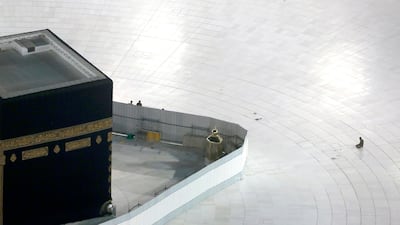
A Saudi policeman prays in front of the Kaaba, the cubic building at the Grand Mosque, in the Muslim holy city of Mecca, Saudi Arabia. AP Photo -

A pilgrim poses for a picture as in front of the Kaaba, the cubic building at the Grand Mosque, during the minor pilgrimage, known as Umrah, in the Muslim holy city of Mecca, Saudi Arabia. At Islam’s holiest site in Mecca, restrictions put in place by Saudi Arabia to halt the spread of the new coronavirus saw far smaller crowds than usual on Monday. AP Photo -

A small number of pilgrims circumambulate around the Kaaba, the cubic building at the Grand Mosque, during the minor pilgrimage, known as Umrah, in the Muslim holy city of Mecca, Saudi Arabia. At Islam’s holiest site in Mecca, restrictions put in place by Saudi Arabia to halt the spread of the new coronavirus saw far smaller crowds than usual on Monday. AP Photo -

Workers clean the Grand Mosque, during the minor pilgrimage, known as Umrah, in the Muslim holy city of Mecca, Saudi Arabia. At Islam’s holiest site in Mecca, restrictions put in place by Saudi Arabia to halt the spread of the new coronavirus saw far smaller crowds than usual on Monday. AP Photo -

A pilgrim, who entered Saudi Arabia before the country halted travel to the holiest sites, takes a rest on a praying carpet at the roof of the Grand Mosque in the Muslim holy city of Mecca, Saudi Arabia. AP Photo -

A muslim pilgrim wears a protective face mask to prevent contracting coronavirus, as he prays at the Grand mosque in the holy city of Mecca, Saudi Arabia. REUTERS -

Muslim pilgrims wear protective face masks to prevent contracting coronavirus, as they arrive at the Grand mosque in the holy city of Mecca, Saudi Arabia. REUTERS -

Muslim pilgrims wear protective face masks to prevent contracting coronavirus, as they arrive at the Grand mosque in the holy city of Mecca, Saudi Arabia. REUTERS -

A travel agency officer tidies up suitcases owned by Umrah pilgrims, after the cancellation of the departure to Mecca following the Saudi government's temporary ban to keep the country safe because of coronavirus outbreak, in Makassar, Sulawesi Selatan, Indonesia. REUTERS -

Umrah pilgrims leave after the cancellation of the departure to Mecca following the Saudi government's temporary ban announced on Thursday to keep the country safe because of coronavirus outbreak, at Soekarno Hatta International Airport, Tangerang, near Jakarta, Indonesia. REUTERS -

Umrah pilgrims are seen after the cancellation of the departure to Mecca following the Saudi government's temporary ban announced on Thursday to keep the country safe because of coronavirus outbreak, at Soekarno Hatta International Airport, Tangerang, near Jakarta, Indonesia. REUTERS


When Saudi Arabia took the difficult but necessary decision to suspend visas for the umrah pilgrimage, pictures never the like seen before of a vast empty space surrounding the Kaaba in Makkah stunned Muslims globally. Mosques around the world have slowly been shutting their doors one by one, meaning that congregational prayers are no longer the daily fixtures of the lives of many. Friday prayers are also suspended in mosques from Dubai to Delhi to New York.
These are agonising decisions for mosques that aim to support communities in fulfilling their spiritual and social needs. After all, if the current crisis has shown us anything, it is that being spiritual and social are fundamental to human existence.
In fact, the closures are affecting all religions, for daily engagement as well as festivals. How Muslims will cope with Ramadan – a month that centres around shared iftars and daily gatherings for night prayers – is hard to imagine.

For Catholics, Pope Francis has moved to live-streaming his sermons in order to avoid gatherings outside his residence. The occasion of Easter looms on the horizon. The closure of the Church of the Nativity in Bethlehem is part of a global wave of churches being shut down. Hindu, Sikh and Buddhist temples are also following suit. Festivals marking Vaisakhi and Buddha's birthday – both due in April – will not see the mass gatherings of communal worship and joy they usually do.
However, we need guidance more than ever in this time of uncertainty and insecurity. For religious institutions, therefore, this is a chance to find a clear voice to speak to people in a fresh, meaningful way. It is a chance to reinvent what is said and how it is said using 21st-century technology, speaking to an audience that will be spending more time on introspection and contemplation of what it means to be human.
To do that, they need to develop a new voice that speaks to people’s worries and anxieties. The proof of this requirement is how some people are turning to eyebrow-raising religious rituals to mitigate the current situation. Some Hindu fringe groups in India have been bathing in cow urine and dung for protection. In Iran, police have arrested people licking shrines. In the US, faith healers are conducting online ceremonies sending their supposed power of healing and protection via the internet.
This is also a chance to speak to all those who have discarded religion as irrelevant – not by proselytising – but by finding meaning in the challenges and new ways of living and socialising. Religious institutions should not be thinking about winning over new adherents but demonstrating leadership in addressing concerns more holistically.
This applies also to groups that have felt excluded from them, such as women and young people.

This week, the archbishops of Canterbury and York wrote a joint letter calling for the Church of England to put public worship on hold and become a "different sort of church" in the coming months. They explained that the physical closures did not mean that they had to "shut up shop" but, instead, needed to adapt towards a model "rooted in the offering of prayer and praise and overflowing in service to the world".
Religious institutions have been using new means of communication, such as live-streaming, podcasts and other downloadable resources, to create spiritual material. But they will also need to deploy new technologies to recreate the sense of congregation; perhaps an augmented-reality prayer session that gives one the feeling of standing shoulder to shoulder in a mosque, or singing hymns side by side in a church.
At the end of the day, while stocks of dried pasta and toilet roll possibly take care of our physical needs, our requirements for spiritual nourishment, strength of character and moral compass need to be addressed more than ever. And so religious institutions need to step up, and do so urgently with fresh voices and methods. The old ways will no longer work, even though the spiritual needs they are addressing are as old as humanity itself.
Shelina Janmohamed is the author of Love in a Headscarf and Generation M: Young Muslims Changing the World

