


For many of us documenting the cruel and inhuman war crimes of the Assad government in Syria, in the dark years that followed the 2016 fall of Aleppo, it often seemed there would be every chance that Bashar Al Assad, his family and his cohorts would get away with the brutality they heaped on their own people.
Now, with the fall of government, the time has come to bring justice back to Syria. Although the International Criminal Court has limited jurisdiction in Syria because Damascus never signed its governing treaty, this does not mean that those of us taking testimonies from survivors of rape, torture, ethnic cleansing and deportation were wasting our time.
Much of the visual documentation of the destruction of Aleppo or Homs was recorded on civilians’ smartphones. It is said that Syria was the most documented war in history – and much of that material now rests in a villa on the grounds of the UN office in Geneva, specifically in the hands of the International, Impartial and Independent Mechanism.
In 2016, the IIIM was mandated by the UN General Assembly to assist in the investigation and prosecution of those responsible for the most serious crimes committed under international law. That documentation is vital evidence of crimes during the Assad era. But now that Mr Al Assad and his family are in Moscow, what possibilities are there for justice for the Syrian people?
There must be justice because the crimes committed in Syria were the most heinous thinkable. The only place I feel compares to the level of criminality that I witnessed in my career would be Gaza, or possibly Sierra Leone or Liberia. It wasn’t unusual that I could come home from a day working in the field in Syria, and literally be sick from what I had witnessed or documented.
Last week, I went through my notebooks and papers, diving back into the dozens of testimonies I took in the years I worked in Syria, first as a journalist, then researching my book about war crimes, The Morning They Came for Us: Dispatches from Syria. More than 200,000 people were killed – and at least 15,000 died from torture, or were killed in the government’s terrible prisons. More than 130,000 are still missing.
The cases I researched were of student activists brutally tortured by government doctors, and tossed into morgues, still alive, to die. Young women, usually virgins, were brutally raped and left bleeding and beaten in prison cells. Children were mutilated in prison and died of their wounds. Families, reduced to making soup from leaves, died as part of Mr Al Assad’s “kneel or starve” campaign.
Today, in the euphoric but cautious weeks after Mr Al Assad’s fall, the accountability community is beginning to track what can be done, now that Syria’s former president is in Russia. The answer is: a lot. While it seems unlikely Mr Al Assad will stand trial, Ahmad Al Shara – Syria’s de facto leader – has said torturers will be prosecuted.
However, the criminality network did not extend to the Assad family only – there was an entire complex of terror. “We are targeting the system,” Fadel Abdulghany, director of the Syrian Network for Human Rights, told The New York Times last month. “The Assad regime is not just the man himself. We need to target the security forces and the army and the tools Assad used to commit those crimes.”
These crimes can be accounted for. One alternative is that national prosecutors in countries outside Syria can file charges under the concept of universal jurisdiction. This means that national courts in a third-party country can prosecute individuals for serious crimes against international law. In 2022, the Koblenz trial in Germany sentenced a former Syrian intelligence officer to life in prison after he was convicted of crimes against humanity. In France, judges issued a warrant for Mr Al Assad’s arrest for his 2013 sarin attacks against his own people in Eastern Ghouta.
The ICC’s chief prosecutor, Karim Khan, can also file charges – perhaps in Jordan, a country that is a member of the ICC and to where about 700,000 Syrians fled to escape government atrocities. There can also be special tribunals or domestic courts.
Things can radically change. Those of us who witnessed the brutalities of the Bosnian war in the 1990s never thought Slobodan Milosevic, the Serbian leader who presided over four wars and the destruction of his country, would ever step foot in The Hague. But a new government came to power, and Milosevic was put on a helicopter to stand trial (he died in his prison cell in 2006). In the same way, a trial in The Hague could also await Mr Al Assad.
-
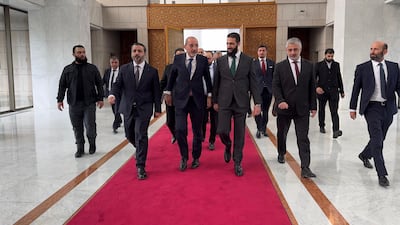
Jordan's Foreign Minister Ayman Safadi meets Syria's de facto leader Ahmad Al Shara in Damascus. Photo: Jordanian Foreign Ministry -
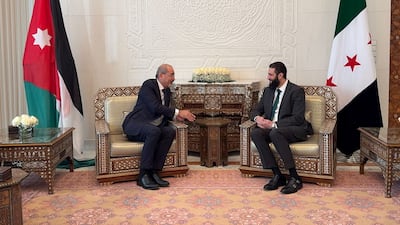
The two men held extensive talks in the Syrian capital. Photo: Jordanian Foreign Ministry -
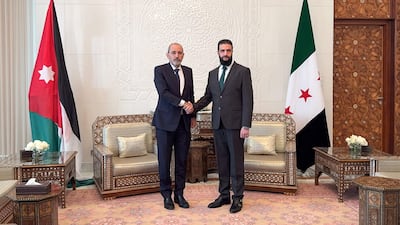
Mr Safadi, left, seen shaking hands with Mr Al Shara, is expected to meet other key Syrian officials during the visit. AFP -
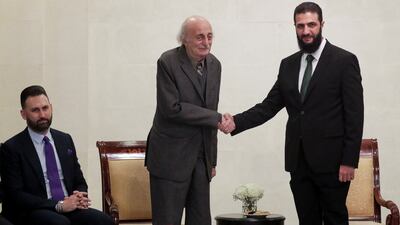
Lebanese Druze leader Walid Jumblatt, with his son Taymur looking on, is received by Mr Al Shara in Damascus. Reuters -
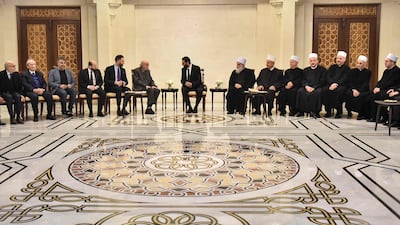
Walid and Taymur Jumblatt in talks with Mr Al Shara, Syria’s interim prime minister Mohammed Al Bashir and Druze leaders in Damascus. AFP -
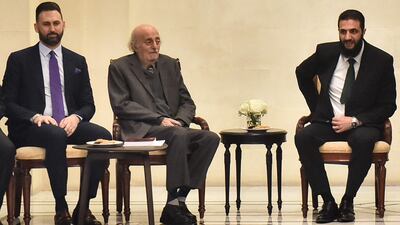
Walid Jumblatt is the first Lebanese leader to meet Mr Al Shara since his Hayat Tahrir Al Sham group and allied rebel factions launched a lightning offensive, seizing Damascus and ousting long-time Syrian president Bashar Al Assad. AFP -
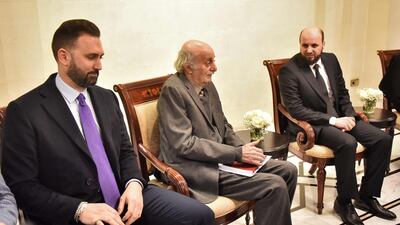
Taymur Jumblatt, Walid Jumblatt and Mr Al Bashir. AFP -
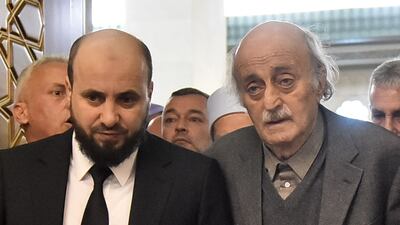
Mr Al Bashir with Walid Jumblatt. AFP -
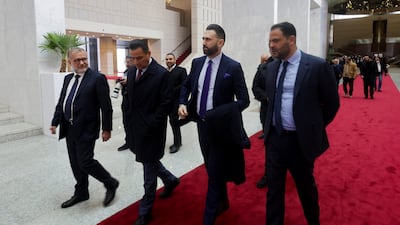
Taymur Jumblatt with officials in Damascus. Reuters -
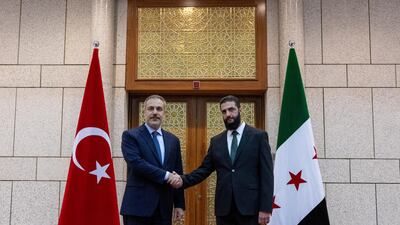
Turkish Foreign Minister Hakan Fidan meets Mr Al Shara in Damascus. Reuters -
Mr Fidan, left, with Mr Al Shara during their meeting. Mr Fidan is the first foreign minister to visit Damascus since president Bashar Al Assad's overthrow two weeks ago. Reuters -
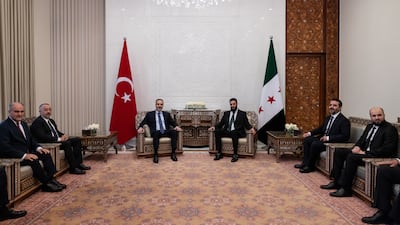
Mr Fidan and Mr Al Shara held talks on Sunday during which they vowed to strengthen bilateral ties. EPA -
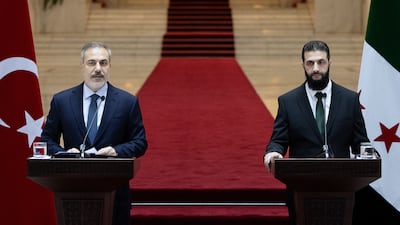
Mr Fidan, left, and Mr Al Shara attend a press conference after their meeting. EPA -
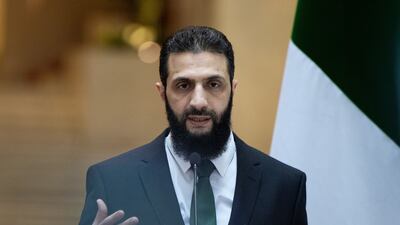
Hayat Tahrir Al Sham leader Mr Al Shara at a press conference after meeting Mr Fidan in Damascus, Syria. EPA -

Mr Fidan at a press conference after a meeting Mr Al Sharaa in Damascus, Syria. EPA


Justice following a war is imperative because without it, there can never be sustainable peace. Transitional justice – the mechanisms that ensure that the wars will not start again – can include memorialisation of the dead and the survivors, such as Kigali’s Genocide Memorial to the one million victims of the 1994 massacres in Rwanda. It can also mean a Truth and Reconciliation Committee, such as the one that operated in South Africa in 1995 and which examined the crimes under apartheid. The real purpose was to uncover the truth.
Domestic courts can also be set up in Syria, letting the Syrian people – whose civil society was courageous and robust in documenting crimes during Mr Al Assad’s time – control their own justice system, as in the Ukrainian model. Or there can be hybrid courts, such as Lebanon’s Special Tribunal after the assassination of former Lebanese prime minister Rafic Hariri.
Without justice, especially for a war as damaging and as cruel as Mr Al Assad’s, there can never be peace. Syria must heal, but it will take decades – generations. One of the most vital ingredients to reaching peace is to ensure that justice is at work.

