

Jimmy Carter, who has died aged 100, once famously said that “I am a better ex-president than I was a president.” It was a typically self-deprecating and charming comment, but also one that wasn’t true. His White House years have been reassessed several times over the decades and many former critics have come to view them with more benevolent eyes than they did in the 1980s.
He won the 1976 election, beating incumbent Gerald Ford, despite entering the presidential race as a little-known former governor from Georgia. Ford had presided over America’s months-long bicentennial celebrations earlier that year and later remarked that the “nation’s wounds had healed” in the act of marking the country’s 200th anniversary. In truth, the scar tissue left by the humiliating retreat from Vietnam and the scandal of Watergate was still very evident in US society.
As Carter’s campaign gathered pace through the autumn, it helped in that febrile moment that he was a Washington outsider and, perhaps, the world's most famous former peanut farmer. He carried the popular vote by the narrowest margin, winning 50.1 per cent of the ballot.

His four years in office delivered key diplomatic wins, notably the Camp David Accords, a regional peace deal between Egypt and Israel, and the Salt-II treaty with the Soviet Union to set limitations on nuclear weapons. He was also an early champion of renewables during the energy crisis of the 1970s, placing him decades ahead of his time, and an honest and compassionate leader who sought consensus in government and progressive change in society.
Above all, he exuded the type of dignified and calm leadership people so often yearn for in politicians today, but ultimately, foreign and domestic woes would hasten his departure from Washington DC in 1981.
The US economy stagnated in the late 1970s, which he tried and failed to fix through Congress, but the 39th president was almost certainly undone by the long-running hostage crisis in Tehran and the unsuccessful mission to rescue the 52 Americans held captive by revolutionaries who had earlier stormed the US embassy in Iran.
The power of Ronald Reagan’s charismatic campaign to “make America great again” at home and abroad swept Carter out of office after a single term. Reagan won 44 of the 50 states in the 1980 election with a little under 51 per cent of the popular vote, while the hostages were eventually released minutes after he was sworn into office in January 1981.
After leaving the White House, it would have been easy for Carter to retreat from public life rather than rush towards it, which he did, with vigour.
Carter Centre work
The Carter Centre, which he co-founded in 1982 with his wife Rosalynn, became the hub for his four decades of work following his four years in DC.
He was awarded the Nobel Peace Prize in 2002 and led the centre’s work with energy and purpose.
It is hard to put a number on how many people the Carter Centre has helped since it was established. Its peace programmes have monitored more than 100 elections in 39 countries. The centre works ceaselessly on conflict resolution.
Its health programme has led the fight to eliminate preventable diseases, including Guinea worm and river blindness. The centre’s mental health programme has improved access to treatment, and its mental health journalism fellowship scheme has trained and supported reporters and editors around the world on how to report fairly and accurately in that field.
The National is the Carter Centre’s country partner in mental health journalism in the UAE and it has been my honour to administer the fellowship programme in the Emirates for the past six years.
Carter led a life of devoted service and leaves an enduring legacy.
Long into his nineties, he exhibited a clarity of thought and expression that many of us struggle to find even in our best moments.
The last time I saw him speak was at the Carter Centre in the immediate pre-Covid period when the term “in-person meeting” would have been considered a redundancy.
Carter's legacy
- Jimmy Carter's obituary: Nobel-winning president who championed humanitarian causes
- Jimmy Carter's devotion to the Middle East
- Jimmy Carter: The green energy pioneer
- Why Jimmy Carter was the rock 'n' roll feminist president
He and Rosalynn, who died in 2023, hosted A Conversation with the Carters and fielded questions from an audience of a few hundred guests in Atlanta.
Even from seats far back in the centre's auditorium it was possible to detect the twinkle in his eyes as he discussed everything from married life – he and Rosalynn wed in 1946 – to the turbulent White House years of Donald Trump, as well as the urgent foreign policy solutions that were required for Iran, Syria, Yemen and North Korea.
On every issue he had a thoughtful and fair perspective. There was neither bitterness nor rancour towards those who succeeded him in Washington DC.
Most presidents end up consumed by the burdens of office when they are in power. So often, too, the post-White House years are a short postscript.
Carter, of course, disrupted that convention, finding fresh spirit and purpose after returning to Georgia and living a long and fulfilling life. He was thoroughly reconciled to the slings and arrows of his presidential years.
As it transpired, his presidency was a mere prelude to one of the most successful and longest running second acts ever in the US. In hindsight, the first act seems very good, too.
The world has lost one of its great post-war western leaders this week and a tireless campaigner for social justice.
Jimmy Carter's life – in pictures
-
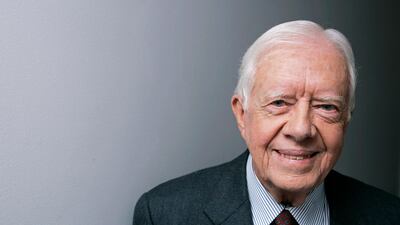
Former US president Jimmy Carter at the Toronto International Film Festival, September 10, 2007, in Toronto. AP -
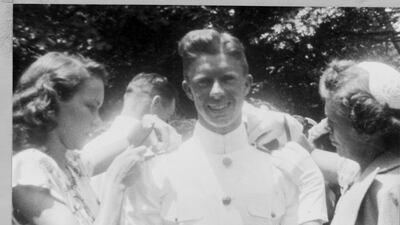
Jimmy Carter's mother, Miss Lillian, right, and his fiancée, Rosalynn Smith, left, at his graduation from the Naval Academy in Annapolis, Maryland, US, on June 5, 1946. EPA -
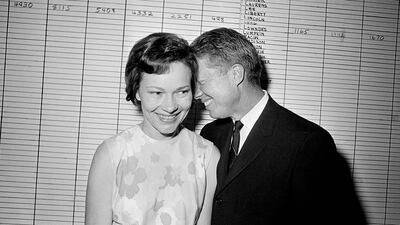
Mr Carter hugs his wife, Rosalynn, at his Atlanta campaign headquarters, September 15, 1966. AP -
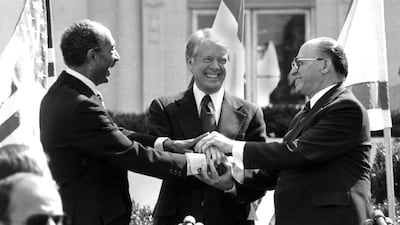
Egyptian President Anwar Sadat, left, Mr Carter, centre, and Israeli Prime Minister Menachem Begin at the White House after signing the peace treaty between Egypt and Israel, March 26, 1979, in Washington. AP -
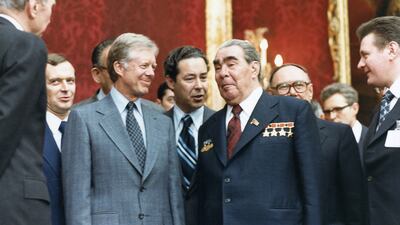
Mr Carter, left, and USSR Secretary General Leonid Brezhnev during a meeting before the signing the SALT II nuclear arms treaty in Vienna, Austria, 15 June 1979. EPA -
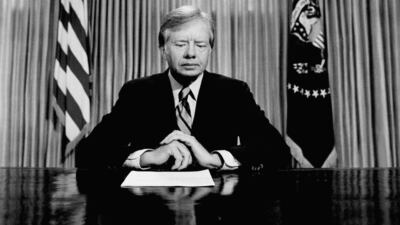
Mr Carter prepares to make a national television address from the Oval Office at the White House, April 25, 1980, in Washington. AP -
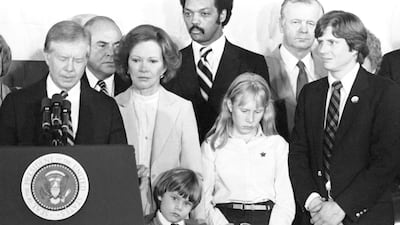
Mr Carter, with his wife Rosalynn, daughter Amy and grandson Jason tells supporters at a Washington hotel that he has conceded the election to challenger Ronald Reagan, November 4, 1980. AP -
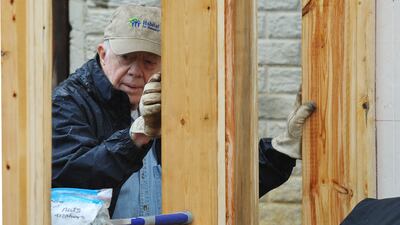
Mr Carter helps erect a frame during a Habitat for Humanity project October 4, 2010 in Washington, DC. AFP



