


Just a few weeks ago, Beijing warmly welcomed its Arab allies for the 10th ministerial meeting of the China-Arab States Co-operation Forum. This was attended by several leading Arab figures, including President Sheikh Mohamed of the UAE.
The resulting Beijing Declaration offered a new blueprint for the future of Arab-China relations, including stronger political and economic ties with a special focus on investment, energy, infrastructure, science and technology, and culture. Organisations were assigned to develop these links, with a clear timetable for progress to be achieved in the two years.
The joint statement also sent a strong and clear message regarding the issue of Palestine, calling for a cease-fire in Gaza and an early date to achieve the comprehensive, just and lasting settlement of conflict.
Celebrating its 20th anniversary, the forum has achieved some remarkable successes, firmly establishing itself as the primary framework for fostering relations between China and the Arab world. Notably, the forum has boosted trade between the two, with it growing nearly tenfold over the past two decades to reach $400 billion, according to figures from China’s State Council.
-
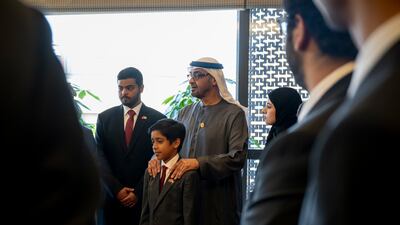
President Sheikh Mohamed meets Emirati students during his state visit to China. All photos: UAE Presidential Court -
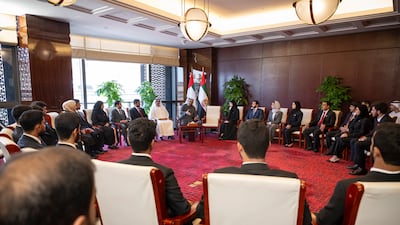
Sheikh Mohamed speaks with the Emirati students. Sheikh Hamed bin Zayed also attended the event. -
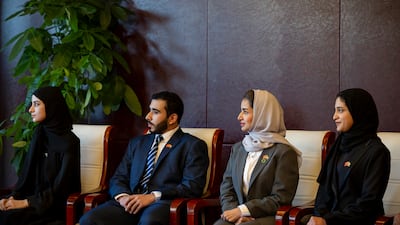
The President urged the students to persevere with their education and learn lessons that will help the UAE to progress. -
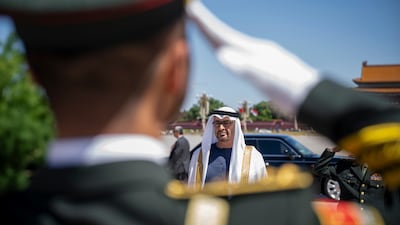
Sheikh Mohamed visits the Monument to the People’s Heroes, in Beijing. -
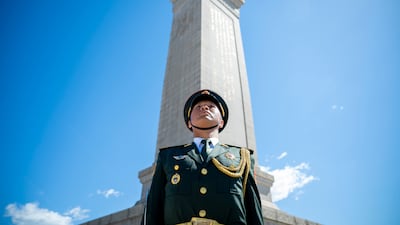
The trip to the monument was part of a two-day state visit, which came after Sheikh Mohamed travelled to South Korea. -
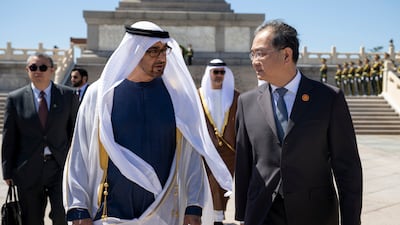
Sheikh Mohamed with Deng Li, China's Vice Minister of Foreign Affairs, at the monument. -
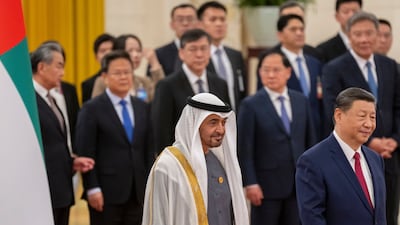
President Sheikh Mohamed attends a reception hosted by China's President Xi Jinping, at the Great Hall of the People in Beijing. -
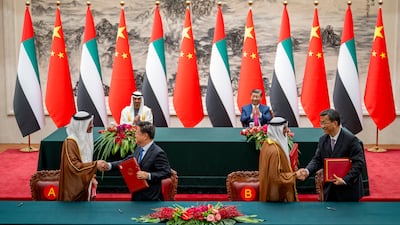
Sheikh Mohamed and Mr Xi witness a signing ceremony at the Great Hall of the People. Sheikh Abdullah bin Zayed, Minister of Foreign Affairs, and Hussain Al Hammadi, UAE ambassador to China, handed over the agreements. -
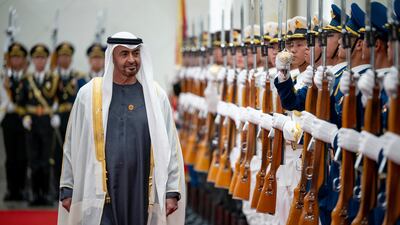
Sheikh Mohamed inspects a guard of honour at the Great Hall of the People, in Beijing. -
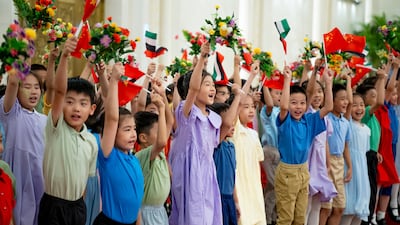
Children wave Emirati and Chinese flags at a state visit reception at the Great Hall of the People. -
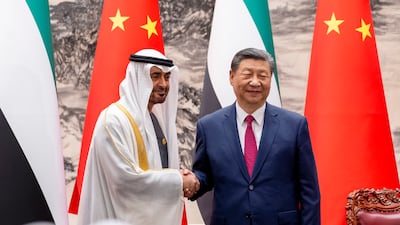
Sheikh Mohamed and Mr Xi witness the exchange of deals between their countries. -
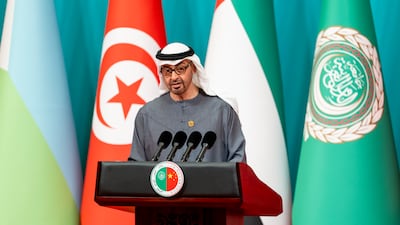
President Sheikh Mohamed at the China-Arab States Co-operation Forum in Beijing. -
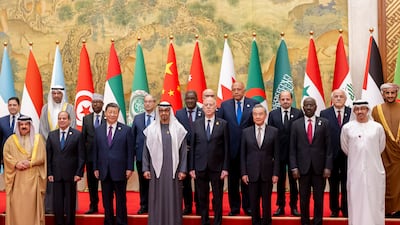
Sheikh Mohamed with Sheikh Abdullah bin Zayed, UAE Minister of Foreign Affairs, at the summit with Chinese President Xi Jinping and Arab leaders including Bahrain's King Hamad and Egyptian President Abdel Fattah El Sisi. -
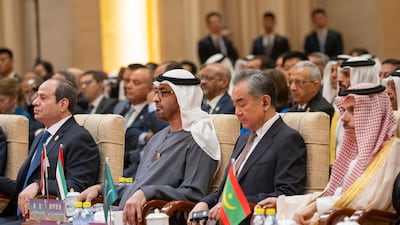
Sheikh Mohamed and Mr El Sisi, far left. -
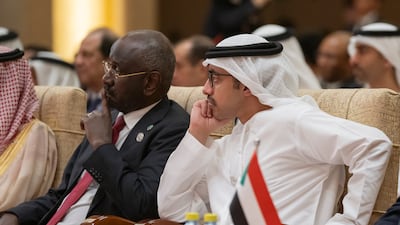
Sheikh Abdullah and Mohamed Salem Ould Merzoug, Minister of Foreign Affairs of Mauritania. -
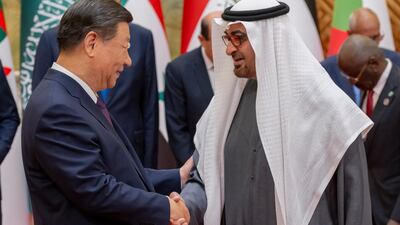
Sheikh Mohamed greets Mr Xi in Beijing. -
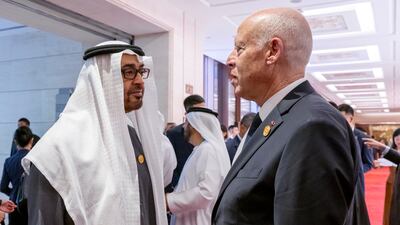
Sheikh Mohamed and Tunisian President Kais Saied. -
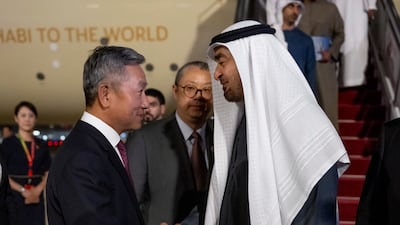
Sheikh Mohamed greets Zhang Yiming, China's ambassador to the UAE. -
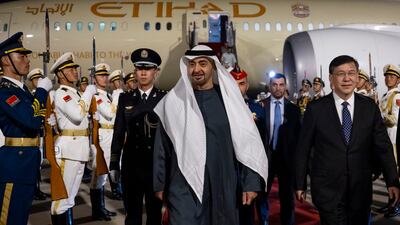
Sheikh Mohamed is welcomed by Yin Hejun, China's Minister of Science and Technology, at Beijing Capital International Airport. -
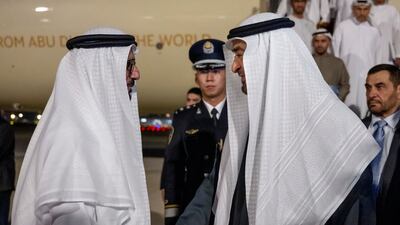
Sheikh Mohamed greets Hussain Al Hammadi, UAE ambassador to China, at the airport. -
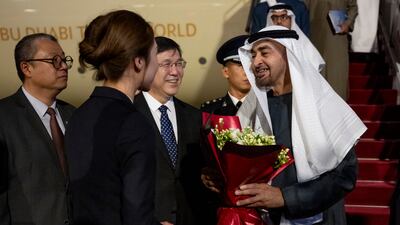
Sheikh Mohamed is presented with flowers by a member of the Chinese delegation. -
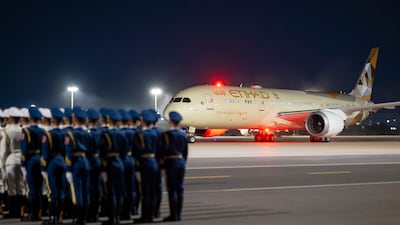
A guard of honour gathers after the Etihad Airways aircraft carrying Sheikh Mohamed lands. -
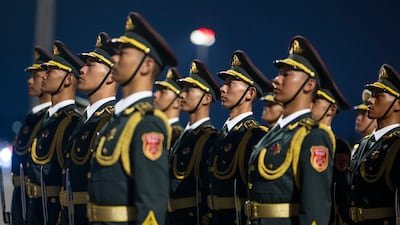
The Chinese guard of honour at Beijing Capital International Airport.


The Emirates has played a pioneering role in strengthening Arab-Chinese relations. In 19990, UAE Founding Father, the late Sheikh Zayed bin Sultan Al Nahyan, became the first Gulf state leader to visit China, and the Emirates was the first Arab country to establish an Arabic language center in Beijing the same year.
Today, trade co-operation between the UAE and China accounts for nearly a quarter of total Arab trade with China. Many major Chinese companies have chosen the Emirates as their base for Middle Eastern operations, drawn by the country’s stability, modern laws and favorable business environment. The UAE hosts the largest Chinese community in the Arab region – about half a million people – and has established the only Chinese school in the Arab world that is recognised by the Chinese Ministry of Education.
Under the care of Sheikh Mohamed, UAE-China relations have continued to flourish. Abu Dhabi was an early partner of China’s Belt and Road Initiative and was a founding member of the China-led Asian Infrastructure Investment Bank. During his visit, Sheikh Mohamed attended celebrations marking the 40th anniversary of the partnership between Beijing and Abu Dhabi, referring to China as his "second hometown," a sentiment that was much appreciated in Beijing. Such strong economic and financial ties with China have reinforced growing Arab influence there.
Politically, two thirds of Arab countries have become strategic partners of Beijing, the highest concentration of such partnerships for China in any region. All Arab states have signed on to China’s Belt and Road Initiative, with an increased number of formidable ambassadors seeking to articulate the Arab world’s perspective in the heart of the Chinese capital. The Arab-China Co-operation Forum has also fostered considerable political understanding – China publicly backs the legitimate rights of the Palestinian people, respects Arab sovereignty and opposes external interference in Arab affairs. Conversely, Arab countries respect the one-China policy and reject interference in China's internal affairs.
Cultural and scientific exchanges have also thrived, with thousands of Arab students studying in China and hundreds of young Chinese pursuing their education in Arab countries. China has incorporated Arabic language and culture into its universities, and the Confucius Institute – non-profit educational institutions jointly established by Chinese and overseas partner institutions – has opened 21 branches in Arab countries. Mandarin Chinese is now part of the curriculum in numerous Arab states, echoing the UAE's decision to begin offering the language as a subject four years ago. Furthermore, given that Chinese public opinion holds the UAE in high regard, the country has become a top tourist destination for Chinese citizens.
China’s President Xi Jinping has significantly enriched Arab-Chinese co-operation through numerous initiatives. These include the 2014 proposal to jointly build the Belt and Road, the 2016 concept of a community of common interests, the decision in 2018 to elevate Beijing’s bilateral relations with the UAE to a comprehensive strategic partnership, and the 2022 proposal to build a community with a shared future. At this summit, Mr Xi proposed five new co-operation frameworks to advance ties with Arab states, providing lasting momentum to Sino-Arab relations.
Over the past two decades, the Arab-China Co-operation Forum has deepened and broadened Arab-Chinese relations, and has allowed Arab countries to co-ordinate their approach to China. Arab countries' concerns are listened to more carefully by Beijing when they act collectively, and the $400 billion in China-Arab trade volume make them an important trading partner.
The forum also countered pressure from the US for its Arab friends to keep a certain distance from the peer competitor that China represents today.
Most of the Arab states have sent a clear message to Washington and Beijing that they have little appetite to join one side or another in the G2 clash. Paradoxically they should try to benefit from the continuing competition of the great powers, a craft they should strive to perfect by committing to developing more China affairs experts and advisors as well as setting an exemplary standard for fair and equal international relations.

