


Several Gulf countries, most notably Bahrain and the UAE, are evolving national identities that emphasise religious tolerance. Some observers will naturally interpret this as an attempt to de-escalate the region’s religious-based violence. However, a deeper examination of the impact of religion reveals an economic benefit to developing more tolerant societies.
It has become fashionable for many modern secularists to demonise religion as being a major barrier to peace. When they learn someone is devout, it often wrongly conjures up images of extreme confessional intolerance, such as the Spanish Inquisition torturing suspected heretics based on flimsy evidence. It is perhaps not a surprise, then, that the significant role religion plays in daily life in Gulf countries – including the political and legal systems – occasionally draws antipathy and hysterically negative media coverage in the West.
Thoroughly investigating the role religion has played in human societies, however, yields a much more complex view. In all human societies, a fundamental problem is how to encourage pro-social behaviour, such as respecting property rights and refraining from marital infidelity, when there isn’t someone monitoring people’s actions. Religious beliefs that reward righteousness and punish deviant behaviour can help overcome this problem, as adherents will fear divine retribution should they behave in an anti-social manner. From the perspective of many 21st-century people who are religious, a lack of belief may breed nihilism of the kind that could encourage destructive acts that are all too common on social media today, such as bullying, narcissism, greed and so on.
-

About 65,000 people turned out at the BAPS Hindu Mandir temple in Abu Dhabi on March 3, the first Sunday it was open. All photos: Pawan Singh / The National -
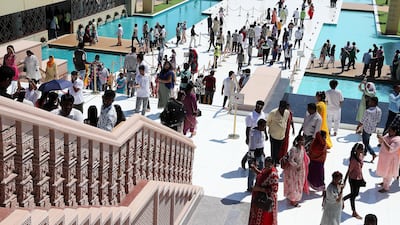
The temple was inaugurated by Indian Prime Minister Narendra Modi in February -

Now, 30,000 people on average visit the complex every Sunday with weekend waiting times of up to 90 minutes -

When the Baps Hindu temple formally opened on February 14, people began queuing almost immediately -
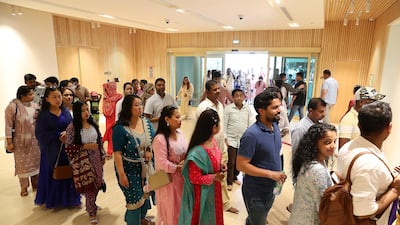
Hindus also expected to converge in large numbers to celebrate the Ram Navami and Hanuman Jayanti festivals -
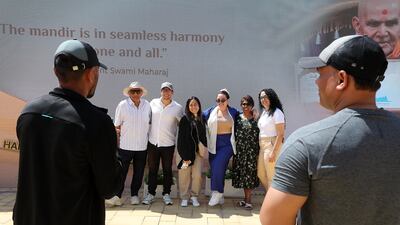
Elaborate carvings of deities are an integral part of the temple -
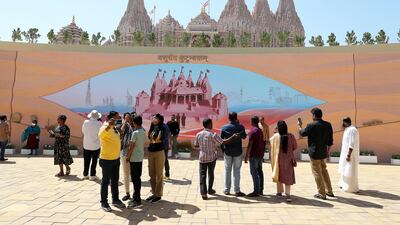
Temple officials are bracing for high numbers of visitors while maintaining a festive atmosphere -

The Baps Hindu Mandir, in the Abu Mureikha area off Sheikh Zayed Road, is open to people of all faiths -

Abu Dhabi’s first Hindu temple is gearing up to welcome tens of thousands of people for several festivals this month -

April is a packed month in the Hindu calendar with celebrations centred around Hindu new year and the spring season


Along these lines, religion’s positive impact on pro-social behaviour allows societies to scale up significantly, going from roving bands of a dozen people (like those you might see in the Mad Max films) to modern cities with much higher levels of mutual trust. This opens the door to the economic benefits associated with specialisation and division of labour.
As societies mature, religion also confers economic benefits by providing a foundation for the concept of rule of law, which is often defined as senior officials being subject to the same legal restrictions as ordinary people. This happens because religious scriptures are – by definition – above all humans, and so everyone, regardless of social status or power, must respect their prescriptions. Since many religiously based rules relate to good governance, such as banning theft and murder, placing these constraints on the people that wield the most power in society yields significant economic benefits.
For Muslims, this is best illustrated by the righteous leadership of the first four Caliphs, Abu Bakr, Umar, Uthman and Ali, all of whom were extremely conscious of the need to respect the same laws that ordinary Muslims had to abide by. The result was a large boost to Muslims’ collective military and economic power compared to some of their contemporary rivals, for whom corruption and arbitrary, unconstrained rule severely undermined the quality of their public administration.
Of course, religion does not have a universally positive effect on economic performance. It can often generate an in-group bias, with the followers of a religion sometimes tacitly – or even explicitly – being instructed to mistreat non-followers. While religion is definitely not the only reason European colonisers felt free to behave genocidally in the Americas during the 16th and 17th centuries, the belief that the innocent natives they were slaughtering were heathens bound for Hell certainly helped overcome any intrinsic inhibitions against engaging in mass slaughter. Similarly, Northern Ireland has suffered many difficulties over the past five centuries due to religious-based violence, and the salience of religion continues to breed mistrust between neighbours, colleagues, teammates and so on.
Beyond their direct human costs, violence and distrust of others have a large, negative economic effect, too. People start allocating resources away from education and health towards weapons and fighting. Societies that religiously Balkanise unwind the benefits that come from scale, such as the division of labour, as occurred in the former Yugoslavia. When general trust in the community declines as people become wary of followers of other religions, the burden on the legal system rises, as people start to demand longer and more complicated contracts to protect their interests. In-group bias also undermines the establishment of meritocratic norms in businesses and government organisations as people start hiring and promoting based on religious affiliation, leading to inferior commercial performance and lower-quality public administration.
It is with half an eye on these costs of religious conflict that Gulf countries have started to nurture higher levels of tolerance in their own societies. They are aware that religion can really help the economy through its encouragement of pro-social behaviour. Moreover, they are keenly aware of the way some western societies are disintegrating as a direct result of their rejection of religion, and the associated economic damage taking the form of crime, broken families and pervasively hedonistic behaviour.
Thus, countries such as the UAE and Bahrain are trying to reform religion’s traditional role to reap its benefits without incurring its costs. They want their residents to behave righteously, but they also want them to refrain from the historical tendency to fight with people from other religious groups. Encouraging tolerance and peaceful co-existence works towards that end.
Secularists who scoff at the idea of religion being a force for good would do well to remember that the two most destructive ideologies in world history – communism and Nazism – were intensely anti-religious. However, harnessing the benefits of religion – including the considerable economic gains available – requires taming of the tendency for followers of one religion to exclude and work against non-followers. Teaching children to be tolerant helps defuse that bomb, engendering pious behaviour channelled towards lives that are more productive spiritually, socially and economically.

