


When so many European voters seem intent on drifting to the right or, without trace of embarrassment, even to the extreme right, it somehow feels odd to be contemplating a victory for the left in Britain.
If the polls are accurate, the UK’s Labour party is bucking a western trend. It is on course under Keir Starmer for an emphatic return to power when a general election is held later this year, after 14 years of office for the Conservatives – a period of despair and disappointment for many people. Some disgruntled Tories, perhaps with exaggerated gloom, even talk mournfully of the prospect of political extinction.
Meanwhile, across Europe, from Portugal to Scandinavia but also in forecasts for this summer’s elections for the European Parliament, the far right is making extraordinary advances, enough in some countries to seize or at least share power. Voters in Europe have become disturbingly open to shallow populist nationalism.
What, then, is different about Britain?

It is not as if Mr Starmer has yet unveiled an irresistibly exciting programme. There are dire warnings from economists that whoever wins the election will have little or no money to spend on pet projects; tax cuts, the sweetener most politicians like to dispense, can probably be achieved only at the expense of public services that are already brutally starved of funding.
In fact, Mr Starmer is so intent on taking nothing for granted that while Labour’s manifesto is keenly awaited, he has avoided hugely adventurous announcements and attaches qualifying clauses to the pledges he has made. The bold plan for £28 billion ($35.5 billion) a year of green investment has finally been ditched. He blames Tory mismanagement of the economy for making it unaffordable but it is an embarrassing U-turn all the same.
To the dismay of many, he repeatedly rules out not only leading Britain back into the EU but even rejoining the customs union and single market.
The polls clearly show growing disenchantment with Brexit. Belief in the wisdom of the project now seems restricted to the status of a cult whose adherents read right-wing newspapers, trust only the right-wing GB News and yearn for their Brexit campaign hero Nigel Farage to lead a future rise to populist power.
But Labour still fears a backlash from the so-called Red Wall, working-class constituencies of the English north and Midlands that voted Leave in 2016 and then switched to the “get Brexit done” Conservatives in the 2019 general election.
The far-right parties of continental Europe have their own Eurosceptic instincts. The quarrels of farmers who brought chaos to France were largely with Brussels, and extreme right-wing voices were those heard loudest in their support.
But while most Labour members opposed withdrawal from the EU, by no means did all its traditional supporters feel the same. Labour’s left also has a long history of resistance to Brussels.
In the absence of any explicit desire from either of the main parties to correct the isolation Britain chose for itself, we must look for other reasons for the centre-left prospering in Britain while it flounders in neighbouring countries.
What actually distinguishes Mr Starmer and his party and makes them favourites to win power – 100 years after Labour formed its first, albeit short-lived government – may in reality be quite simple: they are not the Conservatives.
-

French far-right politician and president of the National Front, Jean-Marie Le Pen, with his wife Pierrette Lalanne and daughter Marine Le Pen, attend a demonstration in Paris in September 1982. All photos: Getty Images -
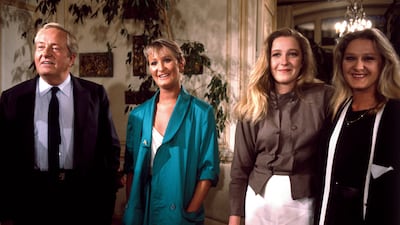
Jean-Marie Le Pen with his daughters Yann, Marine and Marie-Caroline in Saint-Cloud, France, in 1986. -

Jean-Marie Le Pen with daughter Marine after the first round of voting in the 1995 French presidential election. -
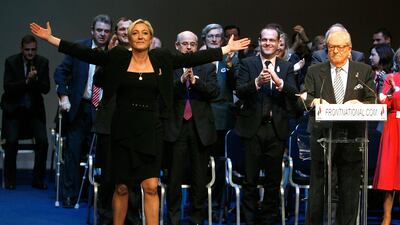
Marine Le Pen salutes party members, with her father to the right, as she is named Front National's new leader at a party conference in January 2011. -
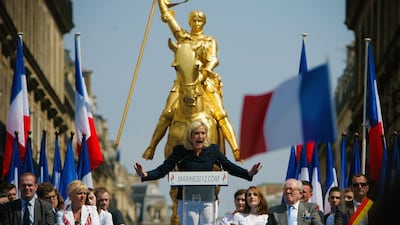
Marine Le Pen delivers a speech during the party's annual celebration of Joan of Arc in May 2011 in Paris. -
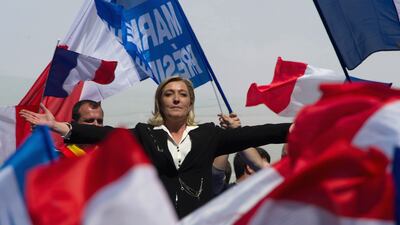
Marine Le Pen after giving a speech during the far-right party's May Day demonstration in Paris in 2012. -
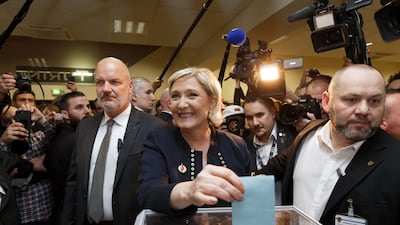
Marine Le Pen votes during her party's congress in March 2018 at the Grand Palais in Lille. -
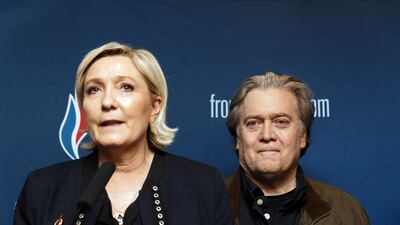
Marine Le Pen and former US president Donald Trump's adviser, Steve Bannon, give a joint press conference at the Front National party's annual congress in March 2018. -
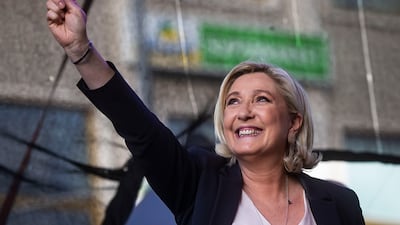
Marine Le Pen at a meeting of populist far-right party leaders at Wenceslas Square in Prague, Czech Republic, in April 2019. -

Marine Le Pen launches her presidential campaign in Reims, France, in February. -
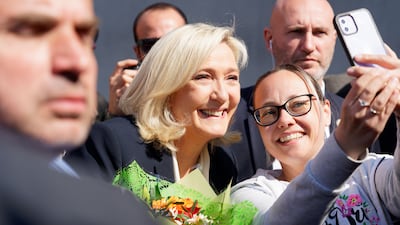
Marine Le Pen poses with supporters as she leaves a polling station in Henin-Beaumont after casting her ballot for the second round of the presidential elections.


Now on their fifth prime minister since ending 13 years of Labour rule under Tony Blair and then Gordon Brown, the governing party is in shambolic disarray, lagging 20 points or more behind in the opinion polls and struggling to shake off impressions of failure and fatigue.
The Covid-19 pandemic and Ukraine war have presented stiff challenges to most governments. But the Conservatives have brought further misfortune on themselves in ways that cast doubt on their honesty as well as their ability to run the country effectively.
Popular perceptions are of a government riddled with infighting that has presided over economic decline, collapsed health and other public services, unrestrained pollution of rivers and seas and a bumbling approach to crises. Could anyone have foreseen a scenario in which a scheme as gimmicky, flawed and potentially unlawful as sending unwanted asylum seekers to Rwanda could be presented as a flagship policy immediately before a general election?
Mr Sunak offered a semblance of normality when he took over from Liz Truss after her brief premiership brought a catastrophic mini-budget of unfunded tax cuts that came close to crashing the economy and left homeowners facing crippling mortgages. But his high-minded promise of “integrity, professionalism and accountability” has not been matched in practice.
Tories now pin their hopes on belated public anxieties about the return of a Labour government.
Time, and analysis of this week’s by-election results, will tell whether Labour has been damaged by the suspicion of lingering pockets of anti-Semitism within its ranks. But if the Tories are duly ejected from office, their legacy will be seen by opponents as one of routine incompetence, hypocrisy – by casually breaking their own lockdown laws during the pandemic – and sleaze.
Meanwhile, we find Dutch voters turning out to support Geert Wilders, who may become prime minister despite his climate-change denial and repellent Islamophobic views. The most popular politician in France is Marine Le Pen, whose attempts to cleanse her National Rally of its anti-Semitic and anti-Muslim past persuade far too many as proving it has matured into “a party like any other”.
The story is repeated across the continent. Europe – despite the swift elimination of a far-right candidate in the Finnish presidential election – is at political crossroads.
In country after country, moderate parties are now dismissed as ineffectual, irrelevant or out of touch. Far from everyone bothers to vote – the turnout for this summer’s European elections will almost certainly be pitiful – but those who do show no qualms in choosing what was previously thought of as beyond the pale in a continent scarred by painful acquaintance with the far right in action.
Mr Starmer’s ultra-cautious nature is reflected in his reported determination to make his election manifesto “bombproof”. But perhaps he could afford to be less fainthearted. What better time for the Labour leader and his team to demonstrate that non-extremist, centre-left ideas still have a place. On their heads could rest the future of mainstream politics in Europe.

