


It’s been a long time coming – two years, or maybe 103 years, depending on your historical starting point.
Northern Ireland now has a power-sharing government again, with British unionists joining Irish nationalists in the administration. This breaks the two-year political deadlock created by the British government’s Brexit blunders.
The most significant of these came when the then-prime minister Boris Johnson undermined Northern Ireland’s unionist community by – in effect – creating a customs border between Northern Ireland and the rest of the UK. Unionists strongly resisted this manoeuvre arguing that it undermined the union of the UK that they have cherished for more than a century.
The Democratic Unionist Party (DUP) pulled out of Belfast’s Stormont parliament and the government was frozen. What is astonishing, and at the same time hugely encouraging, for those of us who hope for a permanent peace on the island of Ireland, is that the DUP has now returned to Stormont, enabling Northern Ireland to have a functioning power-sharing government again.

Even more extraordinary, there’s a profound historical shift. Northern Ireland is now led for the first time by an Irish nationalist First Minister, Michelle O’Neill. She will work alongside her deputy from the DUP, Emma Little-Pengelly.
These two women have a lot on their shoulders. They represent the coming together of two communities – the mostly Protestant unionist community and the mostly Catholic Irish nationalist community.
In the past, Catholics suffered greatly from discrimination in employment, housing and other matters, while in the worst times of the “Troubles” (from the 1960s until the 1990s), both communities endured killings and bombings. Some families were intimidated out of their homes and more than 3,000 people were killed in shootings and bombings.
I lived in Northern Ireland during much of these times. There was often mutual suspicion between people in both communities, but there was also a great deal of goodwill and friendship across traditional religious boundaries. Most people were desperate for peace.
And now we are at what could be a truly hopeful turning point. That’s because Stormont was created after Ireland was partitioned in 1921 along sectarian lines. The plan was to ensure that Northern Ireland would always have a Protestant and unionist majority, while what would become the Irish Republic would be largely Catholic.
It was assumed that the Belfast parliament would never be run by Irish nationalists – and especially not by Sinn Fein. Stormont was sometimes called a “Protestant parliament for a Protestant people”. For their part, those in Sinn Fein, including Ms O’Neill, always believed that the very existence of Northern Ireland was a historic wrong. Their aspiration was and remains for Ireland to be united into one state, ending British rule on any part of the island.
The name “Sinn Fein” is usually translated from Irish into English as “We Ourselves” and the party has a long history as the political wing of the violent terrorist group, the IRA. But things have moved on.
The fact that Sinn Fein is in government with the DUP means that both sides have swallowed diverging long-term aspirations in the hope of improving citizens’ lives right now. This could eventually lead to a united Ireland, although both main political parties are tiptoeing around the sometimes incendiary “national question”. Ms O’Neill is trying hard not to alarm unionists.
But perhaps even more astonishing is that Sinn Fein is now on course to become the biggest political party on both sides of the Irish border.
-
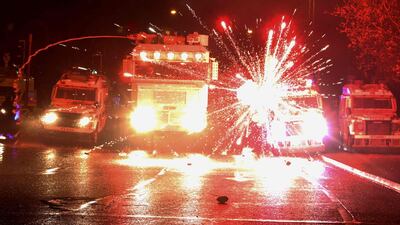
Fireworks explode by police vehicles after being fired at police officers in the Springfield Road area of Belfast. AFP -

Rioters run as the police use a water cannon on the Springfield Road. Reuters -
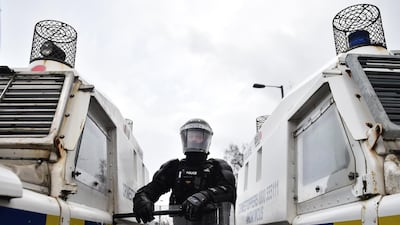
Riot police on the republican side of the divided city were pelted with projectiles. Getty Images -
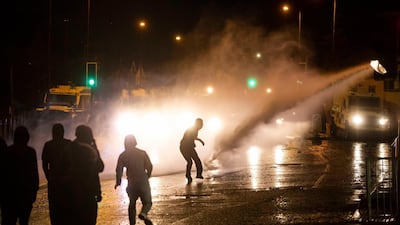
Nationalist youths clash with police on the Springfield Road. EPA -
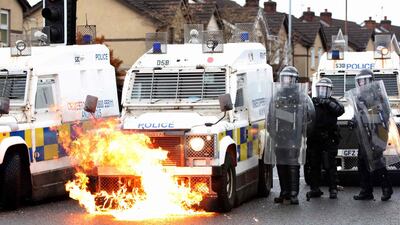
Flames lick up the front of a police vehicle as police officers are attacked by nationalist youths. AFP -
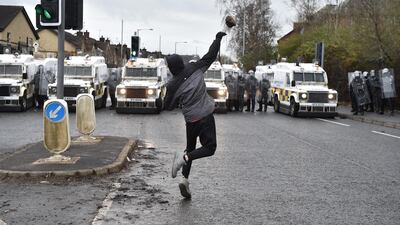
A rioter throws a projectile at police on Springfield Road. Getty Images -
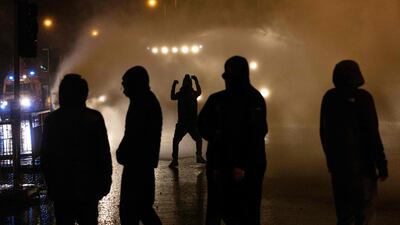
Police officers use a water cannon as they clash with nationalist youths. AFP -
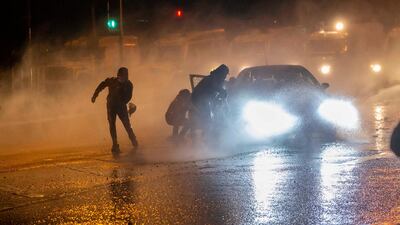
Nationalist youths stealing a car while clashing with police on the Springfield Road. EPA


The next general election in the Irish Republic has to be held by March 2025 and Sinn Fein’s leader there, Mary Lou McDonald, is on course to become Taoiseach, Ireland’s prime minister in the Dublin parliament.
Ms McDonald is also careful in the way she speaks of reunification, while retaining her long-term goal of a united Ireland. She greeted the news of Ms O’Neill’s new role with a quote from the Irish poet William Butler Yeats: “All changed, changed utterly.” That is undeniably true. In the optimism of the moment, however, perhaps Ms McDonald omitted the next (and less optimistic) line of Yeats’s poem when he wrote that “a terrible beauty is born”.
Since this is a moment for optimism and since Ireland has also produced many other great poets, I would suggest we should leave the Anglo-Irish Yeats at this point and switch to a more modern writer, the winner of the Nobel Prize in Literature, Northern Ireland’s very own Seamus Heaney.
I met Seamus a few times and admired him enormously. He passed away in 2013. He would have loved this moment of hope and possible reconciliation. Perhaps he even predicted it. After all, in one of his greatest inspirational poems, he wrote:
History says, don’t hope
On this side of the grave.
But then, once in a lifetime
The longed-for tidal wave
Of justice can rise up,
And hope and history rhyme.
Hope and history are rhyming on the island of Ireland right now. May it last. We can hope.

