British soldiers of the Inkerman Company, 1st Battalion Grenadier Guards Regiment, in Helmand Province, Afghanistan, in 2007. Getty Images


Britain has many traditions – including not being prepared for war


  • English
  • Arabic

January 31, 2024

This is the time of year when Scottish men – including me – wear traditional highland dress. The tartan kilt is worn on and around Burns Night to celebrate the birth in January 1759 of the great Scottish poet Robert Burns.

I was a speaker at a formal “Burns Supper” in London, paying tribute to the genius of our national poet. The traditional food during this annual festival is Scottish, as you would expect. It includes haggis (a kind of sausage, which is delicious). The haggis is paraded around the dining room on a large silver platter, following a bagpiper playing a traditional Scottish tune. The piper also wears the kilt.

For many of us, these traditions bring back sentimental thoughts of the past, of dinners with loved ones who are no longer with us. This year, the memories were especially sharp.

I’m one of the first generations in my Scottish family not to have been forced into military service by conscription into the British army or other branches of the armed services. My family were often in the Scottish infantry. They wore the kilt in the Seaforth Mackenzie tartan because they were Seaforth Highlanders, an old army regiment that suffered many casualties in the First World War.

I have in my filing cabinet a letter sent to my family in Glasgow in 1917 informing them of the death of one relative killed by German machine gun fire in the Battle of Passchendaele. The letter, from his commanding officer, reveals the pain felt by his comrades at his loss.

Much later, my father was also in the British army. He also wore Seaforth Mackenzie tartan, and so do I. Doing so is a celebration of Burns Night and being Scottish, but it’s also tinged with memories of people in the family who are no longer with us, some of whom died in the service of their country.

Seaforth Highlanders, a line infantry regiment of the British army, in the 19th century. Getty Images
Since Brexit, the UK has not only diminished its role in Europe, it has become a much less significant ally to America

The reason I am thinking of this now is that there are rumblings within British military circles, and also within Nato, about the relative weakness of British armed forces. This has led to a public debate about whether conscription – forced military service – might ever return in Britain.

US Navy Secretary Carlos Del Toro suggested that worldwide strategic threats mean the British Royal Navy is underpowered and needs a boost. The military committee chair of Nato, Admiral Rob Bauer, and the outgoing British army chief, Gen Patrick Sanders, also warned of potentially a wider European war if Russia defeats Ukraine. Meanwhile, the US Air Force is putting nuclear weapons back in a refurbished air force base in eastern England.

What is fascinating about all this military discussion is that the British government has for years been scaling back defence spending. One central plan has been to cut back the full-time British army to about 73,000 troops.

Some reports claim that this is a level last seen after the defeat of Napoleon in 1815, although I think that is not correct. Historians suggest that after Napoleon’s defeat at Waterloo, the British army was cut back to 90,000. It looks as if the deeper cuts now to 73,000 full-time soldiers would take Britain back to the troop numbers of 1715, a year after the end of the war of the Spanish Succession.

Whatever the historical context, the result is indisputably a much weaker British military. This was acknowledged by former defence secretary Ben Wallace in 2022. He warned that the army nowadays was only big enough to “stay at home and tootle around”.

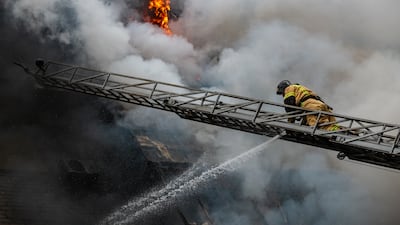
  • Firefighters attend a blaze after a Russian attack in Kyiv. AP
    Firefighters attend a blaze after a Russian attack in Kyiv. AP
  • A destroyed car in a courtyard of a multi-storey apartment building after what local authorities say was a Ukrainian military strike in the city of Belgorod, Russia. Reuters
    A destroyed car in a courtyard of a multi-storey apartment building after what local authorities say was a Ukrainian military strike in the city of Belgorod, Russia. Reuters
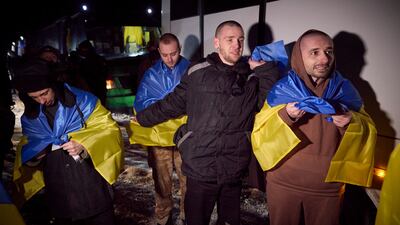
  • Ukrainian prisoners of war after a prisoner exchange near Sumy, Ukraine. AP
    Ukrainian prisoners of war after a prisoner exchange near Sumy, Ukraine. AP
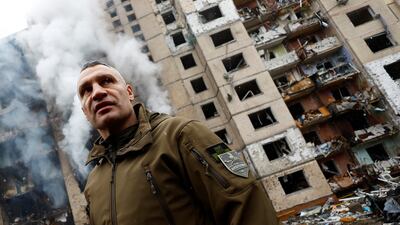
  • Kyiv Mayor Vitali Klitschko visits a residential building damaged during a Russian missile attack in Kyiv. Reuters
    Kyiv Mayor Vitali Klitschko visits a residential building damaged during a Russian missile attack in Kyiv. Reuters
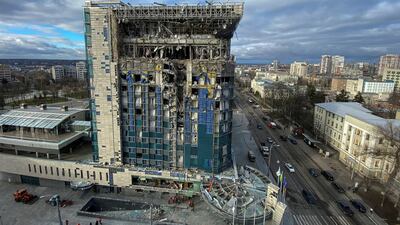
  • The Kharkiv Palace Hotel after a Russian missile strike. Reuters
    The Kharkiv Palace Hotel after a Russian missile strike. Reuters
  • Ukrainian rescuers after a Russian drone attack on an office building in downtown Kharkiv. EPA
    Ukrainian rescuers after a Russian drone attack on an office building in downtown Kharkiv. EPA
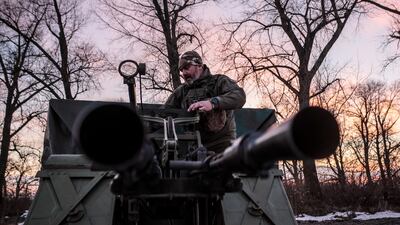
  • A Ukrainian serviceman operates an anti-aircraft machine gun after an air raid alarm in the Kyiv region. EPA
    A Ukrainian serviceman operates an anti-aircraft machine gun after an air raid alarm in the Kyiv region. EPA
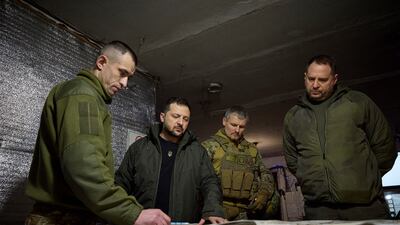
  • Ukrainian President Volodymyr Zelenskyy speaking with commanders during his trip to the Donetsk region. EPA
    Ukrainian President Volodymyr Zelenskyy speaking with commanders during his trip to the Donetsk region. EPA
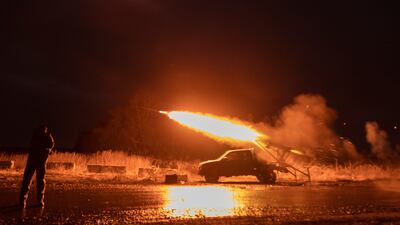
  • Ukrainian servicemen fire a self-made rocket launcher on a front line in the Donetsk area. EPA
    Ukrainian servicemen fire a self-made rocket launcher on a front line in the Donetsk area. EPA
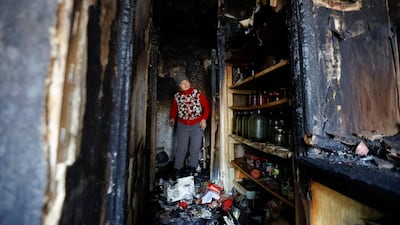
  • A woman searches for household items in her burnt-out apartment, recently hit by shelling in Donetsk. Reuters
    A woman searches for household items in her burnt-out apartment, recently hit by shelling in Donetsk. Reuters
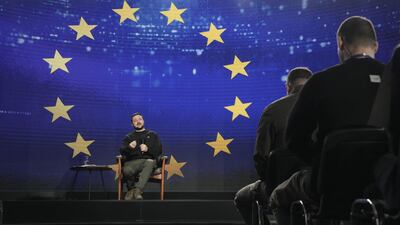
  • Ukrainian President Volodymyr Zelenskyy during a news conference in Kyiv. Bloomberg
    Ukrainian President Volodymyr Zelenskyy during a news conference in Kyiv. Bloomberg
  • A firefighter at the site of a damaged building after shelling in Donetsk. EPA
    A firefighter at the site of a damaged building after shelling in Donetsk. EPA
  • A worker carries out repairs to the Cathedral of the Transfiguration that was damaged as a result of a Russian missile in Odesa. AFP
    A worker carries out repairs to the Cathedral of the Transfiguration that was damaged as a result of a Russian missile in Odesa. AFP
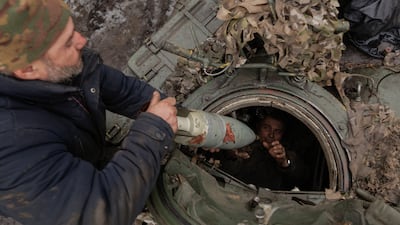
  • Ukrainian troops prepare anti-aircraft artillery from their position on a front line near Zaporizhzhia. EPA
    Ukrainian troops prepare anti-aircraft artillery from their position on a front line near Zaporizhzhia. EPA
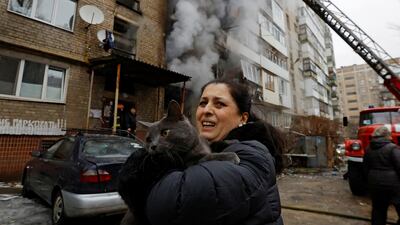
  • A woman with her cat, which was saved from an apartment building damaged by recent shelling in Donetsk. Reuters
    A woman with her cat, which was saved from an apartment building damaged by recent shelling in Donetsk. Reuters
  • A howitzer is fired at Russian positions in Donetsk. Reuters
    A howitzer is fired at Russian positions in Donetsk. Reuters
  • Civilians take shelter in a gym after their apartments were damaged in a drone attack in Odesa. AFP
    Civilians take shelter in a gym after their apartments were damaged in a drone attack in Odesa. AFP
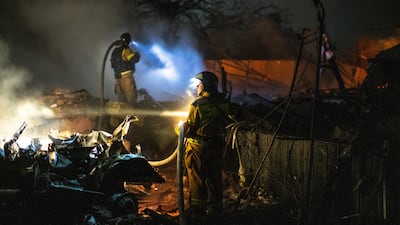
  • Firefighters work at destroyed houses following shelling in Donetsk. EPA
    Firefighters work at destroyed houses following shelling in Donetsk. EPA
  • A Ukrainian soldier looks out for danger near Bakhmut. AFP
    A Ukrainian soldier looks out for danger near Bakhmut. AFP
  • Members of the Siberian Battalion carrying out military exercises with the International Legion of the Armed Forces of Ukraine at an undisclosed location in Ukraine. Bloomberg
    Members of the Siberian Battalion carrying out military exercises with the International Legion of the Armed Forces of Ukraine at an undisclosed location in Ukraine. Bloomberg

The depleted state of the Royal Navy may be even more significant. It takes a long time to commission and build modern warships and a Reuters report in 2016 concluded: “The Royal Navy is a shadow of its former self. Government budgeteers have repeatedly, and excessively, cut the numbers of its ships, planes and manpower. It can barely patrol the United Kingdom’s own waters, much less project British influence abroad.”

What makes the problem worse is that the under-resourcing of the military has been compounded by a failed recruitment programme, handled by a private recruitment company, along with government failures to get a grip and make a military career attractive to younger people.

Since Brexit, as leading British diplomats know only too well, the UK has not only diminished its role in Europe but as a result, it has become a much less significant ally to America. When US President Joe Biden decided to pull his country’s troops out of Afghanistan, for example, Britain was informed rather than consulted.

No one thinks the British government right now has plans to introduce conscription into the armed forces. But for many years, until the invasion of Ukraine, a major land war in Europe was also unthinkable. The 2020s are proving that the world is particularly dangerous and unpredictable.

The tradition of wearing the kilt into battle has, unfortunately, been matched by another British tradition, that of being unprepared for conflict until it bursts upon us. That’s a tradition we should also remember. And avoid.


Bundesliga fixtures

Saturday, May 16 (kick-offs UAE time)

Borussia Dortmund v Schalke (4.30pm) 

RB Leipzig v Freiburg (4.30pm) 

Hoffenheim v Hertha Berlin (4.30pm) 

Fortuna Dusseldorf v Paderborn  (4.30pm) 

Augsburg v Wolfsburg (4.30pm) 

Eintracht Frankfurt v Borussia Monchengladbach (7.30pm)

Sunday, May 17

Cologne v Mainz (4.30pm),

Union Berlin v Bayern Munich (7pm)

Monday, May 18

Werder Bremen v Bayer Leverkusen (9.30pm)

Ten tax points to be aware of in 2026

1. Domestic VAT refund amendments: request your refund within five years

If a business does not apply for the refund on time, they lose their credit.

2. E-invoicing in the UAE

Businesses should continue preparing for the implementation of e-invoicing in the UAE, with 2026 a preparation and transition period ahead of phased mandatory adoption. 

3. More tax audits

Tax authorities are increasingly using data already available across multiple filings to identify audit risks. 

4. More beneficial VAT and excise tax penalty regime

Tax disputes are expected to become more frequent and more structured, with clearer administrative objection and appeal processes. The UAE has adopted a new penalty regime for VAT and excise disputes, which now mirrors the penalty regime for corporate tax.

5. Greater emphasis on statutory audit

There is a greater need for the accuracy of financial statements. The International Financial Reporting Standards standards need to be strictly adhered to and, as a result, the quality of the audits will need to increase.

6. Further transfer pricing enforcement

Transfer pricing enforcement, which refers to the practice of establishing prices for internal transactions between related entities, is expected to broaden in scope. The UAE will shortly open the possibility to negotiate advance pricing agreements, or essentially rulings for transfer pricing purposes. 

7. Limited time periods for audits

Recent amendments also introduce a default five-year limitation period for tax audits and assessments, subject to specific statutory exceptions. While the standard audit and assessment period is five years, this may be extended to up to 15 years in cases involving fraud or tax evasion. 

8. Pillar 2 implementation 

Many multinational groups will begin to feel the practical effect of the Domestic Minimum Top-Up Tax (DMTT), the UAE's implementation of the OECD’s global minimum tax under Pillar 2. While the rules apply for financial years starting on or after January 1, 2025, it is 2026 that marks the transition to an operational phase.

9. Reduced compliance obligations for imported goods and services

Businesses that apply the reverse-charge mechanism for VAT purposes in the UAE may benefit from reduced compliance obligations. 

10. Substance and CbC reporting focus

Tax authorities are expected to continue strengthening the enforcement of economic substance and Country-by-Country (CbC) reporting frameworks. In the UAE, these regimes are increasingly being used as risk-assessment tools, providing tax authorities with a comprehensive view of multinational groups’ global footprints and enabling them to assess whether profits are aligned with real economic activity. 

Contributed by Thomas Vanhee and Hend Rashwan, Aurifer

Company%20profile
%3Cp%3E%3Cstrong%3ECompany%20name%3A%3C%2Fstrong%3E%20Letswork%3Cbr%3E%3Cstrong%3EStarted%3A%3C%2Fstrong%3E%202018%3Cbr%3E%3Cstrong%3EBased%3A%3C%2Fstrong%3E%20Dubai%3Cbr%3E%3Cstrong%3EFounders%3A%20%3C%2Fstrong%3EOmar%20Almheiri%2C%20Hamza%20Khan%3Cbr%3E%3Cstrong%3ESector%3A%3C%2Fstrong%3E%20co-working%20spaces%3Cbr%3E%3Cstrong%3EInvestment%20stage%3A%3C%2Fstrong%3E%20%242.1%20million%20in%20a%20seed%20round%20with%20investors%20including%20500%20Global%2C%20The%20Space%2C%20DTEC%20Ventures%20and%20other%20angel%20investors%3Cbr%3E%3Cstrong%3ENumber%20of%20employees%3A%3C%2Fstrong%3E%20about%2020%3C%2Fp%3E%0A
Ain Dubai in numbers

126: The length in metres of the legs supporting the structure

1 football pitch: The length of each permanent spoke is longer than a professional soccer pitch

16 A380 Airbuses: The equivalent weight of the wheel rim.

9,000 tonnes: The amount of steel used to construct the project.

5 tonnes: The weight of each permanent spoke that is holding the wheel rim in place

192: The amount of cable wires used to create the wheel. They measure a distance of 2,4000km in total, the equivalent of the distance between Dubai and Cairo.

Updated: January 31, 2024, 2:28 PM