Israeli Prime Minister Benjamin Netanyahu holds up a map of Israel that includes all of the West Bank and Gaza during his UN address in 2022. AFP


Netanyahu's western backers let him play them for fools


  • English
  • Arabic

January 24, 2024

Embarrassment. Dismay. Mortification. Fury. I hope these are some of the emotions being experienced by the western leaders who have given Israel such unequivocal support in its campaign in Gaza after the horrific attacks of October 7. They could not let up, no, not one bit, from standing by “the only democracy in the Middle East” as it fights on behalf of the “free world … to save western civilisation”, as Israeli President Isaac Herzog has put it.

But Israeli Prime Minister Benjamin Netanyahu has just made crystal clear that for months he has been taking those leaders for the ride of their lives.

Forget about planning for the day after, involving the Palestinian Authority, or forging an international coalition that can help build an independent Palestine after the war ends. Mr Netanyahu doesn’t want a two-state solution at all. Ever. And this time he has made it as plain as could be.

After speaking with US President Joe Biden last Friday, Mr Netanyahu’s office issued a statement on Saturday: “In his conversation with President Biden, Prime Minister Netanyahu reiterated his policy that after Hamas is destroyed Israel must retain security control over Gaza to ensure that Gaza will no longer pose a threat to Israel, a requirement that contradicts the demand for Palestinian sovereignty.”

For those who needed any clarification, Mr Netanyahu doubled down with a statement on X. “I will not compromise on full Israeli security control over all the territory west of the Jordan River – and this is irreconcilable with a Palestinian state.”

This is also contrary to the position taken by the staunchest of Mr Netanyahu’s defenders, such as UK Labour leader Keir Starmer. The Israeli leader’s statement was “unacceptable and wrong”, Mr Starmer said. “Palestinian statehood is not in the gift of a neighbour. It is the inalienable right of the Palestinian people.”

US Secretary of State Antony Blinken with Israeli Defence Minister Yoav Gallant in Tel Aviv earlier this month. AFP
Shapps described Netanyahu’s opposition to a Palestinian state as 'disappointing'. The word is inadequate. When I order a steak rare and it comes medium, that is disappointing

But for all the indignation displayed by Mr Starmer and his ilk, they shouldn’t have been surprised. Mr Netanyahu has never hidden his opposition to a two-state solution. At a news conference in Tel Aviv last month, he said: “You and your journalist friends have been blaming me for almost 30 years for putting the brakes on the Oslo Accords and preventing the Palestinian state. That is true.

“I’m proud that I prevented the establishment of a Palestinian state because today everybody understands what that Palestine state could have been, now that we’ve seen the little Palestinian state in Gaza.”

Last September, he held up a map of “the New Middle East” at the UN General Assembly in which “Israel” included all of the West Bank and Gaza. Indeed, as far back as 1977 he was talking openly of his belief that Israel should just take the Palestinians’ land.

The historian and newspaper editor Max Hastings was writing a biography of Mr Netanyahu’s brother Yoni, a hero of the 1976 Entebbe raid, and recorded the future premier saying: “In the next war if we do it right, we’ll have a chance to get all the Arabs out. We can clear the West Bank, sort out Jerusalem.”

But Mr Netanyahu’s western backers chose to ignore all this, just as they ignored statements made by Israeli officials that are carefully detailed in South Africa’s case on genocide at the International Court of Justice. They repeated ad nauseam that Israel had the right to defend itself – which of course it does – but while troubled by the escalating death toll, could never quite bring themselves to call for a ceasefire.

US Secretary of State Antony Blinken said in November that “too many Palestinians have been killed”, and early this month added that “there’s been far too much loss of life” – still doing nothing to put an end to it. (I wish someone would ask him what the right amount of “loss of life” would be. What would be the “Goldilocks” figure, neither too small nor too high, that the Biden administration would approve as appropriate vengeance, never mind that the majority of the dead would be women and children?)

For underlying it all was the assumption that the Israeli leadership would come round in the end. Mr Biden and British Prime Minister Rishi Sunak were insistent: there had to be a two-state solution.

  • President Joan Donoghue and other judges at the International Court of Justice before the hearing of the genocide case against Israel, brought by South Africa, in The Hague, the Netherlands. EPA
    President Joan Donoghue and other judges at the International Court of Justice before the hearing of the genocide case against Israel, brought by South Africa, in The Hague, the Netherlands. EPA
  • Pro-Palestinian protesters rally in The Hague. EPA
    Pro-Palestinian protesters rally in The Hague. EPA
  • Protesters wave Israeli flags. AP
    Protesters wave Israeli flags. AP
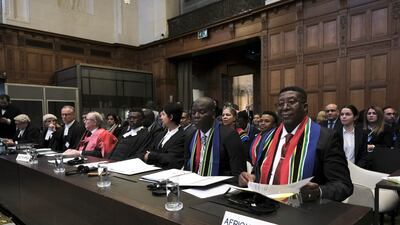
  • South Africa's ambassador to the Netherlands Vusimuzi Madonsela, right, and Minister of Justice Ronald Lamola during the hearings. AP
    South Africa's ambassador to the Netherlands Vusimuzi Madonsela, right, and Minister of Justice Ronald Lamola during the hearings. AP
  • Tal Becker, lawyer for the Israeli Foreign Ministry. EPA
    Tal Becker, lawyer for the Israeli Foreign Ministry. EPA
  • Pro-Palestinian demonstrators watch proceedings. Bloomberg
    Pro-Palestinian demonstrators watch proceedings. Bloomberg
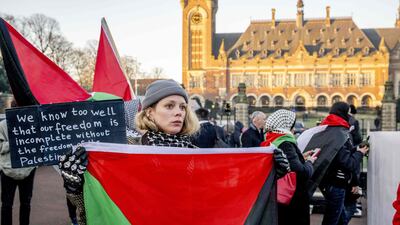
  • A protester holds a Palestinian flag outside the ICJ. AFP
    A protester holds a Palestinian flag outside the ICJ. AFP

Well, Mr Netanyahu has just defied the US and all his supporters who laboured under that illusion. Only now is there some pushback, although the US Senate recently rejected a measure that would have made military aid to Israel conditional on it upholding human rights and international accords.

Now the man they have been supporting is unambiguously in view – a man who would like to solve the Palestinian problem by erasing Palestine. This is his aim: no two state-solution, no state of Palestine, and quite possibly no Palestinians in their historic lands either; and it is for this that the cheerleaders of Mr Netanyahu’s government have allowed it to visit death on 25,000 in Gaza and biblical scenes of destruction on the Strip.

UK Defence Secretary Grant Shapps described Mr Netanyahu’s implacable opposition to a Palestinian state as “disappointing”. The word is utterly inadequate. When I order a steak rare and it comes medium, that is disappointing. The adjective Mr Shapps is reaching for is “catastrophic”.

All along, the US, UK and others have refused to step in and stop the killing on the grounds that they had to let Mr Netanyahu and his allies do what they wanted because, ultimately, they would be amenable to a reasonable solution, namely two states. Remember when we were told, by White House officials, that it would be “repugnant” and “disgraceful” to call for a ceasefire?

And all along, they have been played for fools by a man who cannot be described as concealing his true intentions – as they have always been in plain sight, for those with eyes to see.


Scotland's team:

15-Sean Maitland, 14-Darcy Graham, 13-Nick Grigg, 12-Sam Johnson, 11-Byron McGuigan, 10-Finn Russell, 9-Ali Price, 8-Magnus Bradbury, 7-Hamish Watson, 6-Sam Skinner, 5-Grant Gilchrist, 4-Ben Toolis, 3-Willem Nel, 2-Stuart McInally (captain), 1-Allan Dell

Replacements: 16-Fraser Brown, 17-Gordon Reid, 18-Simon Berghan, 19-Jonny Gray, 20-Josh Strauss, 21-Greig Laidlaw, 22-Adam Hastings, 23-Chris Harris

MATCH INFO

Liverpool 2 (Van Dijk 18', 24')

Brighton 1 (Dunk 79')

Red card: Alisson (Liverpool)

The burning issue

The internal combustion engine is facing a watershed moment – major manufacturer Volvo is to stop producing petroleum-powered vehicles by 2021 and countries in Europe, including the UK, have vowed to ban their sale before 2040. The National takes a look at the story of one of the most successful technologies of the last 100 years and how it has impacted life in the UAE. 

Read part four: an affection for classic cars lives on

Read part three: the age of the electric vehicle begins

Read part two: how climate change drove the race for an alternative 

THE%20SPECS
%3Cp%3EEngine%3A%203-litre%20V6%20turbo%20(standard%20model%2C%20E-hybrid)%3B%204-litre%20V8%20biturbo%20(S)%0D%3Cbr%3EPower%3A%20350hp%20(standard)%3B%20463hp%20(E-hybrid)%3B%20467hp%20(S)%0D%3Cbr%3ETorque%3A%20500Nm%20(standard)%3B%20650Nm%20(E-hybrid)%3B%20600Nm%20(S)%0D%0D%3Cbr%3EPrice%3A%20From%20Dh368%2C500%0D%3Cbr%3EOn%20sale%3A%20Now%3C%2Fp%3E%0A
How to apply for a drone permit
  • Individuals must register on UAE Drone app or website using their UAE Pass
  • Add all their personal details, including name, nationality, passport number, Emiratis ID, email and phone number
  • Upload the training certificate from a centre accredited by the GCAA
  • Submit their request
What are the regulations?
  • Fly it within visual line of sight
  • Never over populated areas
  • Ensure maximum flying height of 400 feet (122 metres) above ground level is not crossed
  • Users must avoid flying over restricted areas listed on the UAE Drone app
  • Only fly the drone during the day, and never at night
  • Should have a live feed of the drone flight
  • Drones must weigh 5 kg or less
What is an ETF?

An exchange traded fund is a type of investment fund that can be traded quickly and easily, just like stocks and shares. They come with no upfront costs aside from your brokerage's dealing charges and annual fees, which are far lower than on traditional mutual investment funds. Charges are as low as 0.03 per cent on one of the very cheapest (and most popular), Vanguard S&P 500 ETF, with the maximum around 0.75 per cent.

There is no fund manager deciding which stocks and other assets to invest in, instead they passively track their chosen index, country, region or commodity, regardless of whether it goes up or down.

The first ETF was launched as recently as 1993, but the sector boasted $5.78 billion in assets under management at the end of September as inflows hit record highs, according to the latest figures from ETFGI, a leading independent research and consultancy firm.

There are thousands to choose from, with the five largest providers BlackRock’s iShares, Vanguard, State Street Global Advisers, Deutsche Bank X-trackers and Invesco PowerShares.

While the best-known track major indices such as MSCI World, the S&P 500 and FTSE 100, you can also invest in specific countries or regions, large, medium or small companies, government bonds, gold, crude oil, cocoa, water, carbon, cattle, corn futures, currency shifts or even a stock market crash. 

Teachers' pay - what you need to know

Pay varies significantly depending on the school, its rating and the curriculum. Here's a rough guide as of January 2021:

- top end schools tend to pay Dh16,000-17,000 a month - plus a monthly housing allowance of up to Dh6,000. These tend to be British curriculum schools rated 'outstanding' or 'very good', followed by American schools

- average salary across curriculums and skill levels is about Dh10,000, recruiters say

- it is becoming more common for schools to provide accommodation, sometimes in an apartment block with other teachers, rather than hand teachers a cash housing allowance

- some strong performing schools have cut back on salaries since the pandemic began, sometimes offering Dh16,000 including the housing allowance, which reflects the slump in rental costs, and sheer demand for jobs

- maths and science teachers are most in demand and some schools will pay up to Dh3,000 more than other teachers in recognition of their technical skills

- at the other end of the market, teachers in some Indian schools, where fees are lower and competition among applicants is intense, can be paid as low as Dh3,000 per month

- in Indian schools, it has also become common for teachers to share residential accommodation, living in a block with colleagues

Updated: January 24, 2024, 12:32 PM