


Donald Trump’s decisive victory in the Iowa caucuses and his commanding lead in upcoming primary contests should put to rest the fantasies of those Republicans who still cling to the hope that their party can be rescued from his clutches. That’s not going to happen precisely because the former president’s foes don’t understand his hold over voters.
Frustrated Republicans, known as “Never Trumpers”, and many establishment Democrats continue to operate as if the problem were just the man. They act on their belief that if only he could be beaten or shut down, all would be well, or at least “normal”, in American politics.
There is no question that Mr Trump represents a problem for the United States. He is a pathological narcissist, who is prone to outlandish exaggerations or outright fabrications. He has been called a fraud, a misogynist and an inciter to violence against vulnerable groups. Many have known all of this for more than a decade. And yet despite the best efforts of his own party’s leadership and others to discredit or dislodge him, Mr Trump has only grown in strength even as his rivals have fallen by the wayside.
On Sunday, less than a week after finishing second in the Iowa caucuses, Florida Governor Ron DeSantis bowed out of the race to be the Republican presidential nominee.
There are two major reasons for the party’s failure to rein in Mr Trump. The first is that those seeking to depose him ignore the simple fact that his support base is grounded in the deep discontent that predated his emergence on the national political stage. The second is that because the attacks against Mr Trump emanate from the very institutions and individuals he has targeted, their attacks have only served to reinforce his popularity with his supporters.
-
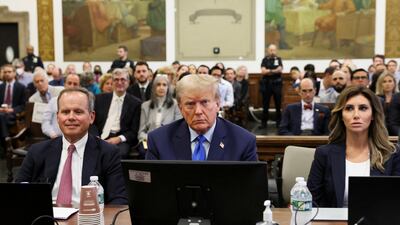
Former US president Donald Trump attends the trial against him, his adult sons, the Trump Organisation and others in a civil fraud case brought by state Attorney General Letitia James, at a Manhattan court. Reuters -
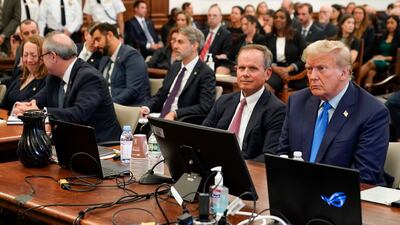
Mr Trump said he would attend the first week of his civil fraud trial, which is expected to last until December. AP -
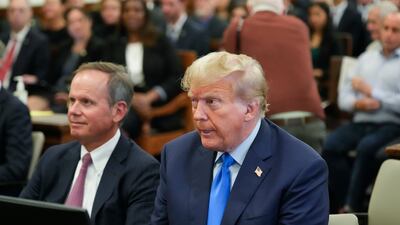
Former US president Donald Trump sits in the courtroom at New York Supreme Court. AP -
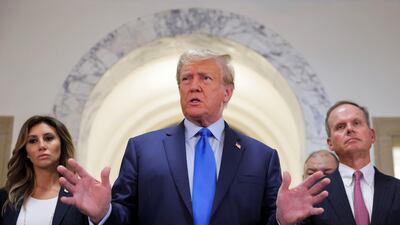
Mr Trump addresses reporters before attending his civil fraud trial. Reuters -
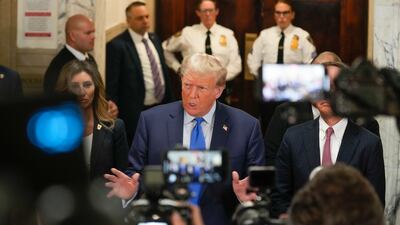
Mr Trump lashed out at New York Attorney General Letitia James and Judge Arthur Engoron before his civil fraud trial began in New York. AP -

Eric Trump arrives at New York Supreme Court. AP -

New York Attorney General Letitia James arrives for the start of Mr Trump's trial. Reuters -

Members of the media outside the New York State Supreme Court Building in New York. Bloomberg


Mr Trump isn’t the first demagogue in the contemporary era to lead a right-wing populist movement. There was the late governor George Wallace’s segregationist American Independence Party in the 1970s, the Moral Majority/Christian Coalition movements of the late 1980s, Pat Buchanan’s “Pitchfork Brigade” in 1988, and the anti-Barack Obama Tea Party and “Birther“ movements. All of these set the stage for Mr Trump’s rise.
More than a half a century ago, many mainly white middle and working-class Americans experienced social, political and cultural dislocations resulting in an unsettling sense of loss of control over their lives and futures.
The 1960s and 70s were especially traumatic for many Americans with the emergence of three transformative movements that shook society, politics and culture: the civil rights movement; the deeply divisive movements both for and against the war in Vietnam; and a cultural revolution that upended accepted social mores.
In the wake of these movements, what then-president Richard Nixon called “the silent majority” reacted: incidents of overt racism or fear of racially motivated violence; displays of hyper-patriotism or a loss of faith in the country, its institutions, and professed values; and finally, a sense of being unmoored in the face of the radical social and cultural change.
For 50 years, Americans played out their traumas in reaction to the stressful changes of those two fateful decades. There were manifestations of racially motivated fear of the “others”, whether African Americans, Latinos, or immigrants. Driven by the pain incurred from our defeats in foreign wars, or losses in jobs due to factory and mine closures, or other economic crises, we witnessed either a hyper-patriotism or a romanticisation of America’s “great past”. And finally, those who felt threatened by the challenges to long-accepted social and cultural values sought certainty, often ending up seeking refuge in the embrace of fundamentalist religious beliefs.
The economic collapse of 2008-2009 and the election of Mr Obama brought these threads together, setting the stage for Mr Trump’s emergence. In a matter of weeks, the stock market fell, erasing the pensions of many middle-class Americans, unemployment doubled, and one in five homes were in danger of foreclosure.
During this period, my brother John Zogby noted that his polling showed that for the first time two thirds of the electorate indicated a loss of hope in the American Dream. And with the election of Mr Obama, Republicans pounced on his race and “foreignness”, raising questions about whether or not Mr Obama was even an American. One of the major proponents of this craze was Mr Trump.

While all of the preconditions for Mr Trump’s rise were present and had earlier manifested themselves in other forms, Mr Trump was a masterful entertainer who knew how to exploit the fears and insecurities his public felt and how to project the strength and certainty they craved. He assures his supporters that he understands their plight, and that he alone has the power and resolve to save them. He warns of immigrants who bring violence and take jobs, and of once respected institutions, such as law enforcement, courts and the media.
A decade later, his movement has taken control of the Republican Party and may retake the White House. Despite efforts by the Republican establishment and Democrats, he has only grown stronger.
One reason is that their efforts to hold him accountable for his troubling and unlawful behaviours have relied on the very institutions he accuses of conspiring against him. By questioning the integrity of the courts, the FBI, the media, and of course, Democrats, Mr Trump has successfully inoculated himself against their attacks.
His winning argument with his supporters has been that he alone understands their pain, fears and frustrations, and that he alone can defend them. An attack on him is, therefore, an attack on them. They cling to him and the sense of security and certainty he gives them. Thus, neither being found liable for sexual abuse nor concurrent trials for financial fraud, incitement, mishandling and lying about illegal possession of secret government files will bring him down.
Mr Trump may still lose this election, but his movement will remain and continue to pose a threat of violence, maybe even greater than that of January 6, 2021.
Lawlessness and acts of bigotry cannot be tolerated. While accountability is required, simply defeating Mr Trump and punishing him and his followers isn’t enough. There is no shortcut out of this bind. Instead of demeaning or attacking Mr Trump’s supporters, a concerted effort is needed to address the issues at the root of their insecurities and discontent.
Finding constructive and progressive solutions that demonstrate respect and concern won’t happen overnight, but if efforts aren’t made in this direction, “Trumpism” will only fester and grow.

