


This year’s US presidential election may be the first in which the issues involving Palestinian rights may affect the outcome.
Over the past several decades, elections have been fought over a range of domestic and foreign policy concerns – from civil rights and abortion to the wars in Vietnam and Iraq. In most instances, these were partisan “wedge” issues – that is, issues that were used by one party against the other. The growing concern for Palestinian rights has become a “wedge issue“ that is dividing the governing Democratic Party.
Whether deliberate or not, Democrats made a fateful choice over the past several decades. They abandoned the white working class in favour of courting what has come to be known as the “Obama voters”. They were young voters, voters of colour (black, Latino and Asian), and educated women voters. The problem is that having lost a sizable percentage of white working-class voters, Democrats can’t afford to lose the substantial majorities of voters from the Obama coalition they need to win national elections.
Recent polls, such as the one conducted in December by The New York Times, show that young voters are deeply disappointed with President Joe Biden’s handling of the war on Gaza. They demonstrate greater solidarity with Palestinians than with Israelis and, in part, motivated by their dissatisfaction, they appear less inclined to support him in this year’s election.
Given the continuing deadly violence in Gaza and the start of the election year, this past week my Arab American Institute co-sponsored a summit on Gaza together with the Rainbow Push Coalition, founded by Rev Jesse Jackson, and other partners. In order to have a detailed look at how voters were thinking about the war, we commissioned a special nationwide poll of likely voters.
-
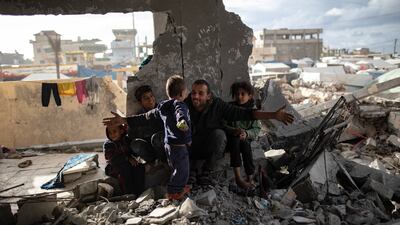
Palestinian Muhammad Al Durra with his children in the ruins of a house in Rafah where they sheltered on January 11, 2024. EPA -

Family and friends at the funerals of journalists Hamza Al Dahdouh and Mustafa Thuraya on January 7, 2024 in Rafah, Gaza. Getty Images -

Palestinians mourn relatives killed by Israeli bombardment of the Gaza Strip outside a mortuary in Khan Younis January 4, 2024. AP Photo -

Displaced Palestinians queue to bake bread at a camp in the Muwasi area of Rafah, Gaza Strip, on December 23, 2023. AP Photo -
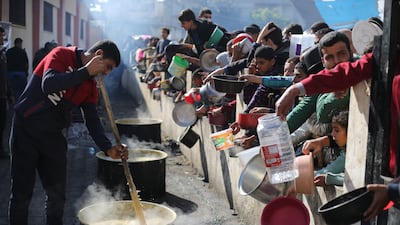
Palestinians queue for food in Rafah, the Gaza Strip, on December 20, 2023. AP Photo -

The ruins of Rafah on December 14, 2023. AFP -

Palestinians wounded in the Israeli bombardment of the Gaza Strip arrive at a hospital in Khan Younis on December 8, 2023. AP Photo -
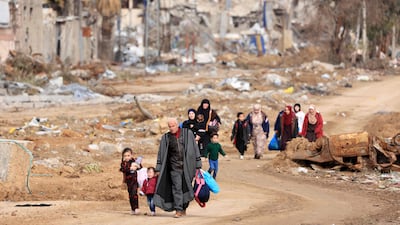
Palestinians flee Israeli bombing along the Salaheddine Road in the Zeitoun district of Gaza city on November 28, 2023. AFP -

A Red Cross vehicle takes Israeli hostages from the Gaza Strip into Egypt in Rafah on November 25, 2023. AP -
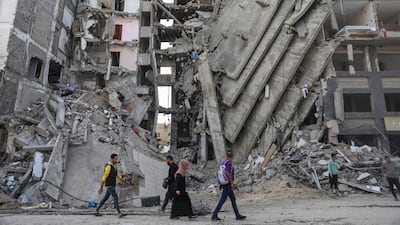
The ruins of buildings in Gaza city on November 24, 2023, as a temporary truce between Israel and Hamas took effect. AP Photo -

A woman and her cat return home to eastern Khan Younis in the southern Gaza Strip during the first hours of a four-day truce between Israel and Hamas forces on November 24, 2023. AFP -

Mourning the dead of Israeli bombardment outside the mortuary at Nasser Hospital in Khan Younis on November 14, 2023. AFP -

Civilians and rescuers look for survivors in the rubble of a building after Israeli bombing of Khan Younis in the southern Gaza Strip on November 12, 2023. AFP -

November 7, 2023, a month to the day after Hamas attacked Israel, a victim of an Israeli bombardment in Rafah is moved from the rubble. AFP -
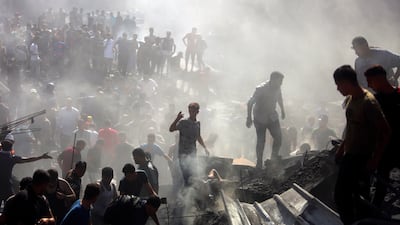
Searching the rubble after Israeli air strikes on the town of Khan Younis, southern Gaza Strip, on October 26, 2023. AP Photo -

Mourning the Kotz family at their funeral in Gan Yavne, Israel, on October 17, 2023. AP Photo -

An Israeli firefighter composes himself after he and his colleagues extinguished cars set on fire by a rocket fired from the Gaza Strip in Ashkelon, Israel, on October 9, 2023. AP Photo -

Palestinians with the wreckage of an Israeli tank at the Gaza Strip fence east of the city of Khan Younis on October 7, 2023, the day Hamas forces swept unopposed into Israel. AP Photo -

Israeli police officers evacuate a woman and a child from a site hit by a rocket fired from the Gaza Strip, in Ashkelon, southern Israel, on October 7, 2023. AP Photo


We learnt four central lessons: because of growing sympathy for Palestinians, voters want American policy to be more balanced and less supportive of Israel. Second, because of the toll the bombings have taken on Palestinian lives, voters want US military aid to Israel to be restricted and conditional. Third, voters want members of Congress to support a ceasefire and are less inclined to support candidates who oppose a ceasefire.
And finally, in almost every instance, the percentages of young voters and non-white voters who support a more balanced Middle East policy, conditioning aid to Israel and a ceasefire far exceed those of other groups of voters. And because these two groups are so important to their party’s chances in 2024, Democrats had better find ways to change direction and win them back.
The numbers speak for themselves.
American public opinion has shifted away from Israel as the invasion of Gaza continues. Forty-two per cent of voters now say they sympathise with both Israelis and Palestinians equally. While a higher percentage of Americans indicated sympathy towards Israelis alone rather than Palestinians alone, Palestinians have more support among voters who are young (34 per cent to 16 per cent) and people of colour (21 per cent to 17 per cent).
Since the start of the current violence in Gaza, sympathy for Palestinians has increased, especially among Democrats (23 per cent increased sympathy towards Palestinians versus 17 per cent towards Israelis), younger Americans (37 per cent increased sympathy towards Palestinians versus 27 per cent for Israelis), and people of colour (29 per cent increased sympathy towards Palestinians versus 13 per cent for Israelis).
At the same time, Americans are calling into question the Biden administration’s handling of the conflict.
Fifty per cent of Americans believe Mr Biden’s policy favours Israel. But when asked how his administration should conduct US policy, a plurality of respondents (42 per cent) say it should be balanced between Israeli and Palestinian needs. By a decisive two-to-one margin, voters say that instead of siding with Israel (a position held by only 26 per cent), the US should strive to be an honest broker between Israelis and Palestinians (a position held by 57 per cent).

This questioning of the administration’s one-sided support for Israel also has an impact on voters’ attitudes towards US military assistance to that state. By a two-to-one margin (51 per cent to 26 per cent), voters reject the notion that the US should give unrestricted military assistance to Israel as long as Israel is putting Palestinian civilian lives at risk.
By the same two-to-one margin, respondents said that they sided with those Democratic senators who objected to the President’s recent decision to bypass congressional oversight in sending weapons to Israel. A plurality of voters (41 per cent) now indicate that it is time to consider cutting or conditioning Israel’s annual $3.8 billion appropriation for military assistance.
American voters are more likely to vote for candidates that support a ceasefire. Respondents want a ceasefire and an end to the conflict. In responses to two separate questions, by a two-to-one margin, respondents indicated that they are more inclined to support a member of Congress who supports a ceasefire and that they are less willing to support those who oppose calls for it.
The bottom line is that Democrats should be hearing alarms going off as a result of the White House’s refusal to stop the way Israel is conducting this war or even consider supporting a ceasefire to end the killing. The result is that they are losing votes from groups that have formed their most loyal supporters.
The cavalier attitude of those who are guiding Mr Biden’s campaign is simplistic and deeply flawed. Betting on young and non-white voters drifting back to Mr Biden in November – on the assumption that they won’t want to see Donald Trump return to the White House – is demeaning to the feelings of these voters.
It’s also dangerous. As The New York Times poll demonstrates, almost one in five say they would prefer to vote for third-party candidates. The “political pros” in the White House need to consider this threat and not discount it as Democrats did in the 2000 and 2016 elections.

