


“China has no selfish interests on the question of Palestine,” said Zhang Jun, the Chinese ambassador to the UN, amid testy exchanges with his Israeli counterpart, Gilad Erdan, last month.
“Any initiative that contributes to peace will receive China’s staunch support. Any endeavour that facilitates Palestinian-Israeli reconciliation will be pursued by China with all-out efforts,” Mr Zhang added.
In the wake of the October 7 massacres, Beijing has tried to project neutrality by emphasising, among other things, how “equal attention should be paid to the security concerns and legitimate rights of both Israel and Palestine” as well as condemning “violence and attacks against civilians”.
But with the US opposing UN resolutions calling for a humanitarian pause in Gaza, China has increasingly taken up the cudgels for the Palestinian cause. Throughout the past month, top officials have repeatedly emphasised the importance of looking at the root causes of the ongoing conflict as well as the Palestinian people’s right to self-determination.
Confronting a new Cold War with the US, China is now taking the fight to the West by presenting itself as not only a potential peace broker in the Middle East, where anti-American sentiments appear to be on the rise, but also a champion for Muslim-majority countries. This subtle but significant shift in Beijing’s foreign policy reflects a more fundamental transformation in the global balance of power.
While China is emerging as a full-fledged global player, now intent on playing a more active role in several regions, a number of Muslim-majority countries are now pivotal players in the international system. The upshot is an emerging alliance between China and the Muslim world, with the Palestinian cause serving as a major rallying point.
Mao Zedong, China’s most influential leader in modern times, once famously said: “Where the enemy advances, we retreat. Where the enemy retreats, we pursue.” Mao’s dictum perfectly captures Beijing’s strategic calculus in recent years amid its competition with the US.
-
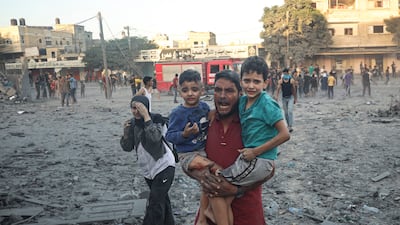
Palestinians cry as they walk away after an area hit by Israeli missiles in Rafah, the Gaza Strip. AP -
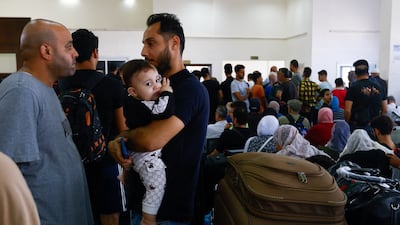
Palestinians with foreign passports wait for permission to leave Gaza at the Rafah border crossing with Egypt. Reuters -
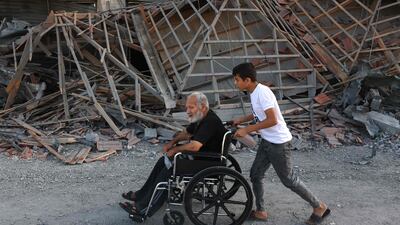
A Palestinian boy pushes a man on a wheelchair past debris in Rafah. AFP -

A paramedic holds an injured bird as he searches through buildings destroyed during Israeli air raids in Khan Younis, in the southern Gaza Strip. Getty Images -

Israeli soldiers take part in ground operations at a location given as Gaza. Reuters -
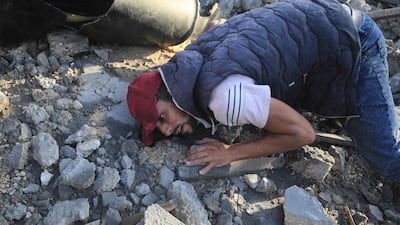
A man listens for any potential sounds of life following an Israeli air strike on the Maghazi refugee camp in Gaza. AFP -
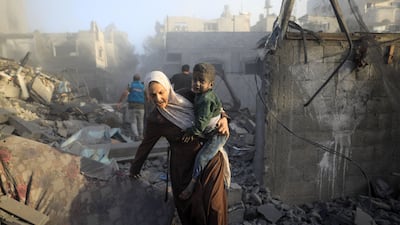
People flee after Israeli air strikes on the Maghazi refugee camp. AFP -

An Israeli soldier arranges artillery shells near the border with the Gaza Strip. AFP -

Relatives and friends of those kidnapped during the October 7 Hamas attack hold photos of their loved ones during a protest calling for their return outside Israel's parliament. AP -
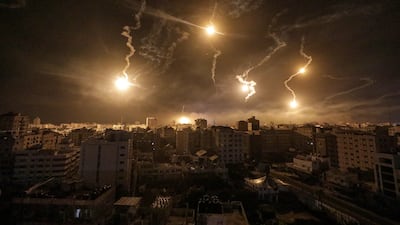
Israeli flares illuminate the sky over west Gaza in the northern Gaza Strip. EPA -
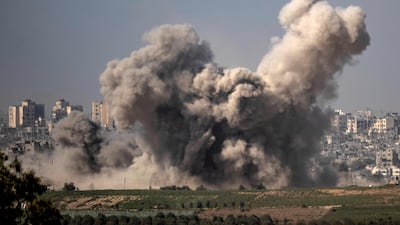
Smoke rises from northern Gaza after Israeli pounded the besieged enclave. AFP -

Ambulances queue at the Rafah border as they wait to cross into Gaza to transport the injured back to Egypt for treatment. Getty Images -

Women cry as one of them holds an injured toddler outside Shuhada Al Aqsa hospital after an Israeli bombardment of Deir Balah, in the central Gaza Strip. AFP -
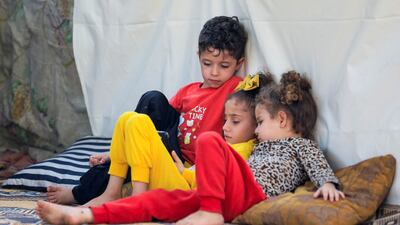
Displaced Palestinian children sit in a makeshift shelter at Al Shifa hospital, amid the Israel-Gaza war. Reuters -
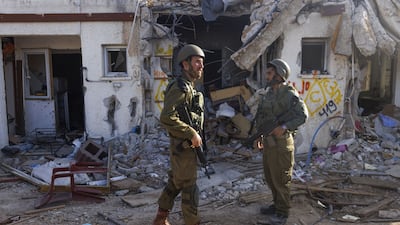
Israeli soldiers patrol outside a house destroyed during fighting with Hamas militants, in the kibbutz of Kfar Aza. Bloomberg -

Palestinians from Bureij refugee camp use Salah Al Din street as they flee the southern Gaza Strip. AP -
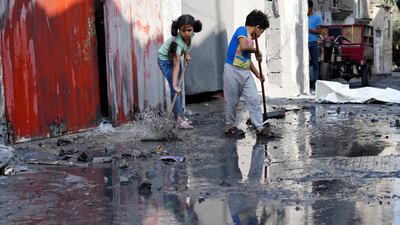
Palestinian children clean up outside their home after Israel struck Maghazi refugee camp in the Gaza Strip. AP -
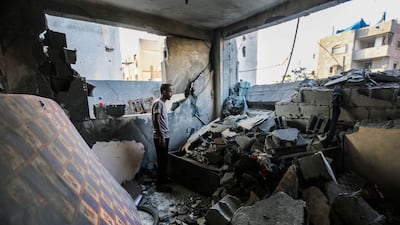
Khan Younis residents search through buildings destroyed during Israeli air raids. Getty Images -
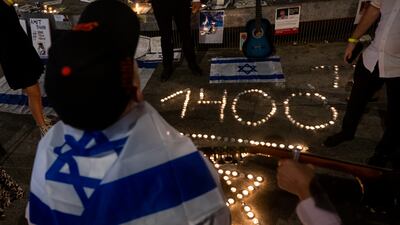
People take part in a candlelight vigil in Dizengoff Square, in Tel Aviv. Getty Images -
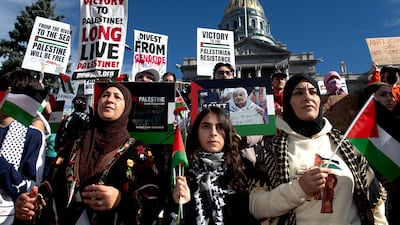
Demonstrators rally in support of Palestinians in Denver, Colorado. AFP -

Galya David, the mother of hostage Evyatar David, takes part in the 'Bring them home' event organised by the Greek Israeli Community in Athens. EPA -

Lebanese parademics show the blood-stained high-vis jackets of four of their colleagues wounded after their ambulances were hit in a strike on the Lebanese town of Tayr Harfa. AFP -
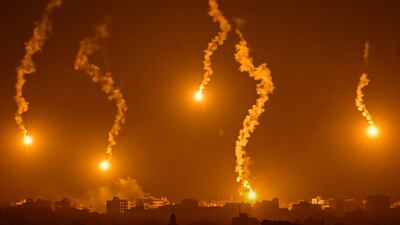
Flares are dropped by Israeli forces above Gaza, as seen from Sderot, near the border with the Palestinian enclave. AFP -

Israeli forces at a position along the the border with Gaza. AFP -

Palestinians search for bodies and survivors at Magazi refugee camp in Gaza after an Israeli air strike. Reuters -

Leaflets are dropped by the Israeli army over Gaza city asking people to evacuate towards the south of the Palestinian enclave. AFP -
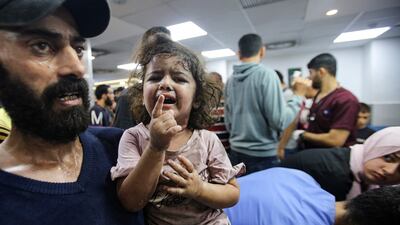
An injured toddler awaits treatment at the emergency ward of Al-Shifa Hospital following an Israeli strike, in Gaza city. AFP -

A Palestinian man wails amid a search for casualties after an Israeli strike on houses, at Magazi refugee camp, Gaza. Reuters -
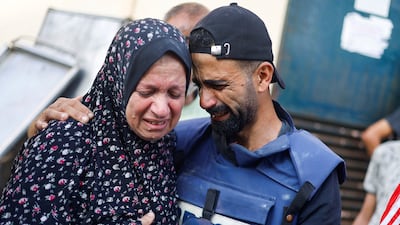
Anadolu news agency cameraman Mohammed El Aloul pictured after several of his children and siblings were killed in Israeli strikes. Reuters -

Israeli soldiers walk past debris and damaged buildings at a location given as Gaza by Israel's military. Reuters -

Protesters rally outside the White House in support of Palestinians in Gaza, Washington. Reuters -
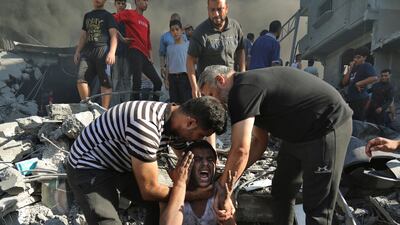
A man mourns after losing relatives following an Israeli air strike in Gaza city. AP -
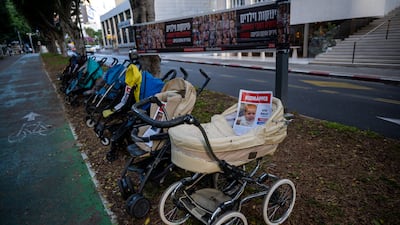
An art installation of prams with the faces of kidnapped children on display in Tel Aviv. Getty Images -

An Israeli woman calls for a ceasefire in the Gaza Strip. AP -

A Palestinian man stands on a collapsed building following a strike by the Israeli military on Khan Yunis in the southern Gaza Strip. AFP -
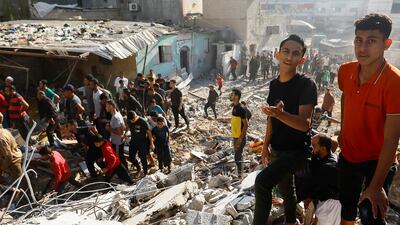
Palestinians gather at the site of Israeli strikes on a residential building in Khan Younis. Reuters -
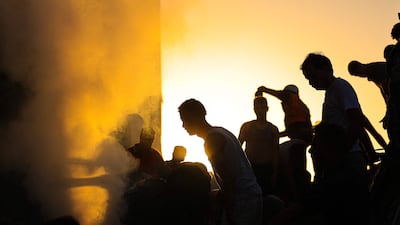
Thousands of civilians, both Palestinians and Israelis, have died since October 7, 2023. AFP -

A Palestinian woman sits in the rubble as rescuers look for her relatives following the Israeli bombardment of Khan Younis. AFP -
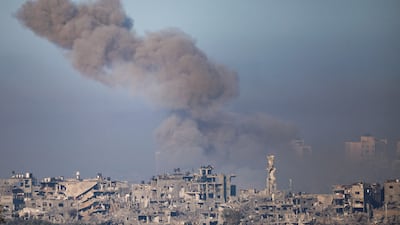
Smoke rises from Gaza as the conflict between Israel and Palestinian group Hamas continues. Reuters -

Mourners at the funeral of Druze Israeli Lt Col Salman Habaka in the village of Yanuh Jat, northern Israel. AP -
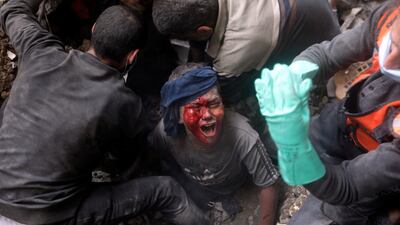
A Palestinian boy pulled from the rubble of a building following an Israeli air attack on Bureij refugee camp, in the Gaza Strip. AP -

A survivor calls from Nasser Hospital in Khan Younis following Israeli air attacks. EPA -
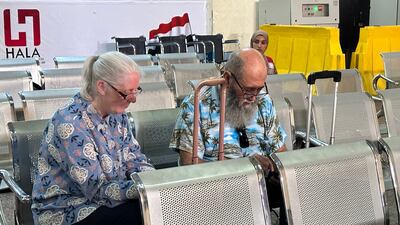
People wait on the Egyptian side of the border after passing the Rafah border crossing between the Gaza Strip and Egypt. EPA -
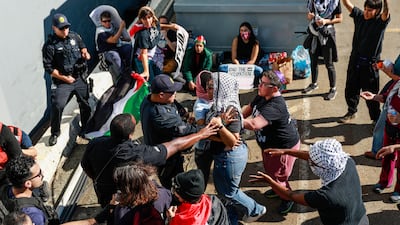
Pro-Palestinian supporters during a demonstration near a US military transport vessel at the Port of Oakland in California. AP


Only a decade ago, China largely took a defensive position when the Obama administration launched its much-vaunted “Pivot to Asia” policy to contain the rise of a new challenger in one of the world’s most dynamic regions. The Trump administration further intensified this policy by launching trade wars against Beijing.
The Biden administration has steadily expanded military co-operation with a network of regional partners and allies – including Australia, India, Japan, the Philippines, South Korea and Vietnam – under an “integrated deterrence” strategy to constrain China. This strategic offensive was coupled with expanded sanctions on its tech sector and national champions.
As if that weren’t enough, Beijing also faced growing sanctions over its internal policies, as western nations and various human rights organisations accused it of oppressing religious minority groups.
By all indications, China is now taking the fight to the West.
First, it stepped up its charm offensive around the world by launching its trillion-dollar Belt and Road Initiative, which aims to enhance infrastructure connectivity across several continents.
It also sought to enhance its soft power by mediating major conflicts. In March, it defied all expectations by brokering a game-changing detente between Saudi Arabia and Iran.
Given China’s heavy dependence on energy imports from the region, it has a great incentive to facilitate stability and enhance its soft power in the Mena region.
It’s no wonder, then, that the majority of newly admitted members to the Brics grouping are from the region, including Egypt, Iran, Saudi Arabia and the UAE. The world’s largest Muslim-majority country, Indonesia, was also reportedly among those invited to join an expanded Brics.
Crucially, China has also waded into the most contentious conflict in the region, if not in the world. In June, President Xi Jinping hosted Palestinian Authority President Mahmoud Abbas in Beijing, where they signed a strategic partnership. Its pivot to the region couldn’t be timelier.
The US is increasingly unpopular in the Middle East. A Pew Research Centre survey in 2020 showed that Washington suffers from a 73 per cent disapproval rating in Turkey, a fellow Nato member-state, followed by Lebanon (53 per cent) and Tunisia (44 per cent).
With the US firmly standing by Israel in the latest conflict in the Middle East, anti-western sentiments are likely to intensify across the region.
This has provided a key opening for China to present itself as an ostensibly constructive player, thanks to its robust relations with all the major powers in the Middle East as well as its more historically balanced position on the Palestine-Israel conflict.

During a recent phone conversation with Saudi Foreign Minister Prince Faisal bin Farhan, Chinese Foreign Minister Wang Yi made it clear that “China believes that the historical injustices against Palestine have lasted for more than half a century and cannot go on”.
Meanwhile, Beijing’s top envoy on the Middle East, Zhai Jun, promised proactive diplomacy by underscoring how China will “further strengthen co-ordination with all parties in the direction of a ceasefire, the protection of civilians, de-escalation and the promotion of peace talks”.
There appears to be genuine affinity between China and several Islamic countries, in part due to their shared experience of western colonialism.
The late Chinese premier Zhou Enlai was a pivotal figure during the establishment of the Non-Aligned Movement in the mid-20th century, when post-colonial nations sought to create an alternative sphere outside both the western and Soviet circles of influence.
After the end of the Cold War, the political scientist Samuel Huntington identified both the Islamic and Chinese civilisations as the ultimate bastions of resistance to western hegemony in the 21st century. That supposed “civilisational alliance” now seems to be congealing into a potent geopolitical force.
Amid the humanitarian catastrophe in Gaza, there seems to be popular support in China for a more sympathetic position towards Palestinians.
It’s quite telling that even Israel and the US have recognised China’s importance as a potential peacemaker, particularly as Beijing has positioned itself as a champion of the Global South – at a time when Washington is facing growing criticism for its ostensible double-standards on humanitarian crises outside the West.
Far from being contained in its backyard by the West, China is now extending its influence around the world.
It remains to be seen, however, if it can succeed where its western predecessors failed.
Beijing’s yet-to-be-proven ability to nudge the protagonists towards a desperately needed ceasefire in Gaza will serve as a crucial acid test of its emerging role in the Mena region.

