Smoke rises after Israeli air strikes on northern Gaza Strip on Tuesday. EPA


How the US missed a chance to nip the Israel-Gaza war in the bud


  • English
  • Arabic

October 17, 2023

The unfolding horror in Gaza is a reminder of two important lessons that should have been heeded by Hamas, Israel and the US.

The first came from the late Ibrahim Abu Lughod, the brilliant Palestinian-American historian. He always cautioned never to make judgements based on the day’s headlines, because like the ocean’s tides or waves, they come in and go out. If we are driven by them, we are left flailing about without being grounded in reality. Rather, we should focus on the deep currents that shape the direction of events.

Using that lesson, I disagree with some experts who insist that after this Israel-Gaza War, nothing will ever be the same again. No doubt, some things will be different, but when the dust settles, no matter how much damage Israel is able to inflict on Hamas, the Palestinian people and Gaza, too many constants will remain.

In the first place, Palestinians will still be under an oppressive occupation, chafing at the way Israel controls their land and denies them freedom.

Hamas may be defeated, but out of the anger and trauma caused by this huge display of Israeli might, the seeds are being planted for Hamas 2.0 or something worse. At the same time, the already diminished Palestinian Authority will have become even more irrelevant and Palestinians, as they have been since the tragic end of Yasser Arafat, will be operating without a leadership that could actually inspire them. That unfortunately is unlikely to change.

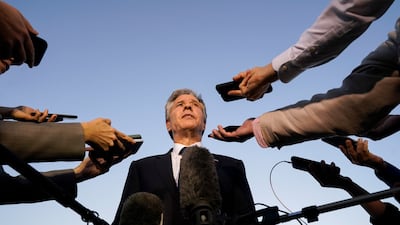
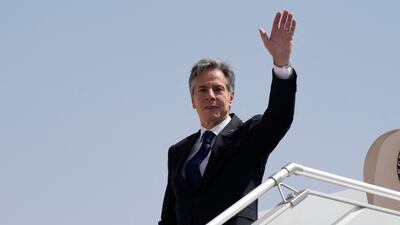
  • US Secretary of State Antony Blinken speaks to members of the media before leaving Cairo, en route to Jordan. AP
    US Secretary of State Antony Blinken speaks to members of the media before leaving Cairo, en route to Jordan. AP
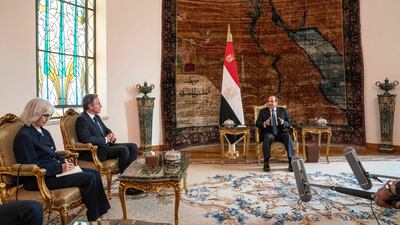
  • Egypt's President Abdel Fattah El Sisi, right, meets with Mr Blinken, centre, in Cairo. AFP
    Egypt's President Abdel Fattah El Sisi, right, meets with Mr Blinken, centre, in Cairo. AFP
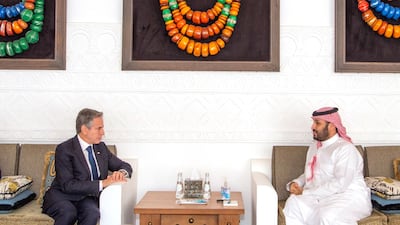
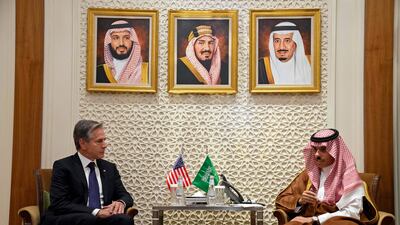
  • US Secretary of State Antony Blinken meets Saudi Crown Prince Mohammed bin Salman in Riyadh. AFP
    US Secretary of State Antony Blinken meets Saudi Crown Prince Mohammed bin Salman in Riyadh. AFP
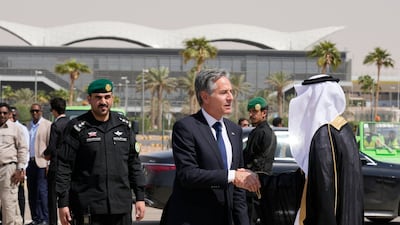
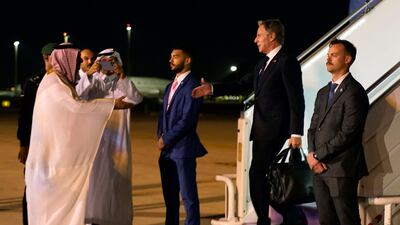
  • Mr Blinken shakes hands with a Saudi official before boarding a plane leaving Riyadh. AP
    Mr Blinken shakes hands with a Saudi official before boarding a plane leaving Riyadh. AP
  • Mr Blinken toured six Arab capitals to build pressure on Hamas. AP
    Mr Blinken toured six Arab capitals to build pressure on Hamas. AP
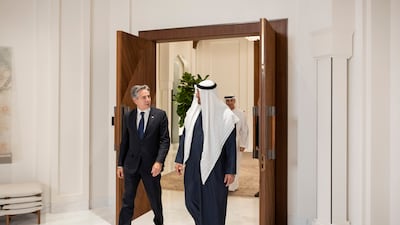
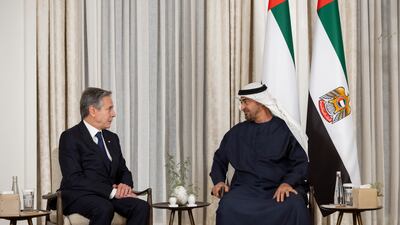
  • President Sheikh Mohamed and Mr Blinken at Shati Palace, Abu Dhabi. Ryan Carter / UAE Presidential Court
    President Sheikh Mohamed and Mr Blinken at Shati Palace, Abu Dhabi. Ryan Carter / UAE Presidential Court
  • Sheikh Mohamed and Mr Blinken. Ryan Carter / UAE Presidential Court
    Sheikh Mohamed and Mr Blinken. Ryan Carter / UAE Presidential Court
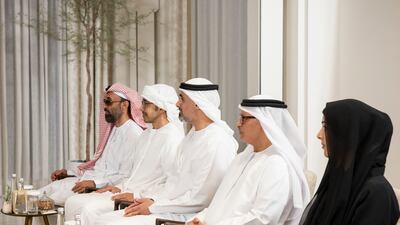
  • From left: Sheikh Tahnoon bin Zayed, Deputy Ruler of Abu Dhabi and UAE National Security Adviser; Sheikh Abdullah bin Zayed, UAE Minister of Foreign Affairs; Sheikh Khaled bin Mohamed bin Zayed, Crown Prince of Abu Dhabi and chairman of Abu Dhabi Executive Council; Dr Anwar bin Mohamed Gargash, diplomatic advisor to the UAE President; and Reem bint Ibrahim Al Hashimi, UAE Minister of State for International Co-operation. Ryan Carter / UAE Presidential Court
    From left: Sheikh Tahnoon bin Zayed, Deputy Ruler of Abu Dhabi and UAE National Security Adviser; Sheikh Abdullah bin Zayed, UAE Minister of Foreign Affairs; Sheikh Khaled bin Mohamed bin Zayed, Crown Prince of Abu Dhabi and chairman of Abu Dhabi Executive Council; Dr Anwar bin Mohamed Gargash, diplomatic advisor to the UAE President; and Reem bint Ibrahim Al Hashimi, UAE Minister of State for International Co-operation. Ryan Carter / UAE Presidential Court
  • Saudi Foreign Minister Prince Faisal bin Farhan meets Mr Blinken, in Riyadh. AFP
    Saudi Foreign Minister Prince Faisal bin Farhan meets Mr Blinken, in Riyadh. AFP
  • Mr Blinken arrives in Riyadh, Saudi Arabia, after a one-day tour of Jordan, Qatar, and Bahrain. AFP
    Mr Blinken arrives in Riyadh, Saudi Arabia, after a one-day tour of Jordan, Qatar, and Bahrain. AFP
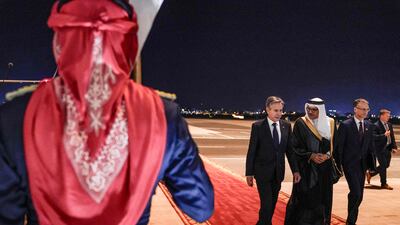
  • Mr Blinken is received by Bahrain's Foreign Minister Abdullatif bin Rashid and US Ambassador to Bahrain Steven Brody, in Manama. AFP
    Mr Blinken is received by Bahrain's Foreign Minister Abdullatif bin Rashid and US Ambassador to Bahrain Steven Brody, in Manama. AFP
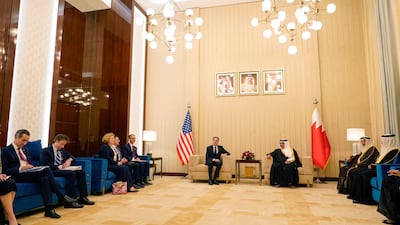
  • The US Secretary of State meets Bahrain's Prime Minister Crown Prince Salman Bin Hamad, in Manama. Reuters
    The US Secretary of State meets Bahrain's Prime Minister Crown Prince Salman Bin Hamad, in Manama. Reuters
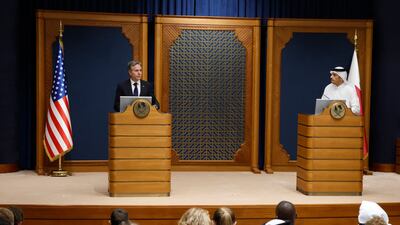
  • Mr Blinken and Qatar's Prime Minister Mohammed bin Abdulrahman Al Thani after their meeting in Doha. AFP
    Mr Blinken and Qatar's Prime Minister Mohammed bin Abdulrahman Al Thani after their meeting in Doha. AFP
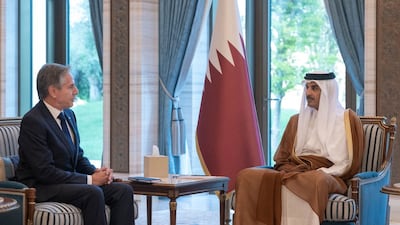
  • Qatari Emir Sheikh Tamim holds talks with Mr Blinken, in Doha. Reuters
    Qatari Emir Sheikh Tamim holds talks with Mr Blinken, in Doha. Reuters
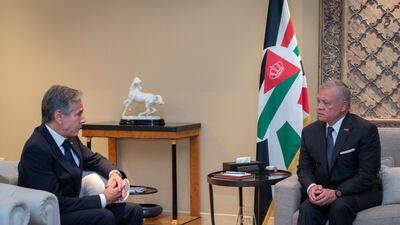
  • King Abdullah of Jordan receives the US Secretary of State, in Amman. EPA
    King Abdullah of Jordan receives the US Secretary of State, in Amman. EPA
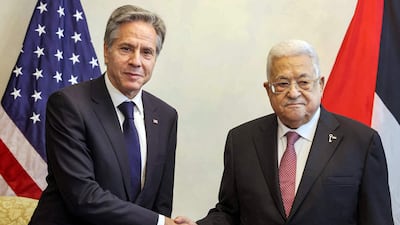
  • Mr Blinken meets Palestinian President Mahmoud Abbas, in Amman. AFP
    Mr Blinken meets Palestinian President Mahmoud Abbas, in Amman. AFP
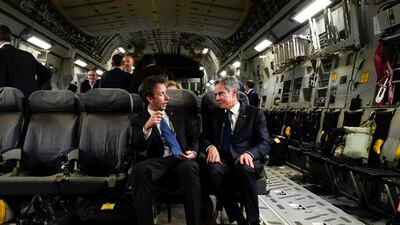
  • With Tom Sullivan, US deputy chief of staff for policy, as they depart Tel Aviv, en route to Jordan. AP
    With Tom Sullivan, US deputy chief of staff for policy, as they depart Tel Aviv, en route to Jordan. AP
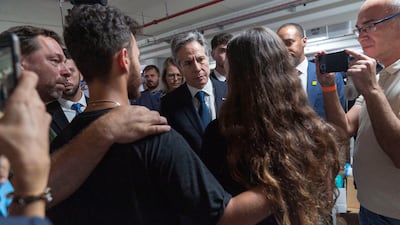
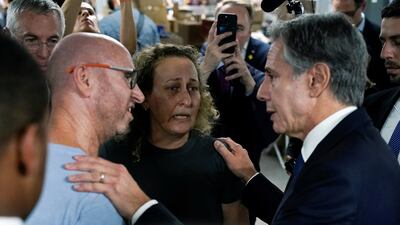
  • Mr Blinken speaks with survivors of a Hamas attack on a rave party, in Tel Aviv. AP
    Mr Blinken speaks with survivors of a Hamas attack on a rave party, in Tel Aviv. AP
  • Visiting the donation centre for victims of the Hamas attacks, in Tel Aviv. Reuters
    Visiting the donation centre for victims of the Hamas attacks, in Tel Aviv. Reuters
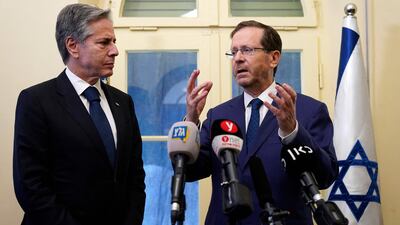
  • Mr Blinken and Israel’s President Isaac Herzog during a media briefing at the Kirya, in Tel Aviv. AFP
    Mr Blinken and Israel’s President Isaac Herzog during a media briefing at the Kirya, in Tel Aviv. AFP
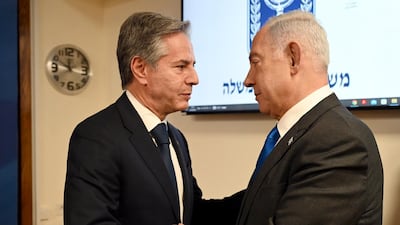
  • Israeli Prime Minister Benjamin Netanyahu and Mr Blinken during a meeting at the Kirya. EPA
    Israeli Prime Minister Benjamin Netanyahu and Mr Blinken during a meeting at the Kirya. EPA
Did the Biden administration actually believe that by giving Netanyahu full-throated support that he would act with restraint?

Israel is also unlikely to change. As it emerges from its trauma, its politics will not be more moderate. There may be less of a push for radical changes in the judiciary and fewer accommodations made for the ultra-Orthodox, but Prime Minister Benjamin Netanyahu’s new/old partner, former defence minister Benny Gantz, is no less hardline on the Palestinian issue. In fact, Mr Gantz’s past critique of Mr Netanyahu was that he hadn’t “finished off” Hamas in the last Gaza war.

Sadly, little will anything change on the US front. While public opinion, especially among Democrats, continues to be increasingly critical of Israeli right-wing policies (and will most likely become more critical after Israel finishes bombing Gaza), the pro-Israel lobby will continue to influence elected officials in both parties. At some point, the Biden administration may decide that Israel has gone too far with its assault and press it to halt the violence, but the US shouldn’t be expected to apply the kind of pressure needed to force an end to the occupation or justice for Palestinians.

The bottom line is that because constants are unlikely to change, neither will the political realities shaping the conflict.

The second lesson comes from the famous “doctrine” attributed to Colin Powell, the former US secretary of state. He laid out a series of questions to be considered before ever engaging in a war. Among them were: Is there a clear and attainable objective? Have risks and consequences been assessed? Is there an exit strategy?

It will be recalled that the late Mr Powell tragically didn’t follow his own doctrine that led to American debacles in Afghanistan and Iraq. It’s equally clear that neither Hamas nor Israel heeded his guidance.

There are 2.3 million Palestinians in Gaza. In our most recent polling, Hamas has the support of about 20 per cent of them. If history is our guide, Israel’s assault will only make Palestinians angrier and more inclined to fight Israel, just as Hamas’s attack only gave reprieve to an unpopular Mr Netanyahu.

What then were the attainable objectives for either Hamas or Israel? Did Hamas think it would actually advance its cause? Did it believe that its butchery would end the occupation, harm the Netanyahu government, or improve its own standing among Palestinians or in the Arab world? And does Israel really believe that massacres in Gaza are going to pacify Palestinians, turning their hatred into acceptance or that they will salvage Mr Netanyahu’s electoral fortunes? And did either Israel or Hamas think of what might happen in weeks two or three of this war or what the end game might be?

One can try to understand – but never excuse – Hamas and Israel for striking out blindly. But the US needed to be more level-headed. Having seen Israel engage in similar past efforts to destroy Hamas or Hezbollah – and seen them fail – why did the US think this would be different?

Did the administration actually believe that by giving Mr Netanyahu full-throated support that he would act with restraint? Or that the resultant devastation of Gaza and killing of thousands would hasten the prospects for regional peace? And did they really believe that Israel would be any more successful in this war than it was in 2006 in Lebanon or the biannual wars with Hamas over the past 15 years, or for that matter than the US, itself, was in Afghanistan or Iraq?

It’s too late to answer these questions now. They should have been asked and answered by all parties before Hamas launched its deadly attacks, Israel embarked on its huge devastation and killing in Gaza, and the US gave Israel blank-cheque support. Now we’re left to live with the horrific consequences of everyone’s lack of discretion – the dead, the rubble, and the trauma and anger on both sides.


Company%20profile
%3Cp%3E%3Cstrong%3EName%3A%3C%2Fstrong%3E%20WonderTree%3Cbr%3E%3Cstrong%3EStarted%3A%3C%2Fstrong%3E%20April%202016%3Cbr%3E%3Cstrong%3ECo-founders%3A%3C%2Fstrong%3E%20Muhammad%20Waqas%20and%20Muhammad%20Usman%3Cbr%3E%3Cstrong%3EBased%3A%3C%2Fstrong%3E%20Karachi%2C%20Pakistan%2C%20Abu%20Dhabi%2C%20UAE%2C%20and%20Delaware%2C%20US%3Cbr%3E%3Cstrong%3ESector%3A%3C%2Fstrong%3E%20Special%20education%2C%20education%20technology%2C%20assistive%20technology%2C%20augmented%20reality%3Cbr%3EN%3Cstrong%3Eumber%20of%20staff%3A%20%3C%2Fstrong%3E16%3Cbr%3E%3Cstrong%3EInvestment%20stage%3A%20%3C%2Fstrong%3EGrowth%3Cbr%3E%3Cstrong%3EInvestors%3A%3C%2Fstrong%3E%20Grants%20from%20the%20Lego%20Foundation%2C%20UAE's%20Anjal%20Z%2C%20Unicef%2C%20Pakistan's%20Ignite%20National%20Technology%20Fund%3C%2Fp%3E%0A
Uefa Nations League

League A:
Germany, Portugal, Belgium, Spain, France, England, Switzerland, Italy, Poland, Iceland, Croatia, Netherlands

League B:
Austria, Wales, Russia, Slovakia, Sweden, Ukraine, Republic of Ireland, Bosnia-Herzegovina, Northern Ireland, Denmark, Czech Republic, Turkey

League C:
Hungary, Romania, Scotland, Slovenia, Greece, Serbia, Albania, Norway, Montenegro, Israel, Bulgaria, Finland, Cyprus, Estonia, Lithuania

League D:
Azerbaijan, Macedonia, Belarus, Georgia, Armenia, Latvia, Faroe Islands, Luxembourg, Kazakhstan, Moldova, Liechtenstein, Malta, Andorra, Kosovo, San Marino, Gibraltar

UK%20record%20temperature
%3Cp%3E38.7C%20(101.7F)%20set%20in%20Cambridge%20in%202019%3C%2Fp%3E%0A
Results
%3Cp%3E%3Cstrong%3EStage%202%3A%3C%2Fstrong%3E%3Cbr%3E1.%20Soudal%E2%80%93Quick-Step%20-%2018%E2%80%9911%E2%80%9D%3Cbr%3E2.%20EF%20Education%20%E2%80%93%20EasyPost%20-%201%22%3Cbr%3E3.%20Ineos%20Grenadiers%20-%203%22%3Cbr%3E%3Cstrong%3EGeneral%20classification%3A%3C%2Fstrong%3E%3Cbr%3E1.%20Lucas%20Plapp%20(AUS)%20Ineos%20Grenadiers%3Cbr%3E2.%20Remco%20Evenepoel%20(BEL)%20Soudal%E2%80%93Quick-Step%20-%20ST%3Cbr%3E3.%20Nikias%20Arndt%20(GER)%20Bahrain%20Victorious%20-%203%22%3C%2Fp%3E%0A

Meatless Days
Sara Suleri, with an introduction by Kamila Shamsie
​​​​​​​Penguin 

RESULT

Argentina 0 Croatia 3
Croatia: 
Rebic (53'), Modric (80'), Rakitic (90' 1)

The National's picks

4.35pm: Tilal Al Khalediah
5.10pm: Continous
5.45pm: Raging Torrent
6.20pm: West Acre
7pm: Flood Zone
7.40pm: Straight No Chaser
8.15pm: Romantic Warrior
8.50pm: Calandogan
9.30pm: Forever Young

Mercer, the investment consulting arm of US services company Marsh & McLennan, expects its wealth division to at least double its assets under management (AUM) in the Middle East as wealth in the region continues to grow despite economic headwinds, a company official said.

Mercer Wealth, which globally has $160 billion in AUM, plans to boost its AUM in the region to $2-$3bn in the next 2-3 years from the present $1bn, said Yasir AbuShaban, a Dubai-based principal with Mercer Wealth.

Within the next two to three years, we are looking at reaching $2 to $3 billion as a conservative estimate and we do see an opportunity to do so,” said Mr AbuShaban.

Mercer does not directly make investments, but allocates clients’ money they have discretion to, to professional asset managers. They also provide advice to clients.

“We have buying power. We can negotiate on their (client’s) behalf with asset managers to provide them lower fees than they otherwise would have to get on their own,” he added.

Mercer Wealth’s clients include sovereign wealth funds, family offices, and insurance companies among others.

From its office in Dubai, Mercer also looks after Africa, India and Turkey, where they also see opportunity for growth.

Wealth creation in Middle East and Africa (MEA) grew 8.5 per cent to $8.1 trillion last year from $7.5tn in 2015, higher than last year’s global average of 6 per cent and the second-highest growth in a region after Asia-Pacific which grew 9.9 per cent, according to consultancy Boston Consulting Group (BCG). In the region, where wealth grew just 1.9 per cent in 2015 compared with 2014, a pickup in oil prices has helped in wealth generation.

BCG is forecasting MEA wealth will rise to $12tn by 2021, growing at an annual average of 8 per cent.

Drivers of wealth generation in the region will be split evenly between new wealth creation and growth of performance of existing assets, according to BCG.

Another general trend in the region is clients’ looking for a comprehensive approach to investing, according to Mr AbuShaban.

“Institutional investors or some of the families are seeing a slowdown in the available capital they have to invest and in that sense they are looking at optimizing the way they manage their portfolios and making sure they are not investing haphazardly and different parts of their investment are working together,” said Mr AbuShaban.

Some clients also have a higher appetite for risk, given the low interest-rate environment that does not provide enough yield for some institutional investors. These clients are keen to invest in illiquid assets, such as private equity and infrastructure.

“What we have seen is a desire for higher returns in what has been a low-return environment specifically in various fixed income or bonds,” he said.

“In this environment, we have seen a de facto increase in the risk that clients are taking in things like illiquid investments, private equity investments, infrastructure and private debt, those kind of investments were higher illiquidity results in incrementally higher returns.”

The Abu Dhabi Investment Authority, one of the largest sovereign wealth funds, said in its 2016 report that has gradually increased its exposure in direct private equity and private credit transactions, mainly in Asian markets and especially in China and India. The authority’s private equity department focused on structured equities owing to “their defensive characteristics.”

WandaVision

Starring: Elizabeth Olsen, Paul Bettany

Directed by: Matt Shakman

Rating: Four stars

Race card

4pm Al Bastakiya Listed US$300,000 (Dirt) 1,900m

4.35pm Mahab Al Shimaal Group 3 $350,000 (D) 1,200m

5.10pm Nad Al Sheba Turf Group 3 $350,000 (Turf) 1,200m

5.45pm Burj Nahaar Group 3 $350,000 (D) 1,600m

6.20pm Jebel Hatta Group 1 $400,000 (T) 1,800m

6.55pm Al Maktoum Challenge Round-3 Group 1 $600,000 (D) 2,000m

7.30pm Dubai City Of Gold Group 2 $350,000 (T) 2,410m

The National selections:

4pm Zabardast

4.35pm Ibn Malik

5.10pm Space Blues

5.45pm Kimbear

6.20pm Barney Roy

6.55pm Matterhorn

7.30pm Defoe

SQUADS

India
Virat Kohli (captain), Rohit Sharma (vice-captain), Shikhar Dhawan, Ajinkya Rahane, Manish Pandey, Kedar Jadhav, Dinesh Karthik, Mahendra Singh Dhoni (wicketkeeper), Hardik Pandya, Axar Patel, Kuldeep Yadav, Yuzvendra Chahal, Jasprit Bumrah, Bhuvneshwar Kumar, Shardul Thakur

New Zealand
Kane Williamson (captain), Martin Guptill, Colin Munro, Ross Taylor, Tom Latham (wicketkeeper), Henry Nicholls, Ish Sodhi, George Worker, Glenn Phillips, Matt Henry, Colin de Grandhomme, Mitchell Santner, Tim Southee, Adam Milne, Trent Boult

COMPANY%20PROFILE
%3Cp%3E%3Cstrong%3ECompany%20name%3A%3C%2Fstrong%3E%20Sav%3Cbr%3E%3Cstrong%3EStarted%3A%3C%2Fstrong%3E%202021%3Cbr%3E%3Cstrong%3EFounder%3A%3C%2Fstrong%3E%20Purvi%20Munot%3Cbr%3E%3Cstrong%3EBased%3A%3C%2Fstrong%3E%20Dubai%3Cbr%3E%3Cstrong%3EIndustry%3A%3C%2Fstrong%3E%20FinTech%3Cbr%3E%3Cstrong%3EFunding%3A%3C%2Fstrong%3E%20%24750%2C000%20as%20of%20March%202023%3Cbr%3E%3Cstrong%3EInvestors%3A%3C%2Fstrong%3E%20Angel%20investors%3C%2Fp%3E%0A
Expo details

Expo 2020 Dubai will be the first World Expo to be held in the Middle East, Africa and South Asia

The world fair will run for six months from October 20, 2020 to April 10, 2021.

It is expected to attract 25 million visits

Some 70 per cent visitors are projected to come from outside the UAE, the largest proportion of international visitors in the 167-year history of World Expos.

More than 30,000 volunteers are required for Expo 2020

The site covers a total of 4.38 sqkm, including a 2 sqkm gated area

It is located adjacent to Al Maktoum International Airport in Dubai South

BMW M5 specs

Engine: 4.4-litre twin-turbo V-8 petrol enging with additional electric motor

Power: 727hp

Torque: 1,000Nm

Transmission: 8-speed auto

Fuel consumption: 10.6L/100km

On sale: Now

Price: From Dh650,000

UAE currency: the story behind the money in your pockets
Updated: October 17, 2023, 2:00 PM