


On Saturday morning, the Biden administration awoke to the fact that a massive attack on southern Israel by Hamas had probably demolished its ambitious efforts to reshape the Middle Eastern strategic landscape. US officials were amazed that Israel was caught by surprise, despite the intense surveillance and human and signals intelligence that tracks activity in the Gaza Strip.
For now, the game-changing and increasingly plausible effort to redraw the Middle Eastern strategic landscape by brokering Saudi-Israeli normalisation, and strengthen the US hand against Iran in the immediate term and China in the long term is, at the very least, on hold. It could be the case that Tehran even strongly encouraged Hamas to launch the offensive precisely to sabotage a Saudi-Israeli rapprochement.
Israel has vowed to respond with crushing blows against Hamas, which has apparently seized dozens of Israeli hostages. So the likelihood is a prolonged military campaign with little restraint by Israel’s powerful military to kill as many Hamas leaders, militants and supporters, and destroy as much of its infrastructure and equipment, as possible.
The track record of powerful militaries taking on much weaker guerrilla forces in smaller territories is replete with a chronic inability to prevent huge civilian casualties and, typically, massacres, whether intended or accidental. The Israeli military has undertaken numerous operations of this kind, mainly in Lebanon and Gaza. Israelis will probably feel less compunction than ever about Palestinian civilian casualties, given the scale and intensity of the Hamas attack. But others, especially the Arab world, will be enraged and appalled, potentially inhibiting Saudi normalisation with Israel.
-
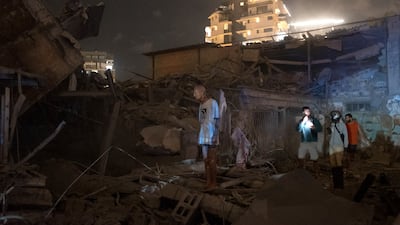
People survey the damage from a rocket fired from the Gaza Strip in Tel Aviv. AP -
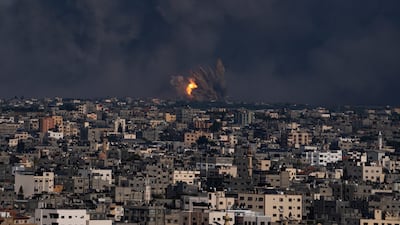
Fire and smoke rise following an Israeli air strike, in Gaza city. AP -
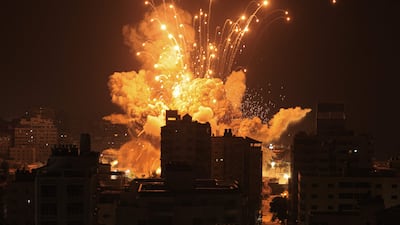
A missile explodes in Gaza city during an Israeli air strike. AFP -

New York City Police hold back Israeli supporters during a protest between Palestinian and Israeli demonstrators. EPA -

Relatives of an Israeli missing since a surprise attack by Hamas militants near the Gaza border during a press conference in Ramat Gan, Israel. AP -

A relative of an Israeli missing since the attack by Hamas militants near the Gaza border sheds tears during a press conference in Ramat Gan, Israel. AP -
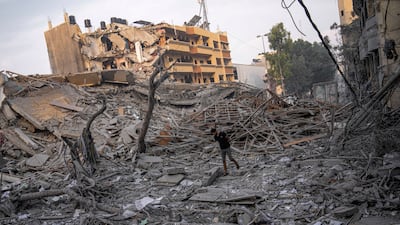
Palestinians inspect the rubble of a building after it was struck by an Israeli air strike, in Gaza city. AP -

A car burnt during an infiltration by Palestinian militants from the Gaza Strip, near Sderot, Israel. AFP -

Israeli border police take cover by a vehicle, near Sderot. Reuters -
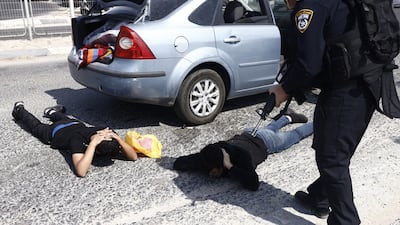
Israeli police check the occupants of a vehicle near Ashkelon, Israel. Bloomberg -

Lebanese soldiers overlook the Israeli town of Metula at the Lebanese side of the border in Kfar Kila, Lebanon. AP -
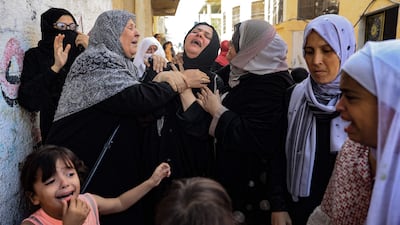
Women mourn during a funeral of a family killed in Israeli strikes on the Palestinian city of Rafah in the Gaza Strip. AFP -
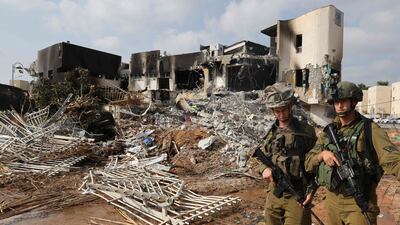
Soldiers walk past an Israeli police station damaged during battles to dislodge Hamas militants who were stationed inside. AFP -
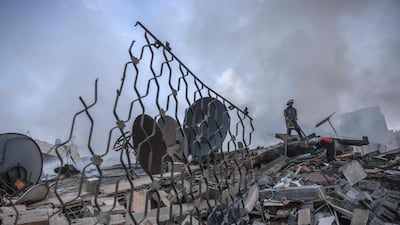
Palestinian firemen check the remains of a residential building destroyed by Israeli airstrikes in Gaza City. AFP -
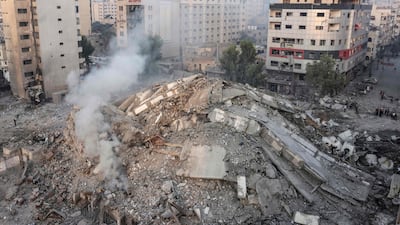
People walk around the ruins of a building destroyed in Israeli airstrikes in Gaza City. AFP -
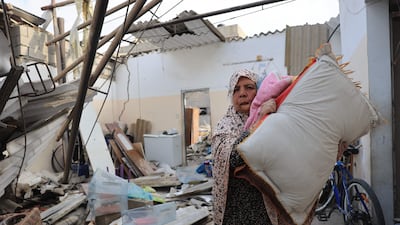
A Palestinian woman's home which was damaged during Israeli airstrikes on Rafah in the southern Gaza Strip. AFP -
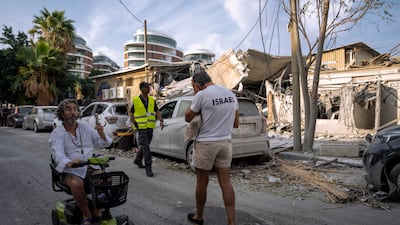
Israelis inspect the rubble of a building in Tel Aviv after it was hit by a rocket fired from the Gaza Strip. AFP -
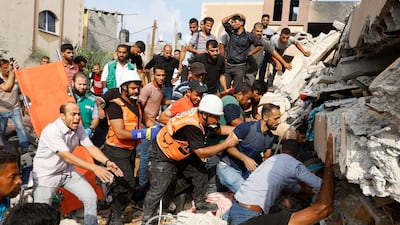
Palestinians search for casualties in a house destroyed by Israeli strikes in Khan Younis, in the southern Gaza Strip. Reuters -

A Palestinian man reacts next to the ruins of a house destroyed in Israeli strikes in Khan Younis. Reuters -
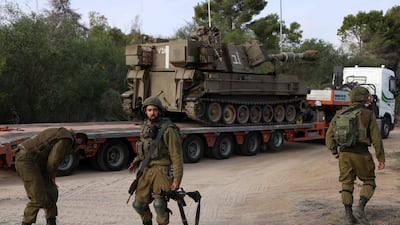
Israeli troops unload 155 mm artillery at an undisclosed location on the border with the Gaza Strip. AFP -
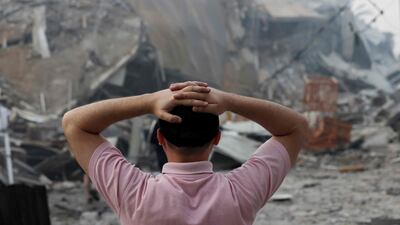
A Palestinian man stands in front of the rubble of Gaza city's Al-Watan Tower, which was destroyed in Israeli airstrikes. AFP -

People near a mosque destroyed in Israeli airstrikes in Khan Yunis, southern Gaza Strip. AFP -
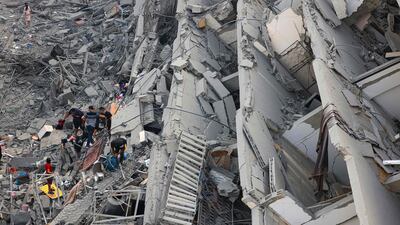
People examine a building destroyed in Israeli air strikes in Gaza city. AFP -
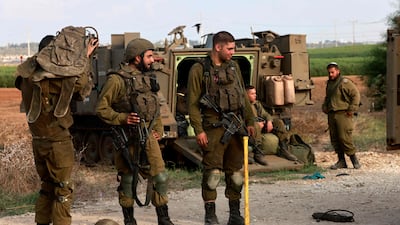
Israeli troops gather at an undisclosed location on the border with the Gaza Strip. AFP -
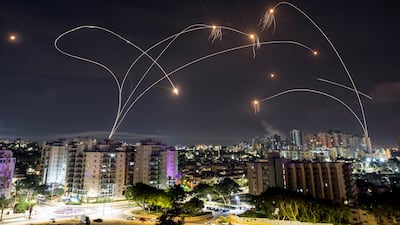
Israel's Iron Dome anti-missile system intercepts rockets launched from the Gaza Strip. Reuters -
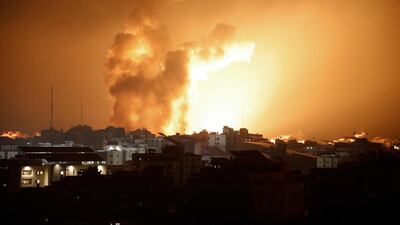
Fire and smoke rises amid an Israeli air strike in Gaza city. AFP -
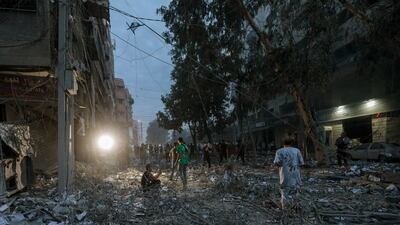
Palestinians inspect the ruins of the Palestine Tower after an Israeli missile struck. EPA -

Rockets launched from the Gaza Strip landed in Tel Aviv. Reuters -
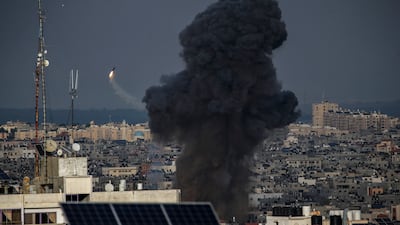
Black smoke rises after an Israeli air strike in Gaza city. EPA -

The departure board at Ben Gurion Airport near Tel Aviv displays a host of cancelled flights. AFP -
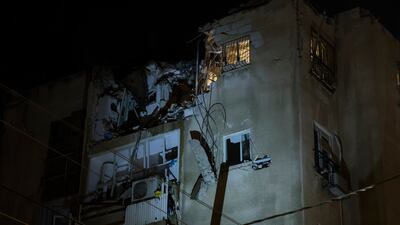
A building hit by a rocket fired from the Gaza Strip. Getty Images -
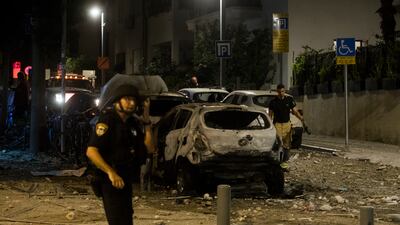
A police officer stands near a burned car at a scene in Tel Aviv. Getty Images -
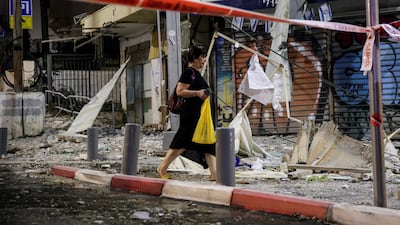
A woman walks past a damaged site after a rocket landed in Tel Aviv. Reuters -
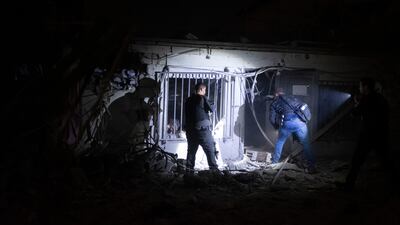
Israeli police inspect the damage from a rocket fired from the Gaza Strip. AP -
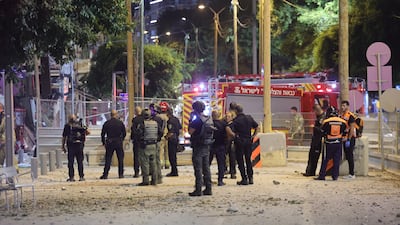
Firefighters, rescue and security workers at the site, where a rocket hit a residential building in Tel Aviv. EPA -

Residents of the Israeli city of Netivot bordering the Gaza Strip wait to be evacuated to central Israel. AFP -
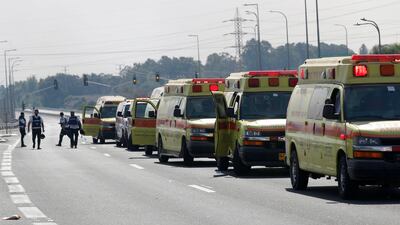
Israeli ambulances wait to evacuate wounded residents from the city of Sderot. EPA -

A car amid the rubble of a destroyed tower after an Israeli air strike in Gaza city. AFP


The Saudi government’s initial statement called on all sides to show restraint but also cited Riyadh’s “repeated warnings of the dangers of the explosion of the situation as a result of the continuation of the occupation, the deprivation of the Palestinian people of their legitimate rights and the repetition of systematic provocations”. That language, in particular, caused considerable consternation among several key Biden administration officials.
One of the goals of the attack, already at least partially successful, is surely to drive a wedge between Riyadh and Washington, because there remains a fundamental difference between them regarding the occupation and the Palestinians, in policy but even more in attitude.
The instinct of Saudi leaders, cognisant of not only their pro-Palestinian domestic audience, but also their country’s role as a regional Arab and global Muslim leader, is to never lose sight of Palestinian rights and grievances. US politicians, on the other hand, tend to compete over who can be more pro-Israel, especially when Israelis are being killed.
Indeed, former president Donald Trump and several other Republican presidential candidates sought to directly blame the Biden administration for the Hamas attack by pointing to Mr Biden’s recent decision to unfreeze $6 billion in South Korean payments for Iranian oil in order to secure the release of Americans being held hostage by Iran. Mr Trump falsely described this money as “American taxpayer dollars” that “helped fund the attacks”.
In reality, the South Korean money was transferred to a third-party account in Qatar and can only be used for humanitarian purposes. Moreover, none of it has yet been spent. Nonetheless, his Republican opponents will seek to pummel Mr Biden for somehow being responsible for the Hamas attack on Israel, if nothing else because they allege he has created an atmosphere of American “weakness”.
The future of Mr Biden’s triangular normalisation initiative depends on Israel’s response to the attack. Given the scale of the assault and the radical failure of Israeli security measures regarding Gaza, a return to the prevailing status quo in Gaza may not be acceptable to most Israelis. But the alternative may mean the direct reoccupation of all or much of Gaza.
Hamas and its Iranian backers are undoubtedly hoping the violence spreads to the West Bank and, especially, occupied East Jerusalem. And Iran may press Hezbollah in Lebanon to enter the fray, plunging Israel into a protracted, multi-front campaign that would tempt Israeli hardliners to create a new security structure by, among other things, annexing large chunks of the occupied Palestinian territories and possibly expelling Palestinians. Hezbollah has already obliged by firing some missiles in the Shebaa farms.

But it’s also conceivable that Israel will have the wisdom to recognise that this attack is an effort to goad them into an overreaction and will, instead, limit their military response in Gaza and do their utmost to prevent violence spreading to the West Bank, Jerusalem or Lebanon. Saudi leaders, too, may recognise that this is an all-out effort to sabotage their own diplomatic overtures towards Israel and thereby obtain a much-coveted formal security guarantee from Washington.
There are many local and domestic reasons for Hamas’s attack but it’s also certainly an effort to scupper a US triangular agreement with Israel and Saudi Arabia. It may well succeed. But the three parties might recognise the attack for what it is, and move as quickly as possible to resume talks and redouble efforts to bridge remaining differences. If it’s this threatening to their mutual enemies, what more evidence is required of the potential benefits of such a deal?
The Biden administration is certainly going to try to make that point, both at home and abroad. Whether they can convince Israel to show restraint and Saudi Arabia to remain open to normalisation despite the coming violence remains to be seen.
The final question for Mr Biden is that, assuming the current conflict makes his grand bargain impossible before the next presidential election, if he gets a second term can the parties pick up more or less where they were a few days ago?
That doesn’t only depend on him winning re-election. It also hinges on what new “security arrangements” Israel decides to impose on Gaza, and possibly the West Bank. It’s almost impossible that the context for a “Significant Palestinian Component” of such a deal won’t be significantly altered at the end of the current fighting. So, all parties, especially Riyadh, are going to have to recalculate when the dust settles.
For Mr Biden, the best-case scenario may be making the triangular deal with Israel and Saudi Arabia a second term agenda item. If Hamas and Iran wanted to upend, and at least postpone, Mr Biden’s proposed US-Saudi-Israeli agreement, they’ve probably already succeeded.

