


The forthcoming expansion of Brics, following the group’s invitation to six countries to join it on Thursday, is an important development. The biggest beneficiary of this move is likely to be China, one of the original founders of the group and the world’s second-largest economy. It has come at a time when another of its founders, Russia, is facing a number of challenges, mostly owing to the war in Ukraine.
While an ally of Moscow, Beijing’s ambitions and strategic programmes are broader and more geared towards unilateral moves – especially due to the Ukraine conflict, which has exposed fault lines among the Brics founding members that also include Brazil, India and South Africa.
At the just-concluded summit in Johannesburg, the Brics nations agreed to invite Argentina, Egypt, Ethiopia, Iran, Saudi Arabia and the UAE.
It appears Brazil and India initially had reservations about the group’s expansion, although their reticence was not directed at the economically developed Saudi Arabia and the UAE, but the economically weaker Argentina, Ethiopia and Iran. The concern was that this imbalance could burden the bloc.
Moreover, India has different objectives from China within and outside the Brics framework. It is worried that expanding the membership could diminish the group’s weight, and New Delhi does not want to be a vessel for Beijing’s growing influence, power and leadership.
Russia, which is due to host the 2024 summit in Kazan, Tatarstan, intends to propose inviting Venezuela and other countries to the group. It is a move that could stir controversy.

Brics is unlikely to become a cohesive force that could rival the G7, which comprises major industrialised entities, namely Canada, the EU, France, Germany, Italy, Japan, the UK and the US. Brics was born out of an aspiration to bring together the world’s emerging economies, but it has not transformed into an organisation with mechanisms or even a headquarters. It is a loose coalition that imposes no political commitments on its members. It is closer to being an economic and political club rather than a coherent organisation with binding obligations on its members.
The accession of Saudi Arabia and the UAE provides advantages to the group. Indeed, the two Gulf countries maintain strong relations with all the Brics founding members and command substantial investments and presence in global markets.
At the same time, neither country is positioning itself against the US or the G7 in the domain of geopolitical competition. Their objective is to contribute to sustainable development and foster diversified partnerships, rather than exacerbating cleavages within the global economy or entangling themselves in confrontational alignments.
Beijing achieved great diplomatic and political success after pushing for the expansion of Brics. Yet it acknowledges that some of the prospective member states might not necessarily align with its interests against those of the US.
It also recognises that Brics represents a long-term endeavour, and that it currently cannot rival the G7 as a significant bloc. Moreover, Brics lacks the capacity to evolve into an alternative currency powerhouse to challenge the dominance of the US dollar, irrespective of China’s efforts to that end.
Nevertheless, the Brics members wield substantial economic and political power. India is a technological powerhouse, Brazil is an agricultural superpower, Russia is a top producer of energy and China is a manufacturing giant.
While Chinese President Xi Jinping shone brightly during his participation at the Johannesburg summit, missing was Russian Vladimir Putin at a time when Moscow’s influence on the international stage appears to be waning.
Russia was in the news during the week after a private jet crashed inside the country on Wednesday evening, killing everyone onboard. The plane was said be carrying members of the Wagner group, including its founders Yevgeny Prigozhin and Dmitry Utkin. News of the plane crash, just two months after Prigozhin attempted a failed mutiny, has been met with an array of reactions both inside and outside Russia.
-

A cameraman films the wreckage of the private jet registered to Wagner Group financier Yevgeny Prigozhin near the crash site in Russia's Tver region. Reuters -

Mr Prigozhin was among the 10 passengers listed on the plane's itinerary, along with his right-hand man, Dmitry Utkin. AP -

Eyewitness footage of the plane's crash site. Reuters -
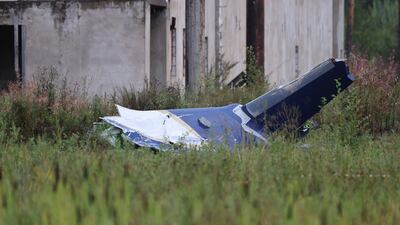
Russian authorities have said eight bodies have been recovered from the crash site so far. Reuters -

Men hang a Wagner Group flag at an informal memorial next to the mercenary group's former office in St. Petersburg. AP -
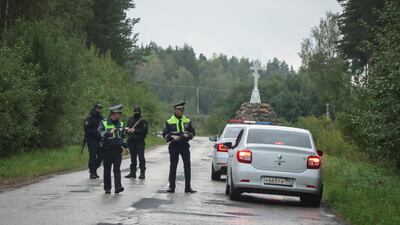
Police officers close off a road near the site of the crash in Tver region. Reuters -

People pay tribute to Mr Prigozhin at the makeshift memorial in St Petersburg. AFP -
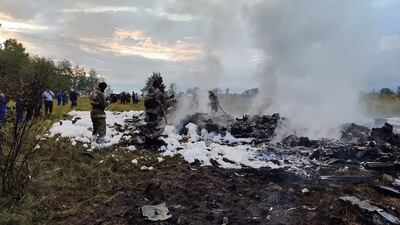
Russian authorities attend the site of the plane crash. AFP


Prigozhin, who was known to be well-connected in Russia, was in charge of a mercenary group that became powerful in Ukraine and in several parts of Africa. His unhappiness over how the war in Ukraine was being prosecuted led to his open conflict with officials in the Russian Ministry of Defence and an eventual march along with his forces towards Moscow. He ceased his operation after holding indirect talks with Moscow and then pulling his group out of Ukraine.
Following his death, which Russian authorities later confirmed, the return of the Wagner forces to the Ukrainian battlefield has become more feasible. Moscow needs these irregular forces, and it has ordered their fighters to pledge their allegiance to the Russian state.
The decree, published on the Kremlin website, obliges anyone carrying out work on behalf of the military or supporting what Moscow calls its “special military operation” in Ukraine to swear a formal oath of allegiance to Russia. In Prigozhin’s absence, the role of the military leadership is even stronger.
The Wagner phenomenon will, of course, not end with the demise of its leaders. Rather, it will evolve. The group is likely to remain active in Africa, Syria, Ukraine and Belarus, as its operational mechanisms there continue to grind.
Time will tell whether the complexities surrounding Russia, both within and beyond its borders, and its leadership’s absence at summits such as the one in Johannesburg continue to diminish Moscow’s influence on the global stage.

