



With tensions between Moscow and the West at an all-time high because of the Ukraine conflict, the death of former Soviet leader Mikhail Gorbachev is a timely, if unfortunate, reminder of an era when global rivals could set aside their differences and work together in the quest for peace.
While Gorbachev will be remembered primarily for presiding over the collapse of the Soviet Union, he also played a significant role in ending the Cold War, a conflict that had begun with the division of Europe following the Second World War and which, on occasion, had brought the planet to the brink of nuclear catastrophe, especially during the 1962 Cuban missile crisis.
After then British prime minister Margaret Thatcher famously identified Gorbachev as someone “she could do business with”, the Soviet leader found himself involved in lengthy negotiations with the US and its allies aimed at reducing their stockpiles of nuclear weapons. Thatcher used her close relationship with then US president Ronald Reagan to persuade him that Washington should set aside its long-standing hostility towards the Kremlin and engage with Gorbachev.
This led to a series of summits between the two leaders who were committed to ending the modern menace of nuclear weapons, beginning with a meeting in Geneva in November 1985, where they discussed the Cold War-era arms race and the possibility of reducing their countries’ stockpiles. This initiated a dialogue that led to the ground-breaking Reykjavik Summit the following year, where both Reagan and Gorbachev agreed that nuclear weapons must be eliminated. They even came close to an agreement to eliminate their stockpiles by 2000.
In the event, the military establishments in both countries shied away from undertaking such a deal. Instead, further negotiations led to the signing, in late 1987, of the Intermediate-Range Nuclear Forces (INF) Treaty, with both sides agreeing to eliminate an entire class of nuclear weapons, while restricting the deployment of both intermediate and short-range land-based missiles worldwide.
The signing of the INF Treaty effectively brought the Cold War to an end, as it laid the foundations for a major de-escalation in tensions between the two superpowers. The agreement was to last for more than three decades until the Trump administration, claiming that the Russians had breached the terms of the deal by developing a new generation of ground-launched, intermediate-range cruise missiles, withdrew from the agreement – a situation that continues to this day.
Looking back at those momentous events, it is hard to imagine today’s generation of leaders having the courage and imagination to take similar measures to de-escalate tensions between East and West. On the contrary, today, the US and Russia are engaged in a new arms race with the threat of mutual nuclear destruction once again becoming a major concern. The Cold War level of nuclear stockpiles may have been significantly reduced as a result of the INF agreement, but both countries still possess significant quantities of these weapons. Russian President Vladimir Putin publicly stated that Moscow would resort to them “to defend its sovereignty".
The re-emergence of nuclear weapons as a threat to world peace is a regressive step. Unfortunately, a process to address this problem seems unlikely as long as relations between Washington and Moscow remain at their current low ebb.
The current level of hostility only serves to underline the extraordinary accomplishment of the Reagan-Gorbachev collaboration. In order to reach a deal with the US, Gorbachev had to overcome enormous resistance from within his own communist party leadership.
-

General Secretary of the Communist Party of the Soviet Union Mikhail Gorbachev (right) shaking hands with Syrian President Hafez Al Assad in Moscow on June 19, 1985. AFP -
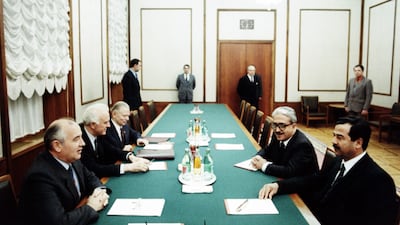
Iraqi President Saddam Hussein (right) and his Vice President Tarek Aziz in Moscow with Mr Gorbachev (left) and his Foreign Minister Edward Shevardnadze during their visit to Soviet Union in 1985. AFP -
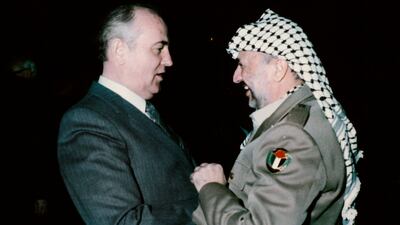
Mr Gorbachev with Yasser Arafat, President of Palestine Liberation Organisation, in East Berlin on April 17, 1986 during the 11th Congress of the Socialist Unity Party of East Germany. AFP -
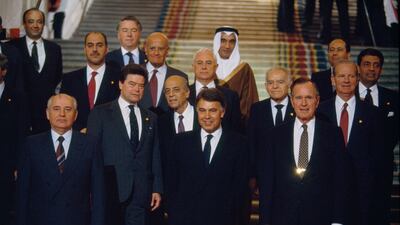
Delegates attend the 1991 Madrid Peace Conference. The 1991 conference for the Middle East was the first time Israel, Syria, Lebanon, Jordan, and the Palestinians all came together for negotiations. Pictured from left are Soviet President Mr Gorbachev, Soviet Foreign Minister Boris Pankin, Spanish Prime Minister Felipe Gonzalez, Israeli Prime Minister Yitzhak Shamir, US President George Bush, US Secretary of State James Baker, Egyptian Foreign Minister Amr Moussa, Palestinian delegate Abdel Haidar Shafi, and Jordanian Foreign Minister Kamel Abu Jaber. Getty Images -
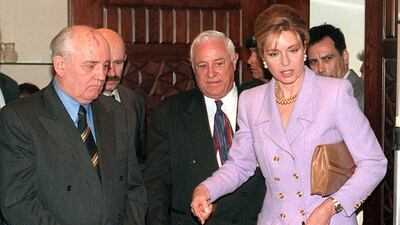
Jordan's Queen Noor greets Mr Gorbachev in Amman in 1998. Mr Gorbachev is in Jordan to give a lecture on the UN Leadership Programme. AFP -

World leaders and Nobel laureates participate in a conference, organised by the Peres Centre for Peace to add impetus to the stalled Israeli-Palestinian peace process, join hands in January 1999 at the end of the two-day meeting in Ramallah. Pictured from left are Archbishop Desmond Tutu, former Costa Rican president Oscar Sanchez, Polish President Alexander Kwasniewski, Palestinian President Yasser Arafat, former Israeli Prime Minister Shimon Peres, ex-Soviet leader Mr Gorbachev and former South African president FW de Klerk. AFP -
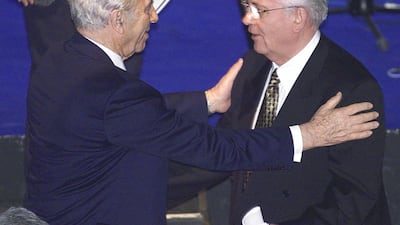
Former Soviet president Mr Gorbachev (right) is greeted by former Israeli prime minister Shimon Peres after the latter's speech to the second annual meeting of the board of the Peres Centre for Peace in Tel Aviv in January 1999. AFP -
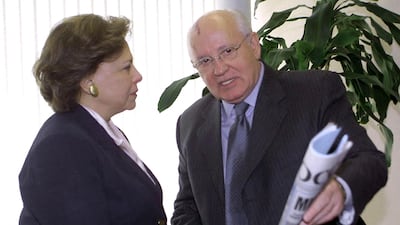
Former Soviet president Mr Gorbachev shakes hands with UN official and former Egyptian minister Mervat Tallawy at the UN head office in Beirut in April 2003. Mr Gorbachev called on the US and Britain to end the "bloodbath" in Iraq and allow the UN to resolve the crisis. AFP -

Former Russian Mr Gorbachev (left) meets Lebanese Prime Minister Rafiq Hariri in Beirut in 2003. AFP -

Mr Gorbachev (centre) speaks with Iraqi boys Ali Ismael Abbas (right) and his friend Ahmed (left) during an awards ceremony where Dr Ahmed Al Shatti, representing Iraqi and Kuwaiti doctors, was honoured with the "Men of the year award" for work during the Iraq war at the World Awards gala in Hamburg on October 22, 2003. Reuters -

Lebanese President Michel Sleiman (left) with Mr Gorbachev at the presidential palace in Baabda, east of Beirut, on February 1, 2010. Gorbachev is on a private visit to Lebanon. AFP -
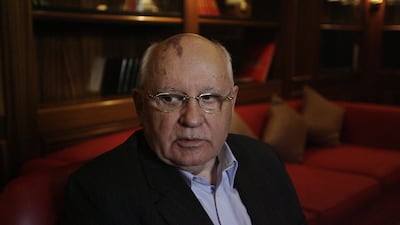
Mr Gorbachev speaks to journalists at the Middle East and North Africa Cristal Festival at a hotel in Faraya, north-east of Beirut, on February 2, 2010. AFP -
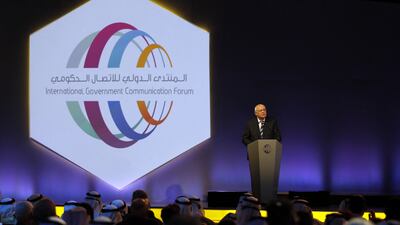
Mr Gorbachev speaks during the International Government Communication Forum (IGCF 2014) in Sharjah on February 23, 2014. The event, gathering international professionals from government, private and media sectors, has the theme "Different Roles...Mutual Interest. AFP


The so-called Nomenklatura, a category of officials who occupied key posts in the state and the economy in the Soviet system, were strongly opposed to Gorbachev’s novel concepts of more political transparency, or "glasnost", as well as his desire to introduce his "perestroika" reform programme to the union’s governmental and economic institutions. The Soviet leader also met with stiff resistance from Moscow’s military establishment, which was perturbed by his disarmament initiatives, seen as weakening the security of the Soviet Union.
To this day, there are many in Russia who still regret the changes undertaken during the Gorbachev era, which would explain the Kremlin’s reluctance to grant a man universally acknowledged as one of the greatest statesmen of the 20th century a state funeral. Speaking shortly after Gorbachev’s death had been announced, Dmitry Peskov, the Kremlin’s spokesman, said that no decision had yet been made.
He also said that it wasn’t clear whether Mr Putin would attend Gorbachev’s funeral. They were never said to be close, with Mr Putin holding Gorbachev responsible for the collapse of the Soviet Union, which took place soon after the signing of the nuclear deal.
Even so, Gorbachev will be held in high regard in the West, where his willingness to engage with his opponents demonstrated his statesmanlike qualities.
The deep bond, for example, he developed with Thatcher, who was no friend of communism, highlighted his ability to place pragmatism over ideology. On one occasion in the Kremlin, the two leaders are said to have argued for nine hours about the merits of their respective political systems, leaving Thatcher no time to change into an evening dress for the Kremlin banquet.
In the current geopolitical climate, it is hard to imagine today’s generation of leaders engaging in such a relaxed dialogue.

