


The world is producing more news than any of us can possibly consume, and unfortunately most of it is bad. A friend – a veteran journalist – is coping by rationing news in his household. He turns off the radio and TV not because it's upsetting for children (although it obviously is), but because he himself finds it too upsetting.
The journalism of conflict and the latest atrocity is inevitable during a time of war. But while much of the world is focused on the deluge of news about the war in Ukraine and the plight of refugees in Eastern Europe, other important news is buried or – by many of us simply ignored.
In Britain, for example, coronavirus is treated as yesterday's news. It isn't. Covid-19-related deaths are at more than 160,000 with almost 12,000 patients currently in hospital. There's been an uptick in hospitalisations and reported cases since the British government ended restrictions.
Brexit news is also buried, unless you are a truck driver or an exporter aware that worse problems are predicted within a few weeks. The trade group Logistics UK says the government needs to "take action now" because new post-Brexit border controls, including checks on agricultural and food products entering the UK, and biometric checks on passengers entering the EU, will cause disruption at ports and airports throughout the summer. The UK Parliament's Public Accounts Select Committee chair, Meg Hillier, agrees. She warns that there is "much more work that government should be doing" because the Brexit bureaucracy will potentially be crippling for businesses and travellers this year.
And then there's Northern Ireland – unfinished business, you might say, for at least the past century. Last weekend, Ireland played against England at rugby at Twickenham Stadium and won convincingly. The Irish team is composed of players from both Northern Ireland and the Irish Republic. But in the margins of the match, and again largely unreported, UK Prime Minister Boris Johnson met his Irish counterpart Micheal Martin to discuss – yet again – the unresolved issues around the Northern Ireland Protocol.
Mr Johnson created the problem. In October 2019, desperate to make progress on Brexit, the Prime Minister agreed to put a customs border in the Irish Sea. It means Northern Ireland is treated almost as if it were still in the EU, at least for customs purposes. Being treated differently from England, Scotland and Wales incenses Ulster unionists, and Northern Ireland's ancient conflict continues to bubble under the surface, even if (for now) it is no longer considered newsworthy. That may change when elections to Northern Ireland's Parliament scheduled for May heat up the political temperature once more.
One further big news story that has been buried, at least for a time, is Mr Johnson's own future, amid allegations of sleaze and law breaking. Napoleon is supposed to have asked if his generals were "lucky". For all his scandals and ethical lapses, Mr Johnson is certainly lucky. The police inquiry into alleged illegal conduct and other ethical lapses has also been buried under the news from Eastern Europe.
-
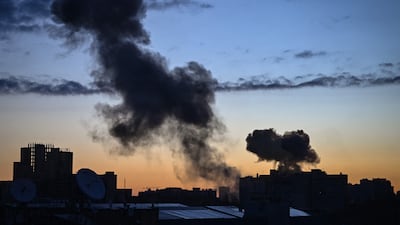
Smoke rising in Kyiv, which mayor Vitali Klitschko says faces a 'difficult and dangerous moment' as Russian forces step up strikes. AFP -

Pope Francis meets visitors holding the Ukrainian flag during his weekly general audience in the Vatican. AFP -

An anti-war protester demonstrates against Russia's invasion of Ukraine in front of the Nato headquarters in Brussels. AFP -
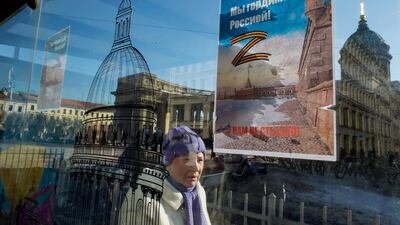
A poster in Saint Petersburg carries the letter Z, a symbol of support for the invasion, and reads: "We are proud of Russia! We are not ashamed!" AFP -

Amid the Ukraine war, there's time for a seaside stroll in Odesa. Reuters -
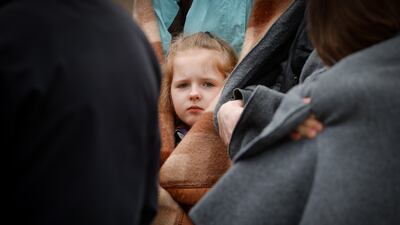
A child who fled from Ukraine to Belgium waits outside an immigration office in Brussels. EPA -
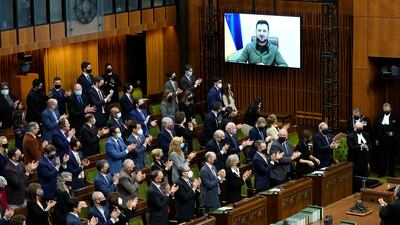
Ukrainian President Volodymyr Zelenskyy receives a standing ovation as he appears via videoconference to make an address to Canada's Parliament. AP -
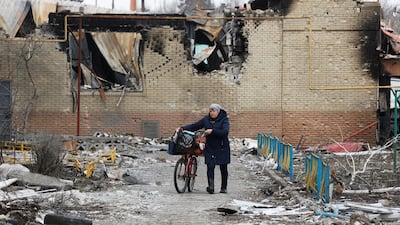
A woman walks with a bicycle next to a building damaged during the conflict in the separatist-controlled town of Volnovakha, Donetsk region. Reuters -
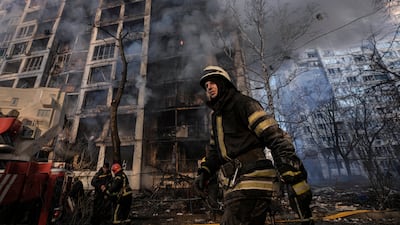
A firefighter outside a destroyed apartment building in a residential area of Kyiv. AP -

Ukrainian soldiers pay tribute to Col Valeriy Gudz, who was killed in battle against Russian troops, at a cemetery in the town of Boryspil. AP -
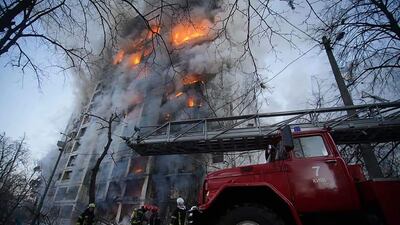
Firefighters work to extinguish a fire in a housing block hit by shelling in the Sviatoshynsky district, in western Kyiv. AFP -
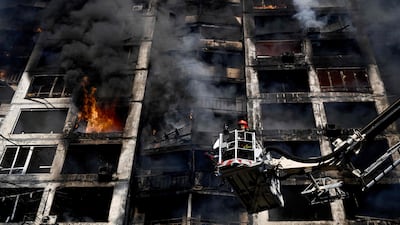
Two people were killed as a series of powerful explosions rocked residential districts in Kyiv just hours before talks between Ukraine and Russia were set to resume. AFP -
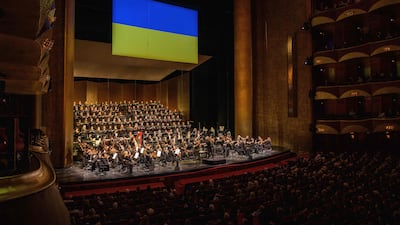
The Met Opera and Chorus performs during 'A Concert For Ukraine' in New York City. AFP -
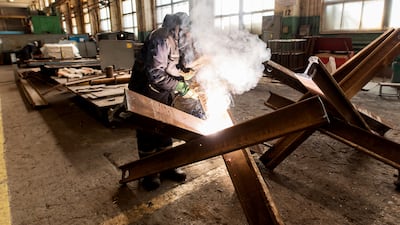
A worker welds metal at the Interpipe Steel plant in Dnipro, Ukraine. Hundreds of Interpipe’s 10,000 employees have joined the fight against Russia. AP -
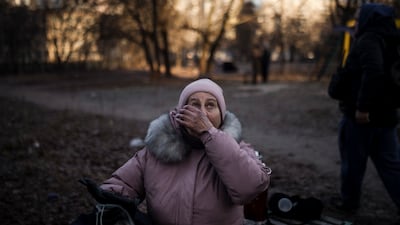
A woman is rescued by firefighters from her apartment in a burning building that was hit by artillery shells in Kyiv. AP -

Rescuers work at a building damaged by an air strike, in central Kharkiv, Ukraine. Reuters -
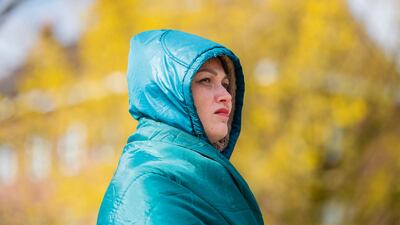
A woman who fled Ukraine to Belgium waits outside an immigration office, in Brussels. EPA -
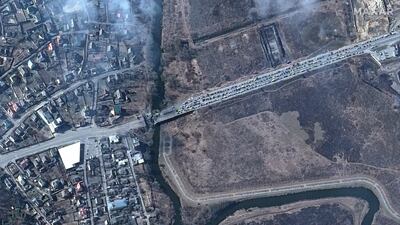
Cars stuck at the Irpin River bridge, as Russia unleashes a barrage of air strikes on cities across Ukraine. AFP -
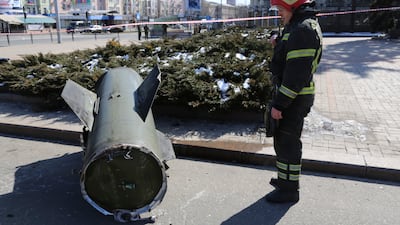
A firefighter looks at a section of a Ukrainian Tochka-U missile on a street in the separatist Donetsk region. The Russian military said 20 civilians were killed by a ballistic missile launched by the Ukrainian forces. AP -
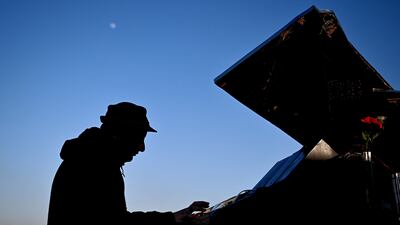
Musician Davide Martello plays a piano near the Ukrainian border in Medyka, Poland. More than 1.76 million people have crossed the Polish-Ukrainian border into Poland, the Polish Border Guard reported on March 14. EPA -
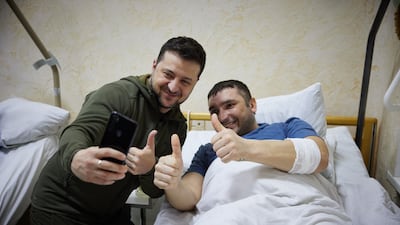
Ukrainian President Volodymyr Zelenskyy, left, snaps a selfie with a wounded man during a visit at a military hospital after fighting in the Kyiv region.AFP -
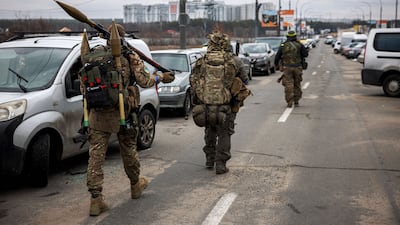
Ukrainian soldiers carry rocket-propelled grenades and sniper rifles as they walk towards the city of Irpin, north-west of Kyiv. AFP -

Troops carry an elderly woman on a stretcher across a makeshift bridge as Ukrainians flee Irpin. AFP -
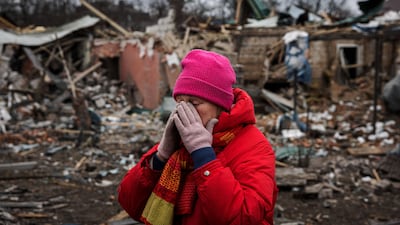
Irina Moprezova, 54, stands in front of a house that was damaged by an air strike in Irpin. AFP -
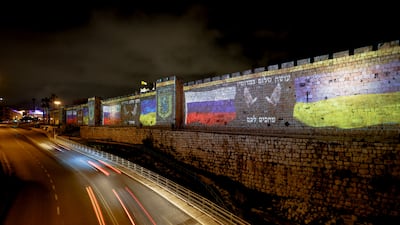
The flags of Russia and Ukraine are projected on the walls of Jerusalem's Old City, which a representative from the Jerusalem Municipality said is a show of support for diplomatic dialogue between the countries. Reuters -
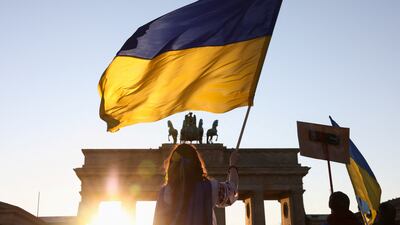
A person holds a Ukrainian flag during an anti-war demonstration at the Brandenburg Gate in Berlin, Germany. Reuters -
A Ukrainian soldier takes cover as people flee Irpin. AFP -

Ukrainians shelter in an underground train station during the day in Kyiv. EPA -
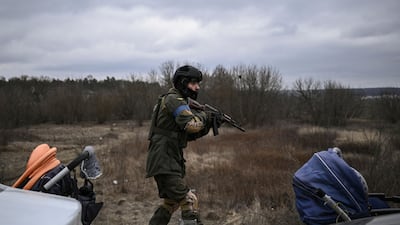
A Ukrainian serviceman walks carefully with his weapon in the city of Irpin, near Kyiv. AFP -
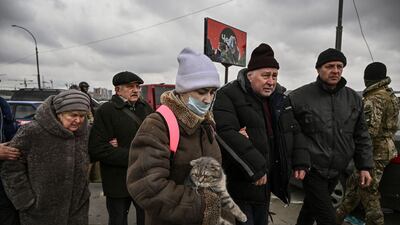
Ukrainian people flee the city of Irpin, north-west of Kyiv. AFP -
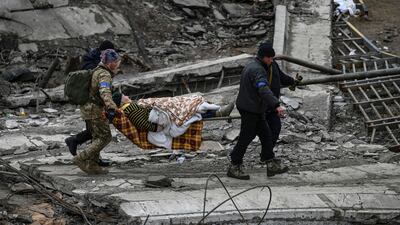
Ukrainian servicemen carry an elderly woman on a stretcher from the city of Irpin. AFP -
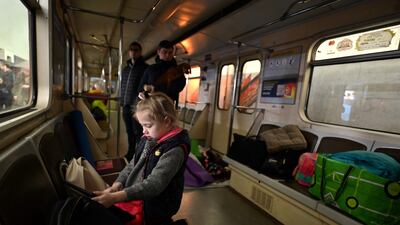
A girl plays games on her tablet inside a subway carriage being used as a bomb shelter in Kyiv. AFP -
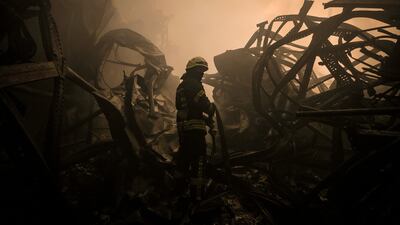
A Ukrainian firefighter drags a hose inside a large food products storage facility which was destroyed by an air strike on the outskirts of Kyiv. AP -

Ukrainian troops with a Javelin anti-tank missile on the front line in the northern Kyiv region. Reuters -
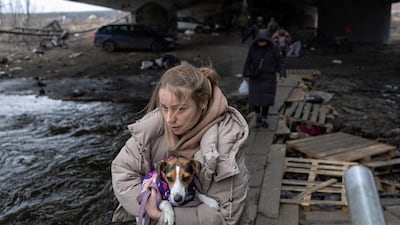
A woman carries her dog during an evacuation in Irpin. Reuters -
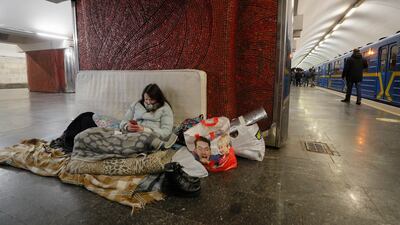
A Ukrainian woman takes shelter in a metro station during the day in Kyiv. EPA -
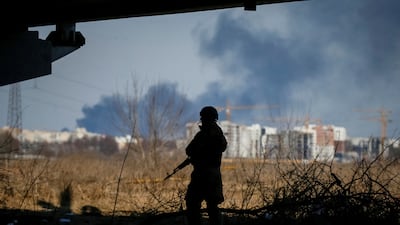
A member of the Ukrainian armed forces on patrol in Irpin. Reuters -

A Ukrainian fighter takes cover behind a car in the city of Irpin. AFP -
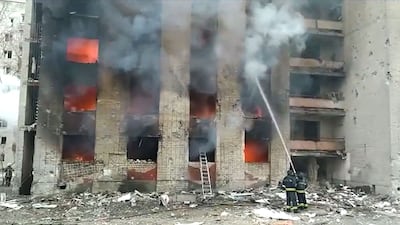
Firefighters at work after air strikes hit residential buildings in Chernihiv, northern Ukraine. AFP -
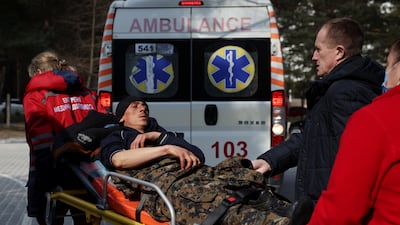
A man wounded in an air strike is helped by medical staff in Novoiavorivsk, western Ukraine. Getty -
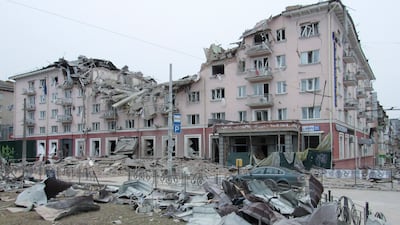
The ruins of the Ukraine Hotel after recent shelling in Chernihiv. EPA


But one big British story with implications elsewhere has burst into the news agenda. Most of us have noticed price increases and warnings that an acute cost of living crisis is about to burst upon us. Petrol and diesel costs are rising every week. Gas and electricity prices are about to go up steeply when a price cap is removed in April. Food costs, even before the Ukraine conflict, were already rising in Britain and elsewhere at the fastest rate in years.
In the US, the Bureau of Labour Statistics noted in January a 7 per cent increase on the previous year. Russian inflation as a result of war-related sanctions has been predicted at 20 per cent but the collapse in the value of the rouble suggests that figure must rise considerably. And since Ukraine has for years been known as the bread basket of Europe, rising wheat prices mean the cost of everything from baked goods to pasta will continue to rise. Russia and Ukraine between them are estimated to supply one quarter of the world's wheat. Bread price rises are already big news in Lebanon, Tunisia, Egypt and other Middle East and North African countries.
UK inflation means a "typical" household is predicted to see a hit to the family budget equivalent to losing £1,000 (about $1,300) this year. The Bank of England's prediction of 7 per cent inflation is regarded as too low, since prices are rising at the fastest rate in 30 years and wages cannot keep up. The squeeze on living standards will, therefore, have profound political consequences around the world. Here, Mr Johnson may for now be lucky that the Ukraine war will distract from his own errors.
But families unable to afford food, heating, petrol and other essentials is news that cannot stay buried for long. Especially with a war, and even in peace, it's going to be a difficult year.

