


It is not everyone’s idea of entertainment but The Squid Game has pulled in at least 142 million households worldwide. That makes this South Korean TV series the most popular Netflix show yet, by a long way. It is brutal, violent but astonishingly intelligent.
Based on a children’s game, it involves a bunch of losers, misfits, bankrupts and gangsters. Out of desperation, they agree to compete for a prize of millions of dollars in a desperate game in which there is only one winner. All losers are eliminated – and here “eliminated” means immediately being shot dead.
The real hook, however, is not violence. It is a profound moral dilemma as old as humanity itself. Is the best strategy in life to compete or to co-operate? If you co-operate, is there a point at which selfishness kicks in and you are forced to betray those who rely on you? Yes, it can sound a lot like modern politics with all its ambitious and often duplicitous players.
The inspiration may be from the 1970s. An economist called Werner Guth at Germany’s University of Cologne created the “Ultimatum Game” by giving a volunteer a sum of money that the volunteer could share at any percentage with another player. If the second player accepted the offer, both got a share of the money. But if the second player said no, neither player received any cash. Mr Guth found that if the offer was just 20 per cent it was often rejected. A degree of generosity to others was required, otherwise everyone lost.
The same kind of mind games involving selfishness and generosity are part of the biggest challenge all of us face now – climate change.
The Cop26 meeting in Glasgow, which hopes to bring together leaders and delegations from all over the world, involves the most ambitious attempt at international co-operation in human history. With luck, as in Paris in 2015, there will be a breakthrough.
If things go wrong, as they did in Copenhagen in 2009, Glasgow will be another milestone towards increasingly severe weather events, loss of biodiversity, increased migration and ultimately the possible “elimination” of our planet.
Over the past month, I have talked with many business leaders, including those of enormous multinational companies, ranging from banks and finance houses to construction companies, the hospitality industry, food and manufacturing. They are all very tough competitors. However, many of them – remarkably – are trying to co-operate with their rivals so there is, at least, a possibility of limiting the damage from global heating through reducing carbon emissions.
But one big theme emerged. Many business leaders – men and women at the top of their professions, generally resistant to government-inspired rules and regulations – desperately want Cop26 to involve government agreements to create new regulations, rules and systems of verification.
That’s because climate-conscious businesses that are aiming for net-zero emissions by 2050, and have set various milestones, are also very concerned that their good intentions will be undercut by competitors who cheat or, in the jargon, are “free riders".
A “free rider” is a business (or entire nation) that benefits when every other business (or nation) makes sacrifices to save the planet while doing very little or nothing themselves.
-

Green light, red light game played in 'Squid Game'. Photo: Netflix -

A scene from 'Squid Game'. -
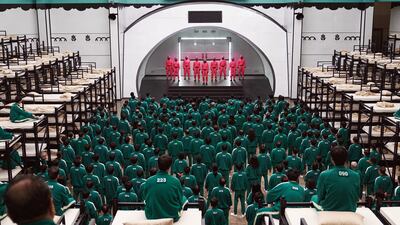
In the Netflix show, participants die when they fail to complete the games. -

Oh Yeong-su plays Oh Il-nam, an elderly man with a brain tumour. -

Jung HoYeon and Heo Sung-tae play characters who risk their lives to compete for the prize money. -

Lee Jung-jae as lead character Seong Gi-hun, a gambling addict. -

Anupam Tripathi as Pakistani worker Ali Abdul. -

The show has been a runaway hit for Netflix since it premiered on September 21. -

In 'Squid Game', players compete in adapted versions of popular children’s playground games in the hope of freeing themselves from financial burden. -

Jung HoYeon plays a North Korean defector in the series. -

Masked enforcers ensure losers from each game are duly eliminated.


If next week, however, governments agree to underpin those industries and nations that are trying to introduce credible and verifiable carbon reduction targets with commitments that, in some way, penalise those who fall behind, then at least naming-and-shaming the free riders would be a start. It would not be the brutal elimination of The Squid Game, but it would at least be a sign that governments and industries recognise co-operation is the only way forward.
Many businesses, and even some entire industries, have already agreed to the co-operation route by paying for external auditors to check their progress against a range of industry-approved targets and agreed metrics. Now governments have to do their bit. They need to agree to help create some kind of level-playing field so that the free riders do not bring the whole process down.
There is much to do.
In the UK, there are many welcome ideas. For example, many governments speak of switching home-heating systems from gas to electricity, introducing heat pumps or hydrogen boilers. But British houses are notoriously badly insulated, and heating a poorly insulated home is like pouring water into a bucket full of holes.
A publicly funded programme – yes, paid for in taxes – to provide better home insulation would combine our personal desire to save on fuel with the co-operative ambition of saving the planet – the selfishness of the individual with the co-operation necessary so everyone wins.
In The Squid Game, the game comes to an end either if one person wins the jackpot, or if a majority of those taking part vote to stop. In the politics and diplomacy of climate change, the prize is much more than a pot of gold. It is a survivable, sustainable planet.
Everyone wins. And not just 142 million homes will benefit. Billions of us need to urge our governments to do the right thing, together.

