


We take our elected representatives for granted. I was thinking about that last Friday, at the funeral of my father, a long-serving councillor in Britain.
Just as we were bidding farewell to him and remembering his life in North-West England, in the South, the MP David Amess was losing his. So yes, some of us abuse our politicians – my father had his share of brickbats – and worse, as in the case of poor Amess and before him, fellow MP Jo Cox, both killed.
One motivation links all three. These weren’t careerists, people of high aspiration, desperate for a powerful position. They did it first and foremost because they cared, because they wished to serve and assist their communities.
The most striking aspect of the tributes to Amess and Cox was their constituents paying tribute to their devotion and selfless endeavour. Their actual party-political beliefs were barely mentioned. It was about how they worked tirelessly to assist their constituents – and not only them, but other causes as well.
Amess was a Tory, Cox was Labour. But they had friends from, and were just as comfortable mixing with, the other side. As was my father. He was an admirer of Margaret Thatcher for her strength and leadership. Ideologically, however, he was closer to the One Nation beliefs of the likes of Kenneth Clarke and Michael Heseltine (the latter he rated hugely because of the time and trouble he took examining the deprivation caused by the decline in manufacturing industry in the North and encouraging redevelopment and investment). My father’s favourite councillor, though, was Nan Tait, from Labour.
-
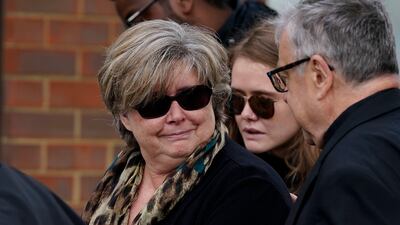
Julia Amess, the widow of Conservative MP SIr David Amess, was comforted by relatives at Belfairs Methodist Church, where he died, on Monday morning. She stayed for about 15 minutes. PA -
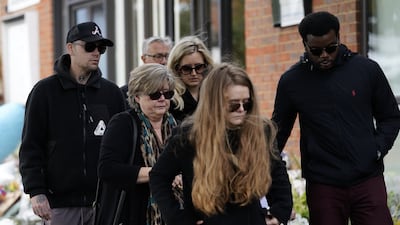
Julia Amess (second left), the widow of Conservative MP Sir David Amess, arrives at Belfairs Methodist Church to read tributes left to her late husband. PA -

The Rev Clifford Newman of Belfairs Methodist Church hugs Sir David Amess's widow. AP -
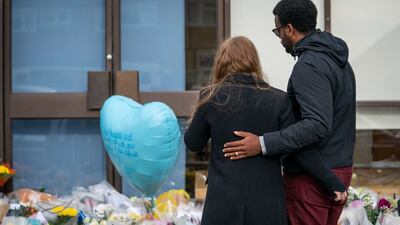
A daughter of SIr David Amess is comforted as she views flowers and tributes left for her late father. AP -
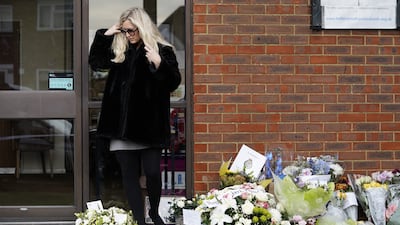
One of Sir David Amess's daughters views flowers and tributes left for her late father at Belfairs Methodist Church. AP -
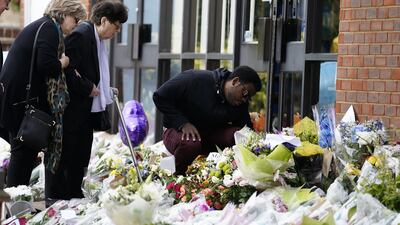
Julia Amess, left, the widow of Sir David Amess, stands with friends and family members to view flowers and tributes left for her late husband. PA -

The mayor of Southend, Councillor Margaret Borton, and mace bearer Adam Tregoning visit Belfairs Methodist Church to pay their respects. Getty Images -

Police officers stand outside Belfairs Methodist Church in Leigh-on-Sea, England. Getty Images -

Tributes outside Belfairs Methodist Church. Getty Images -
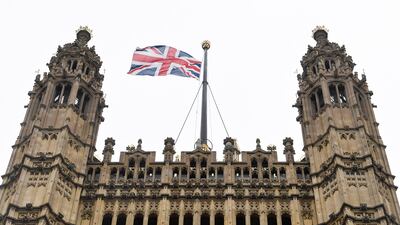
A Union Jack flies at half mast after the killing of British MP David Amess. Reuters -

A book of condolence inside the Southend West Conservative Association's Iveagh Hall. Getty Images -
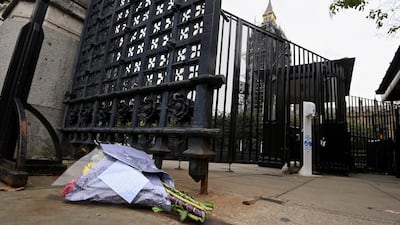
Flowers with a note for Sir David Amess lie outside Parliament buildings in London. Reuters -

A new piece of graffiti artwork depicting the late Sir David Amess appears on a wall in Leigh-on-Sea, England. Getty Images -
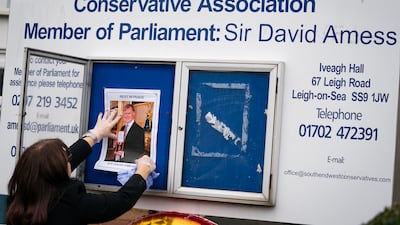
A photograph of Sir David Amess is placed on a noticeboard outside the Iveagh Hall, the home of the Southend West Conservative Association in Leigh-on-Sea. AP -

A Police officer arranges flowers and tributes outside Belfairs Methodist Church in Eastwood Road North. PA -
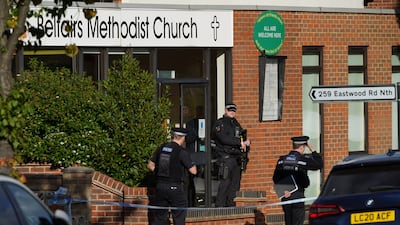
Armed police officers at the scene near the Belfairs Methodist Church, where Conservative MP Sir David Amess died after he was stabbed several times at a constituency surgery. PA -
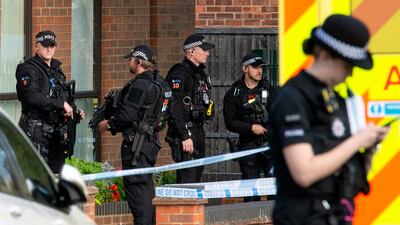
A man was reported to have run into the building and targeted the veteran politician. Police said a suspect had been arrested. AP -
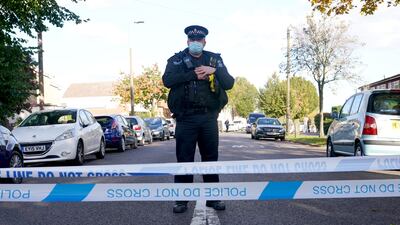
A police officer guards the scene. PA -
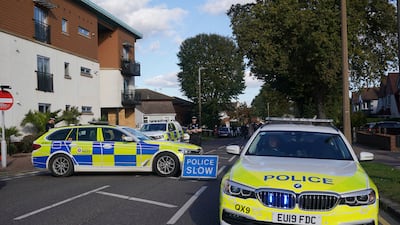
An air ambulance arrived at the scene, before his death was later confirmed by Essex Police. AP -

A police cordon was erected around the crime scene and armed officers were seen standing outside the church. AP


He liked her because, as he put it, while she was Labour, she was sensible and they shared the same objective. Tait was driven by a desire to improve the lives of the folks of Barrow-in-Furness, a town once reliant on shipbuilding, heavy engineering and steelmaking. It continues to build submarines but the numbers employed are much reduced; meanwhile, large slices of the area suffer from poor housing stock, health inequality and lack of opportunities – the legacy of long decay and neglect. In that, Tait and my dad were joined.
They did not do it for the money; they received none. The hours they gave were many. We’d come home and the porch would be full of large brown paper envelopes from the council – this was the pre-internet age, before email – containing more council papers, all requiring reviewing.
Similarly, the phone would ring frequently, with a fellow councillor, borough official or a member of his council ward seeking a word, wanting advice. Weekday evenings would be spent without our father, who was “off to the town hall” or attending a meeting somewhere. When we went out, always he would be stopped in the street by someone, again wanting his ear. It was non-stop.
He never appeared to mind. Likewise, reading and hearing about Amess, it is obvious that he felt the same. Cox, too. It went with the job. It was expected.
The problem is that we expect it of them as well. They receive no thanks. Yes, Amess was awarded a knighthood but that was in 2015, by which time he’d been an MP for 32 years. When my father died, we inquired as to whether the council would fly the town hall flag at half-mast in his honour. We were told “no” – that was reserved for mayors. (My father would have been a mayor, but for the fact that our mother for once put her foot down and said she could not abide the attention that would come from being the mayor’s wife.)
Without them there would be no one speaking up for ordinary people – not only for those who elected them, note, but anyone. There would be no link between the lives of individuals and the machinery of government.
Yet, while they fulfil this vital role, we denigrate them for it and, as with Amess and Cox, slay them for it. Our politics has become devalued, to the point where politicians earn no respect, let alone praise.

They’re seen as in it for themselves. This is nonsense. Of course, there are some bad apples as there always are in any walk of life. Councils have rotten councillors; the Commons has MPs who should not be MPs. But the corrupt and fraudulent are few; the majority exist to try and make a difference, to fuel the common good.
With our media and social media, you could be forgiven for supposing that is not the case. It is true that the MPs’ expenses scandal was not confined to a handful. But nevertheless, relative to the total, it was small.
Our politicians’ standing is weakened as well by the confrontational nature of our politics. In Britain, we tune in to Prime Minister’s Questions wanting to see shouting and tit-for-tat point scoring. If the insults don’t fly, we’re disappointed.
In the Commons chamber, the parties sit opposite each other. In town halls, too. One of the more telling and interesting contributions in the light of Amess’s death was from Chris Bryant. The Labour MP suggested that in his memory MPs should have a day when, for once, opponents sit side by side. It would be a fitting tribute to one who had friends across the spectrum.
One person noticeably absent from a packed Commons remembering Amess was Angela Rayner, the Labour deputy leader. At Labour’s recent conference she referred to Tories as “scum”.
While Mrs Rayner’s remark did not cause Amess’s stabbing, it went towards feeding an atmosphere in which hate is regarded as acceptable and normal. Against that toxic backdrop someone taking a knife to a Tory MP may come as little surprise.
We tend to imagine that their only wish is to ascend the greasy pole, that every move is calculated to enable that rise. Politicians are ambitious, of course they are, the same as plenty of others, But that is often not their primary purpose. Amess, for instance, did not seek ministerial office; he was perfectly content being a backbencher, a constituency MP. Yet so much of our coverage focuses on the gladiatorial head-to-head, the plotting and the betrayals. We even use language like “knifed” and “stabbed” metaphorically without giving any real thought as to how that comes across, how our politics is perceived and whether that makes its practitioners there to be targeted and hunted.
In short, not enough attention is afforded to the value they bring. Without those who are prepared to work on our behalf we would not have a functioning government and the state would remain distant, its leaders impervious and disconnected.
Clearly, something must be done about the abuse they receive. Anonymity on social media, for example, must be restricted. Those whose only aim is to spread poison must be curtailed.
We must look at how we regard one another. But crucially, we must examine how we treat those we elect in our name. If we treat them with disdain, we should not be so shocked if others go further still.

