



When Dubai won the right to stage Expo 2020 almost eight years ago at the general assembly of the Bureau International des Expositions in Paris, it marked the culmination of two years of hard work to win the bid and set in motion another years-long race to get the emirate ready to stage the world fair.
Thursday night’s opening ceremony starts the clock anew on a six-month celebration of possibility, community and innovation. With the gates about to open, we know much about what to expect, but the prospect of the public being welcomed onto the site on Friday is especially enticing.
Only this week, we heard even more about what’s on offer: the Japanese pavilion, for instance, will feature mist-shrouded rooms and a virtual guide through the country’s art and culture. We also discovered that Monaco’s pavilion will consider the principality’s commitment to tackling climate change. We know already that the themes of mobility, sustainability and opportunity will be front and centre. More broadly, each one of the 200 pavilions promises to offer up knowledge and intrigue to the many visitors who will go to the site before the end of March 2022.
The iterative and collective process of disclosure and discovery is about to start in earnest.
The question that is more difficult to answer now is what will endure when the gates close next year?
Of course, we also know with some certainty that the site will become District 2020, a new neighbourhood for residents, businesses and tourists when the expo ends and that much of the infrastructure and architecture that has been delivered over the past eight years will stay in place.
But the more imponderable part of that line of enquiry is what the show be remembered for?
Will we still be talking a few decades from now about Virgin Hyperloop’s transport pods as the moment we properly connected with the future of transport when they are unveiled in Dubai or will the panda robot that visitors will come across at the China pavilion prove an enduring show-stopper in decades to come?
-
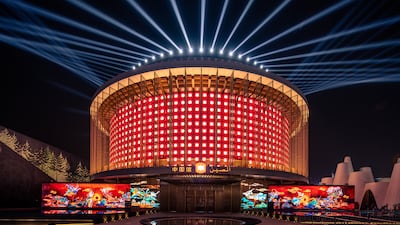
The Chinese pavilion at Expo 2020 Dubai is called Light of China and is modelled on traditional lanterns using modern architecture. All photos: China pavilion Expo 2020 Dubai -
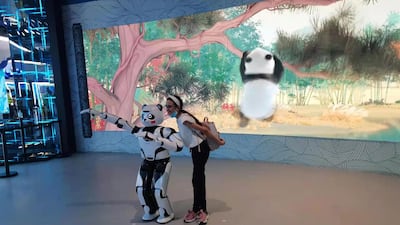
A panda robot inspired by the famous giant Chinese pandas shows some moves to visitors at the China pavilion at Expo 2020 Dubai. -
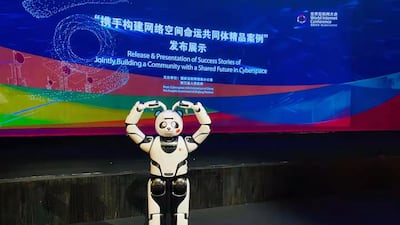
Youyou, a panda robot, developed by Chinese company UBTech, says he wants to spread love around the world. -

Models, photographs and video of China’s achievements in space exploration will be one of the centrepieces of the exhibition. -
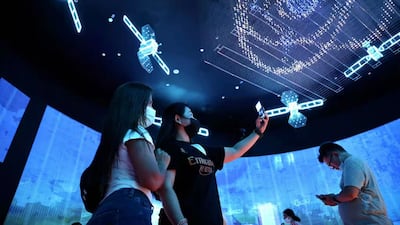
Space exploration and satellite technology are among the main themes of the exhibitions at the China pavilion at the World Fair in Dubai. -

Artificial intelligence and cutting edge science will be showcased on different levels of the China pavilion, one of the biggest at the World Fair. -
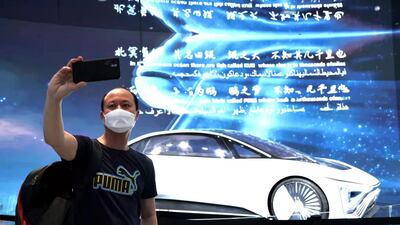
Driverless cars and the technology that power the vehicles will be on display at the China pavilion. -
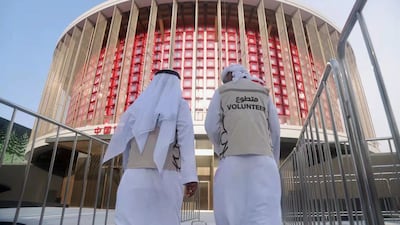
Most of the construction material for the China pavilion at Expo 2020 Dubai was sourced from the UAE with the decorative elements and red panels customised in China. -

A massive lantern with flashing lights and a friendly panda robot will be crowd pullers for the China pavilion at Expo 2020 Dubai.


The less tangible aspects of the show will also play a significant role in the collective memory.
In the months leading up to Dubai’s successful bid in 2013, Bill Gates spoke about this point and the impression that the 1962 world fair in Seattle had made upon him as a seven-year-old child. He said that seeing a collection of cutting-edge technology at the show proved “really quite inspirational”.
The fact that Mr Gates referenced a broader feeling of creativity rather than a particular exhibit is especially telling.
While we tend to focus on expos showcasing particular inventions as a way to make sense of what a world fair is, the chances are they are more likely to leave us with a more general sense of inspiration, excitement and revelation.
That is what will endure from Dubai and as one UN official put it to The National this week, the event will also provide the space for the world to feel that “it’s possible” to return to normality after the pandemic.

The shorthand for describing the Seattle expo of Mr Gates’s youth 60 years later is to reference the monorail trains and the Space Needle observation tower, which opened on the fair’s first day, and, perhaps, for providing the backdrop for a middling Elvis Presley film titled It Happened at the World’s Fair.
The monorail and the architecture are still there but the meaningful connections that the exhibition created also became lasting. The event delivered “something to build on” as Murray Morgan’s collectible volume on the event, Century 21: The Story of the Seattle World’s Fair, recounts.
“As the hot dogs stands were removed,” Morgan wrote, “the permanent buildings of the civic centre, the dream behind the dream of the fair, took their planned relationship. Something permanent, something beautiful had been created.”
Those words are reproduced at the start of Jim Lynch’s engaging 2012 novel, Truth Like the Sun, which uses the 1962 expo as its backdrop. Lynch’s work is part of a canon of cultural content that tends to follow world fairs, such as EL Doctorow’s 1985 nostalgia soaked fictional account of the 1939 New York expo, World’s Fair, or Presley’s Seattle movie caper.

Aside from the delicious prospect of someone penning a great novel of Expo 2020 years from now, I suspect the greatest legacy of the event will be watching Dubai, often seen as a city of the future, undertake a prolonged dialogue with tomorrow’s world on the global stage. During its six-month run, the Museum of the Future and Ain Dubai will also open to visitors in Dubai, with the latter opening on October 21, amplifying this feeling further.
That late October date is also seared into the minds of movie buffs for a different reason. October 21 is Back to the Future day or the moment in 2015 that Michael J Fox and Christopher Lloyd travel forwards to from the successful 1980s film franchise.
Thirty-six years after the first film in the series came out, the movie offers its own lessons in what stands the test of time, delivering as it did a particular portrayal of an America that is now long gone and an enduring fascination with a silver time machine fashioned from a sports car with a troubled history, in the shape of a gull-wing DeLorean.
And perhaps that's the point. Sometimes the most unexpected things end up stealing the show – and they may do so at Expo 2020 Dubai.

