

After the events of recent years, the prognosis of experts in global geopolitics appears to be uniform and unrelenting in its gloominess. Few deposit real hope that the restoration of the experienced team around US president-elect Joe Biden can restore global affairs to a kind of equilibrium.
But there is a kind of mentality trap at work. The accumulation of tensions along the world's geopolitical fault lines is basically seen as so great as to be insurmountable.
Fatalism isn't going to achieve anything. In fact, it’s actively harmful. Conceivably, this trap is already working to lock in the expected first moves of the Biden team. Many of Mr Biden's proposed appointees are retreaded tyres for the US foreign policy engine. The same can be said of their policy options. Everything is reinforcing a sense among Washington's political elite that the status quo prior to president Donald Trump's administration is really an ideal to aim for over the next four years.

A case in point was when, last week, the International Crisis Group unveiled its annual report on 10 conflicts to watch out for in the coming year.
It's not that the list wasn’t well-researched. The 10 pinch points were topped by Afghanistan, but also ranged from Libya to Iran-US and Russia-Turkey to climate change.
At the online launch, a former senior UN official queried the overwhelming pessimism on offer. Yet, the assembled experts could do little more than broadly concur that the outlook was bleak.
It certainly was dark. The US was “polarised, distrustful of its institutions, heavily armed, riven by deep social and racial rifts”, according to the report.
Weakened by the ravages of the Covid-19 pandemic, many states are likely to continue to collapse under the weight of their internal weaknesses, many participants concurred.
“In Sudan, Lebanon, and Venezuela, to mention but a few examples," the report notes, "one can expect the number of unemployed to grow, real incomes to collapse, governments to face mounting difficulties paying security forces and the general population to increasingly rely on state support at a time when states are least equipped to provide it. “
Climate change is hardly a new issue, but 2021 was the first year it gained a risk level all of its own. “This is the first year that a transnational risk has made it onto our top conflicts list, as climate-related violence stretches from the Sahel to Nigeria and Central America,” the report said.
The perils have only mounted. “Many around the globe experienced the past year as an 'annus horribilis', eagerly awaiting its conclusion. But as the list of conflicts to watch that follows suggests, its long shadow will endure.”
As an expert institution, Crisis Group is not alone.
Last week, the Washington Institute also outlined eight highly credible threats that Iran could issue to test the US over the transition period. It also outlined separate tests that could be posted in Syria and by Hezbollah. It offered a roadmap of potential responses for the new White House, with the stern comment the new administration must be ready to be tested on its first day.
-

Vehicles of the "Tripoli Brigade", a militia loyal to the UN-recognised Government of National Accord (GNA), parade through the Martyrs' Square at the centre of the GNA-held Libyan capital Tripoli on July 10, 2020. AFP -

Vehicles of the "Tripoli Brigade", a militia loyal to the UN-recognised Government of National Accord (GNA), parade through the Martyrs' Square at the centre of the GNA-held Libyan capital Tripoli on July 10, 2020. AFP -
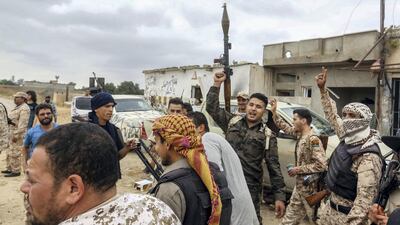
Fighters loyal to the Libyan internationally-recognised Government of National Accord (GNA) are pictured near the frontline during clashes against forces loyal to Khalifa Haftar, on June 1, 2019, in al-Sawani area, south of the Libyan capital Tripoli. AFP -
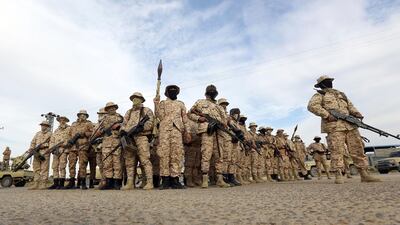
Members of the Tripoli Protection Force, an alliance of militias from the capital city, patrol an area south of the Libyan capital on January 18, 2019, during clashes with the Seventh Brigade group from the town of Tarhuna. Two days of clashes between rival militias near Libya's capital Tripoli have left 10 people dead and 41 wounded, the health ministry said on January 17. Fighting between armed groups erupted Wednesday despite a truce deal four months ago that had halted deadly battles in the city. AFP -
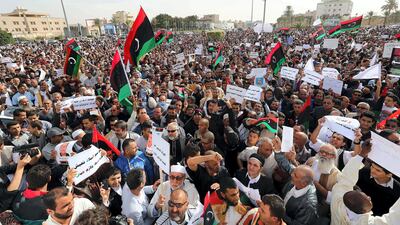
Libyans demonstrate in a street in the capital Tripoli to demand the withdrawal of all armed militias from the capital on November 22, 2013. Residents of Libya's capital were turning out Friday to press militias remaining in the city to follow others and withdraw, aiming to keep up the momentum following deadly clashes last weekend. Many of the groups have long rejected government calls to lay down their arms or integrate into the armed forces, triggering the frustration of Libyans who once hailed them as heroes for toppling Kadhafi. AFP


Chatham House is suffused with gloom, too. It has advised Mr Biden that his first priority is to fix America at home first. “Today, the US is wracked by internal division and the distribution of economic opportunities and benefits across society is radically unequal. Confidence in the leadership, the electoral system, and the capacity of the state to deliver has taken a serious hit,” said Chatham House's US expert, Leslie Vinjamuri, in a commentary ahead of Wednesday’s inauguration.
“Three steps are essential, though not sufficient alone, for improving the quality of democracy in America. First, it is imperative the role of facts and of science in formulating public policy society is rescued. Second, it is essential to create a commission to record – and ensure accountability for – the worst violations of the Donald Trump era; this should extend far beyond the more narrow focus of impeachment.
“Third, the Biden administration must conceive of an approach and set of policies for securing social and economic justice that unites and integrates rather than divides and fractures white working class Americans with America’s racial minorities.”
A cultural rejuvenation, a painful purge and historic reconciliation across all society. Mr Biden has a steep set of challenges to master all at once.
Robin Niblett, the director of Chatham House, recently described the global landscape in nihilistic terms as well. “The transformative learning moment of the end of the Second World War has receded into history, and the hope that accompanied the end of the Cold War has been diluted by the re-emergence of atavistic fears as the centre of global economic gravity has shifted from the West to the East,” he observed.
Mr Biden is Democrat, but he has something of Ronald Reagan’s "Morning in America" confidence and a clear faith in his homeland. He is fond of reciting Seamus Heaney’s line that hope and history can rhyme in the right circumstances.
The think tank experts would be better suited to citing WB Yeats, who wrote of the “rough beast” slouching forwards as anarchy is loosed upon the world.
Whatever the rhetorical flourishes and strangeness of inauguration scenes, it is surely not unreasonable to believe that good things are also happening.
These experts would do well to devote time, too, to fostering hope that improvements are on the way.
Damien McElroy is the London bureau chief at The National

