


When Dr Anwar Gargash, senior diplomatic adviser to the UAE president, recently called for “clear, codified and unambivalent [security] commitments" from the US, he spoke for many in the Gulf. At the Abu Dhabi Strategic Debate in November, he reaffirmed that “our primary strategic security relationship remains unequivocally with the United States", but added we need to “find a way to ensure that we can rely on this relationship”.
For Washington's key strategic partners in the Middle East – the UAE, Saudi Arabia and Israel – American reliability has become the key question. The strength and power of the US military force posture in the region, especially in and around the Gulf, is beyond doubt and hasn't changed much over the past 20 years. However, for at least the past decade, a series of US decisions have raised doubts about American reliability and Washington’s long-term commitment to the region, particularly given rhetoric about a "pivot to Asia" and "great power competition” with China.
The failure in 2012 of the Obama administration to enforce its red line against the use of chemical weapons by the Syrian regime, the Trump administration declining to respond to the Iranian attacks against Saudi Aramco facilities in 2019 and, most recently, a belated and insufficient response by the Biden administration to deadly Houthi rocket attacks in Abu Dhabi in January were all discernible inflection points promoting these misgivings. And there were many others.
But in the wake of the Ukraine war, and what amounts to a new campaign of containment and deterrence against Iran given the failure of the nuclear negotiations, the Biden administration has sent much more positive signals. In early November, Saudi Arabia alerted the US to a potential Iranian plan to strike the kingdom to distract from continued unrest in Iran. US fighter jets were scrambled in an aggressive show of force that appears to have succeeded in deterring the attack.
But beyond such prompt and robust responses, questions about the long-term US security commitment in the Gulf region are most persuasively answered by a game-changing military surveillance system that is being developed for and rolled out in the Gulf, and relies on regional partnerships.
Fifteen months ago, a dramatic breakthrough in unmanned surveillance systems made this possible. In addition to well-established aerial and underwater unmanned systems, ground-breaking surface-level technology has enabled the establishment of an unprecedented complete, three-dimensional and real-time maritime surveillance regime.
The US military has created “Task Force 59” to lead the project. As detailed by Vice Admiral Brad Cooper, commander of the US Naval Forces Central Command, at the recent UAE Security Forum, it will involve combined unmanned surveillance systems in the air as well as underwater and on the water’s surface to survey and track any vessel or object in the Gulf. Using artificial intelligence, the data produced by high-tech cameras and other sensors will be continuously processed. If anything unusual is detected, further investigation by other drones would be triggered, and humans would be quickly brought in to judge what is being detected.
-
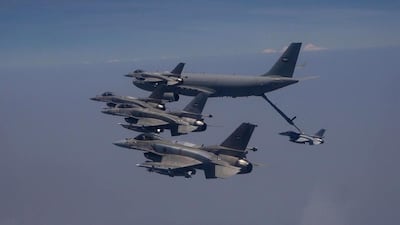
-

The air strikes targeted mountain tunnels meant for storing arms and ammunition. Wam -

The air strikes targeted weapons and radar depots. Wam -
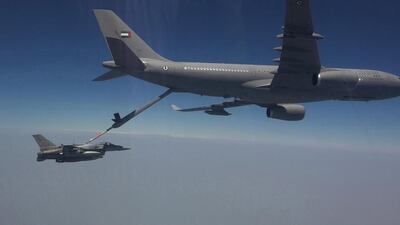
During the mission, the fighter jets conducted air refuelling from the Airbus planes of the Air Force and Air Defence. Wam -
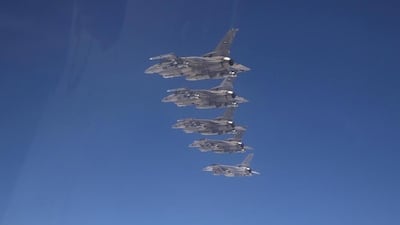
The strikes were carried out in response to a request from President Abd Rabo Mansour Hadi for military intervention. Wam -
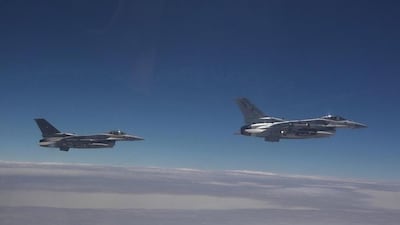
The air strikes targeted weapons and radar depots as well as missile launchers. Wam -
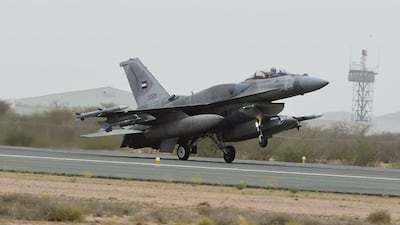
All fighter jets returned to their bases safely. Wam


The system being developed in the Gulf is hardly just American. It is also regional and international. Gulf countries will be deeply involved, as will the UK and France. The plan is that by the end of summer 2023, at least 100 unmanned systems will be operating on the surface waters of the Gulf at any given moment – 20 per cent US and 80 per cent regional or international. These systems will all be linked in real time by satellite and the American systems will be controlled by operators in California.
The US interest in the region isn't altruistic. Strategic calculations are always based on national interests. But the US focus on the Gulf region, plus the Arabian and Red Sea areas, certainly should help to address many of the doubts raised by so many about the sustainability and reliability of the long-term US security commitment.
Three of the world's most crucial strategic chokepoints lie in these waters: the Strait of Hormuz, the Suez Canal and Bab El Mandeb at the mouth of the Red Sea. Maritime security connected to those chokepoints involves a staggering percentage of the world's commercial shipping and, of course, seaborne energy exports.
Indeed, as the US begins to focus on "great power competition" with China, one of its biggest points of leverage is the fact that – along with its regional and international partners – the US has the ability to maintain security in the waterways that provide over 30 per cent of China's annual energy consumption.
The US military has been clear that this technology will be developed and deployed first in the Arabian Gulf and the Red Sea, but is likely to be utilised in a similar fashion in key maritime security areas around the world where possible and as needed.
The political and strategic implications of this project are huge.
First, it demonstrates that the US is in the region to stay. It is preparing for a long-term, abiding and potent regional presence, and is certainly not in the early stages of a "long goodbye", as so many argue.

Second, it demonstrates how central its regional partners have become to US strategic thinking. It is no longer a matter of the US maintaining a military presence in the Gulf to protect supposedly dependent and vulnerable allies. The relationship is being mutually reconceptualised, and this ground-breaking project foregrounds and depends upon regional partners in a co-operative venture that is far more mutual and equitable.
What Task Force 59, based in Bahrain, heralds is a new era in which Gulf countries come into their own as medium-level powers and full partners with western allies such as the US, the UK and France. It's no good yearning for the fully developed equivalent of a Nato Article 5 trigger that guarantees that any attack on a Gulf Arab country will be treated as equivalent to an attack on the US. While that’s not going to happen, a new strategic framework agreement that adds greater clarity to the commitment is being seriously discussed and would be extremely useful.
Seeking greater clarity about what would trigger a US military response is wise. But it's also necessary to recognise what on-the-ground developments, such as Task Force 59, signify: Washington is in the region to stay and is quietly building a coalition, with ground-breaking technology and unprecedented co-ordination, that’s dedicated to Gulf security and stability.

