Insight and opinion from The National’s editorial leadership
December 01, 2021
Yesterday, the UAE observed a minute's silence to commemorate Emiratis who have given their lives serving their country. The primary memorial ceremony was held at Wahat Al Karama, where many of the country's leaders and senior officials gathered to remember and reflect, and to call on younger generations to maintain the hard-won achievements that the country has secured over the past 50 years.
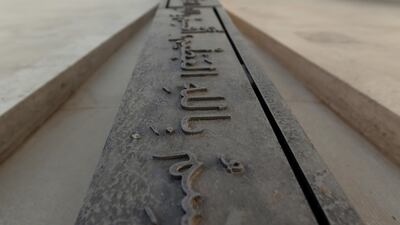
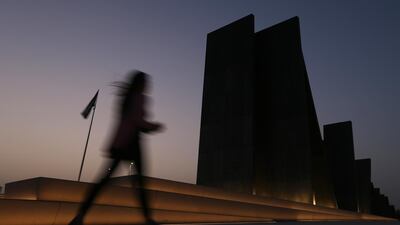
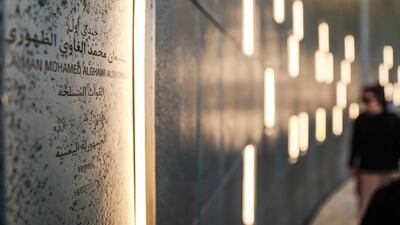
Opened in 2016, a year after Commemoration Day was established, Wahat Al Karama, or Oasis of Dignity, tells the stories of the UAE's heroes. Its Pavilion of Honour puts those who have given their lives for the country to the fore. Names are engraved on metal recycled from military vehicles. The space is framed by other symbolic structures and words that underpin the country's identity, including verses from the Quran and lines of poetry written by Sheikh Zayed, the Founding Father.
Sheikh Mohammed bin Rashid, Vice President and Ruler of Dubai, paid tribute to the "heroes that sacrificed their lives for their country”. His remarks came in a social media post yesterday, reflecting the pride and sadness that people feel across the country as they mark this moment. Earlier in the week, Sheikh Mohammed also stressed the need to think particularly of bereaved households. “I call upon all citizens who know a martyr’s family to visit them and support them on this day,” he said, “for it is a sorrowful day for them, as their feelings of loss are remembered."
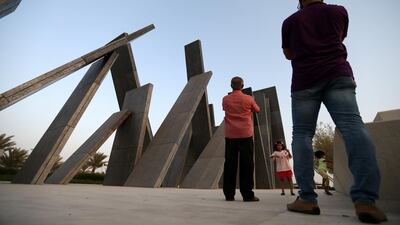
In Idris Khan's Wahat Al Karama work, heavy grey slabs lean against each other, as if arrested in the process of falling. Victor Besa / The National
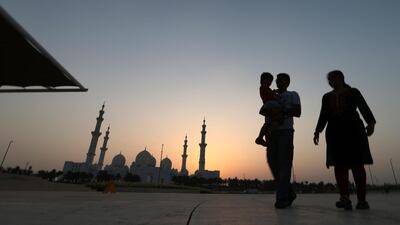
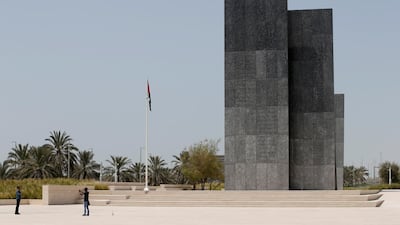
Visitors walk at the courtyard of the memorial of Wahat Al Karama opposite to Sheikh Zayed Mosque in Abu Dhabi. EPA
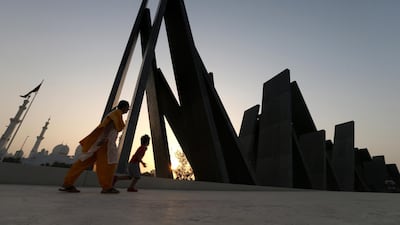
The work is a memorial to the UAE’s martyred soldiers, titled Wahat Al Karama, or "Oasis of Dignity", by British artist Idris Khan. EPA
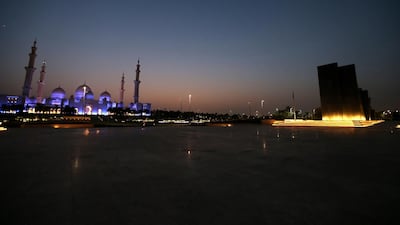
A general view for the external part from the memorial of Wahat Al Karama opposite the Sheikh Zayed Grand Mosque. EPA
Visitors walk through the courtyard of the memorial. EPA
Wahat Al Karama opened to popular acclaim in the UAE in 2016, and has been winning critical awards since. EPA
The Pavilion’s internal walls are clad with more than 2,800 aluminium plates, some of which bear the names of the UAE’s fallen soldiers. Victor Besa / The National
In 2018, the German Design Council announced that the memorial received one of their Iconic Awards for architecture, followed by the Codaworx design and art award. EPA
A commercial aircraft flies over Wahat Al Karama. EPA
“The work has started to get a lot of momentum on the global stage,” says Idris Khan. EPA
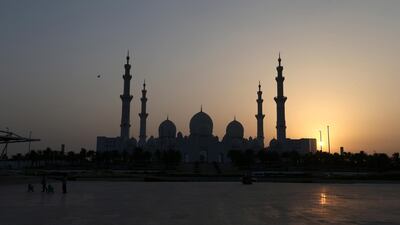
Sheikh Zayed Mosque as seen from the courtyard of the memorial of Wahat Al Karama. EPA
Wahat Al Karama and Skeih Zayed Grand Mosque are open to the public. EPA
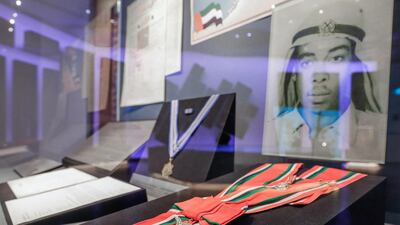
A view of the exhibition at the Wahat Al Karama memorial site. Victor Besa / The National
This year, many people will also be feeling the pain of loss for other reasons. Over the past few months, the country's leaders have also been paying tribute to those who have given their lives fighting in the ongoing battle against Covid-19. The result of their sacrifice, like that of those in the forces, is no less than our safety today.
This legacy of selfless giving started before the country was formed. Commemoration Day falls on November 30 because it was on that day in 1971 that Salem Suhail bin Khamis died fighting against Iranian forces on the island of Greater Tunb. He is believed to be the first Emirati killed in military service.
Over recent years, the country is choosing to remember heroes like bin Khamis in a variety of ways. There is now a Martyrs' Archives project and museums to highlight the sacrifice of fallen soldiers and officers. On a practical level, there is now a Martyrs’ Family Affairs office, which works to ensure that bereaved families are given the care they need.
Taken together, the events, locations, speeches and silences of yesterday showed the many ways people choose honour and pay tribute to those we have lost due to their service. It was a sad day, but one for some reflection too. Many more of these anniversaries will pass, and with each, the country's ongoing progress will be the best reminder that their lives were not lost in vain.

Smart words at Make Smart Cool
Make Smart Cool is not your usual festival. Dubbed “edutainment” by organisers Najahi Events, Make Smart Cool aims to inspire its youthful target audience through a mix of interactive presentation by social media influencers and a concert finale featuring Example with DJ Wire. Here are some of the speakers sharing their inspiration and experiences on the night. Prince Ea
With his social media videos accumulating more half a billion views, the American motivational speaker is hot on the college circuit in the US, with talks that focus on the many ways to generate passion and motivation when it comes to learning. Khalid Al Ameri
The Emirati columnist and presenter is much loved by local youth, with writings and presentations about education, entrepreneurship and family balance. His lectures on career and personal development are sought after by the education and business sector. Ben Ouattara
Born to an Ivorian father and German mother, the Dubai-based fitness instructor and motivational speaker is all about conquering fears and insecurities. His talk focuses on the need to gain emotional and physical fitness when facing life’s challenges. As well managing his film production company, Ouattara is one of the official ambassadors of Dubai Expo2020.
ETFs explained
Exhchange traded funds are bought and sold like shares, but operate as index-tracking funds, passively following their chosen indices, such as the S&P 500, FTSE 100 and the FTSE All World, plus a vast range of smaller exchanges and commodities, such as gold, silver, copper sugar, coffee and oil.
ETFs have zero upfront fees and annual charges as low as 0.07 per cent a year, which means you get to keep more of your returns, as actively managed funds can charge as much as 1.5 per cent a year.
There are thousands to choose from, with the five biggest providers BlackRock’s iShares range, Vanguard, State Street Global Advisors SPDR ETFs, Deutsche Bank AWM X-trackers and Invesco PowerShares.
Ten tax points to be aware of in 2026
1. Domestic VAT refund amendments: request your refund within five years
If a business does not apply for the refund on time, they lose their credit.
2. E-invoicing in the UAE
Businesses should continue preparing for the implementation of e-invoicing in the UAE, with 2026 a preparation and transition period ahead of phased mandatory adoption.
3. More tax audits
Tax authorities are increasingly using data already available across multiple filings to identify audit risks.
4. More beneficial VAT and excise tax penalty regime
Tax disputes are expected to become more frequent and more structured, with clearer administrative objection and appeal processes. The UAE has adopted a new penalty regime for VAT and excise disputes, which now mirrors the penalty regime for corporate tax.
5. Greater emphasis on statutory audit
There is a greater need for the accuracy of financial statements. The International Financial Reporting Standards standards need to be strictly adhered to and, as a result, the quality of the audits will need to increase.
6. Further transfer pricing enforcement
Transfer pricing enforcement, which refers to the practice of establishing prices for internal transactions between related entities, is expected to broaden in scope. The UAE will shortly open the possibility to negotiate advance pricing agreements, or essentially rulings for transfer pricing purposes.
7. Limited time periods for audits
Recent amendments also introduce a default five-year limitation period for tax audits and assessments, subject to specific statutory exceptions. While the standard audit and assessment period is five years, this may be extended to up to 15 years in cases involving fraud or tax evasion.
8. Pillar 2 implementation
Many multinational groups will begin to feel the practical effect of the Domestic Minimum Top-Up Tax (DMTT), the UAE's implementation of the OECD’s global minimum tax under Pillar 2. While the rules apply for financial years starting on or after January 1, 2025, it is 2026 that marks the transition to an operational phase.
9. Reduced compliance obligations for imported goods and services
Businesses that apply the reverse-charge mechanism for VAT purposes in the UAE may benefit from reduced compliance obligations.
10. Substance and CbC reporting focus
Tax authorities are expected to continue strengthening the enforcement of economic substance and Country-by-Country (CbC) reporting frameworks. In the UAE, these regimes are increasingly being used as risk-assessment tools, providing tax authorities with a comprehensive view of multinational groups’ global footprints and enabling them to assess whether profits are aligned with real economic activity.
Contributed by Thomas Vanhee and Hend Rashwan, Aurifer
Credit Score explained
What is a credit score?
In the UAE your credit score is a number generated by the Al Etihad Credit Bureau (AECB), which represents your credit worthiness – in other words, your risk of defaulting on any debt repayments. In this country, the number is between 300 and 900. A low score indicates a higher risk of default, while a high score indicates you are a lower risk.
Why is it important?
Financial institutions will use it to decide whether or not you are a credit risk. Those with better scores may also receive preferential interest rates or terms on products such as loans, credit cards and mortgages.
How is it calculated?
The AECB collects information on your payment behaviour from banks as well as utilitiy and telecoms providers.
How can I improve my score?
By paying your bills on time and not missing any repayments, particularly your loan, credit card and mortgage payments. It is also wise to limit the number of credit card and loan applications you make and to reduce your outstanding balances.
How do I know if my score is low or high?
By checking it. Visit one of AECB’s Customer Happiness Centres with an original and valid Emirates ID, passport copy and valid email address. Liv. customers can also access the score directly from the banking app.
How much does it cost?
A credit report costs Dh100 while a report with the score included costs Dh150. Those only wanting the credit score pay Dh60. VAT is payable on top.