


Last week, the journey for people travelling from Dubai to Abu Dhabi was very different.
Since July 2020, a physical border has stood between the two emirates as part of efforts to control Covid-19. For the first time in years, a checkpoint separated its two most populous jurisdictions. It perhaps also became symbolic of the realities the UAE has had to endure to maintain safety over the past year and a half.
Today, the checkpoint has gone, after Abu Dhabi authorities announced on Saturday that they would no longer require people to get tested for coronavirus before they enter the capital from other emirates. After a temporary but necessary measure, movement across the seven emirates is once more free-flowing and without restrictions.
-

A police checkpoint on the Dubai-Abu Dhabi border in 2020. Courtesy: Abu Dhabi Police -
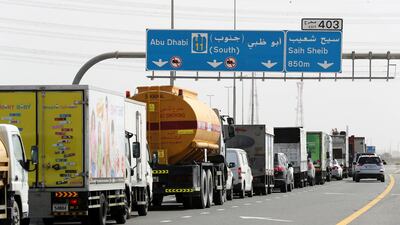
Congestion at the border into Abu Dhabi from Dubai on Sheikh Zayed Road as police check motorists for permits. A ban on travel in and out of Abu Dhabi began on June 2. Pawan Singh / The National -
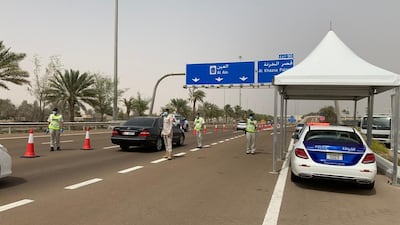
Officers check motorists for travel permits as they enter Abu Dhabi from Dubai. Courtesy: AD Police -
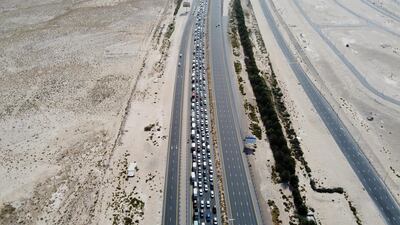
A picture taken with a drone shows cars queueing before a security checkpoint on the E11 highway, between Dubai and Abu Dhabi, in Dubai, United Arab Emirates. EPA -
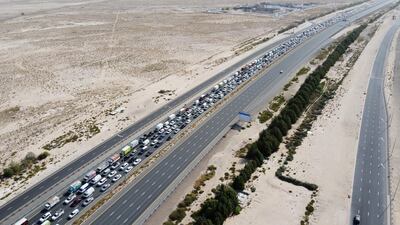
A picture taken with a drone shows cars queuing before a security checkpoint on the E11 highway, between Dubai and Abu Dhabi on June 6. EPA -
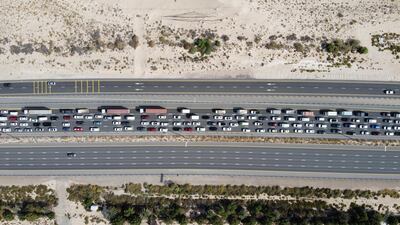
A picture taken with a drone shows cars queueing before a security checkpoint on the E11 highway, between Dubai and Abu Dhabi, in Dubai, United Arab Emirates. EPA -

Traffic builds up on Sheikh Zayed Road as police check motorists for movement permits to enter Abu Dhabi. Pawan Singh / The National -

Tailbacks on Sheikh Zayed Road as motorists wait to enter Abu Dhabi while police check for movement permits. Pawan Singh / The National -
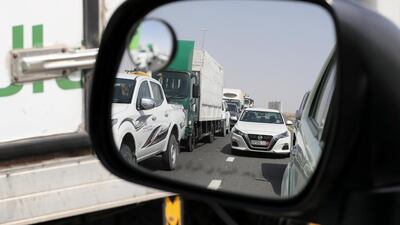
Police check motorists for permits to travel in Abu Dhabi from Dubai as a temporary movement ban comes into force. Pawan Singh / The National -
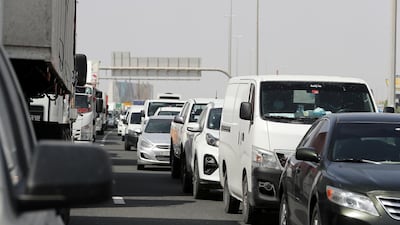
Traffic builds up on Sheikh Zayed Road as police check motorists for movement permits to enter Abu Dhabi. Pawan Singh / The National -
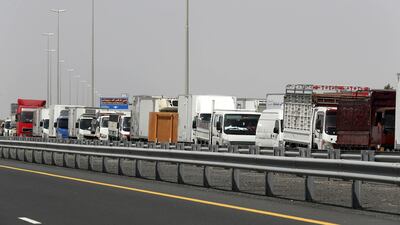
Tailbacks on Sheikh Zayed Road as motorists wait to enter Abu Dhabi while police check for movement permits. Pawan Singh / The National -
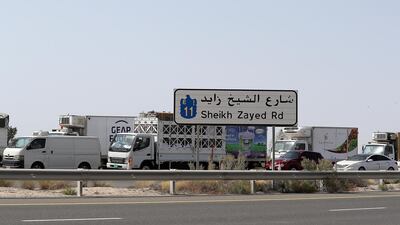
Traffic builds up on Sheikh Zayed Road as police check motorists for movement permits to enter Abu Dhabi. Pawan Singh / The National


This happens as Abu Dhabi bids farewell to another previously necessary measure. People coming from abroad to visit the emirate will no longer have to wear a medical-grade tracking wristband, which had been mandatory for the vast majority of arrivals. Now, the cosmopolitanism that forms part of the UAE's identity is also one step closer to returning to normal.
This all comes after a record low in case numbers. As of last week, just 0.2 per cent of people tested in Abu Dhabi were found to have the virus.
Caution dictates that global reopening will be a slow, measured process, even in countries with falling cases and strong healthcare systems. More than 18.5 million people are currently infected with Covid-19. Worldwide, only 43 per cent of people have received at least one vaccine dose. In the developing world, it is less than two per cent. For now, plotting the route to a new normal is still a premature goal for most.
The UAE is fortunate to be at the opposite end of this spectrum. But it is also deserving. The country had one of the most far-reaching set of coronavirus measures in the world. Schools moved to distance learning. Religious ceremonies were restricted. Many residents abroad at the time had to wait weeks, sometimes longer to return home.
Today, more than 80 per cent of people in the UAE are fully vaccinated. At present, Abu Dhabi is the leading jurisdiction in the world in terms of number of tests per person, and the emirate still requires regular testing in order to enter public spaces, including workplaces and schools. Across the country, masks remain mandatory. The emergence of a next phase in dealing with the pandemic is necessary and welcome, but the responsibility to be vigilant remains for all of us.
Authorities and the public will continue to monitor the situation. But the resilience and capacity the country has been building over the past year and a half is paying off as a new shape is given to what will become normality.
As restrictions lift, more and more of us will realise quite how strange the past few months have been. Bidding farewell to some of these measures will be a great reason to celebrate. After this week's news, doing so with friends from across the country, even across the world, will be a lot easier.

