

ISIS has intensified attacks worldwide over the past six months despite sustained international pressure, a senior UN counter-terrorism official told the Security Council on Wednesday.
Natalia Gherman, executive director of the Counter-Terrorism Committee Executive Directorate (CTED), said the group continues to carry out and inspire “destructive attacks” across a wide geographic arc, from Syria and Iraq, to the Sahel, the Lake Chad Basin, East Africa and Australia.
“The impacts have been devastating,” Ms Gherman said, adding that UN monitors had documented increasingly sophisticated fund-raising and propaganda strategies used by the group.
Ms Gherman warned that the humanitarian situation remains critical in Syria, where more than 26,000 people are being held in camps and detention facilities because of perceived family ties to ISIS.
The majority are children who are unable to return to their communities of origin and have been denied due process, she said.
She added that recent changes in the administration of Al Hol camp in north-eastern Syria require close monitoring and sustained international engagement. The camp was previously run by Syrian Kurdish forces but they lost control to government troops last month.
The Al Hol detainees there were part of the militants’ self-declared caliphate, established after ISIS seized large parts of Syria and Iraq in 2014 and were crushed by US-backed Kurdish forces in 2019. Many of those interned are women and children.
A report by the UN Secretary General circulated to Security Council members last week said the threat posed by ISIS has increased steadily since the previous assessment in August 2025, becoming more complex and spreading across several theatres.
-
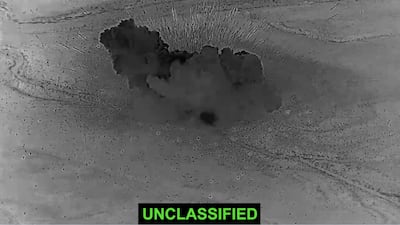
On December 19, US and Jordanian forces struck 70 or more ISIS targets in Syria. Photo: Centcom -
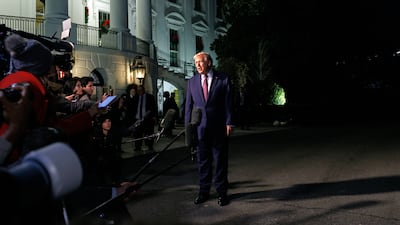
US President Donald Trump on the South Lawn of the White House before boarding Marine One in Washington on December 19. Defence Secretary Pete Hegseth said operations in Syria fulfiled the President’s vow to retaliate after three US personnel were killed in Syria by ISIS. EPA -
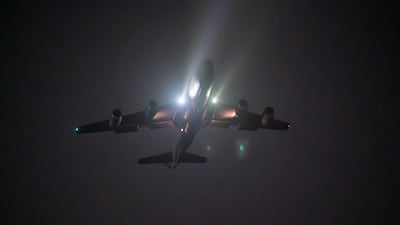
A C-135 Stratotanker aircraft takes off on December 19 in support of Operation Hawkeye Strike against ISIS in Syria, Centcom said. Reuters -

A US soldier attached to the Iowa National Guard signs a GBU-31 munitions systems before it was used in an attack on ISIS in Syria. AFP -
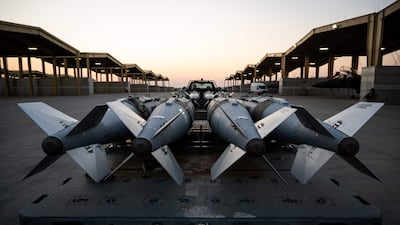
Ordnance is prepared for US F-15E Strike Eagles in support of Operation Hawkeye Strike against ISIS forces in Syria. AFP -
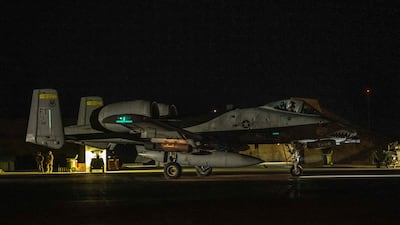
A US Air Force A-10 Warthog ground attack plane taxis for its mission on the night of on December 19, 2025. AFP


The report said the group continues to take advantage of armed conflict, political instability and poor governance, and remains a major threat to human rights, development and international peace and security.
“As this report makes very clear, the threat posed by Daesh [ISIS] has increased in measurable ways,” Ms Gherman said. “Terrorist violence has intensified across multiple regions, and Daesh has proven financially and militarily resilient despite setbacks. We must not lose sight of our shared goal to preserve international peace and security.”
US ambassador to the UN Mike Waltz said Washington remained “deeply concerned” and determined to take “bold action” against ISIS, Al Qaeda and their affiliates.
“They continue to exploit instability across Africa, the Middle East and South Asia, and the threat is increasing,” Mr Waltz said. “It is not only increasingly diffuse and complex. It increasingly involves foreign fighters converging in multiple conflict zones.”
Mr Waltz praised member states whose counter-terrorism operations had constrained militant groups, especially in Iraq, Syria and Somalia.
He urged other countries, particularly in Europe, to follow Baghdad's example in repatriating detained and displaced people from north-east Syria.
It comes after the US announced another series of strikes on ISIS targets in Syria in retaliation for a December attack that killed two American troops and an interpreter.
US Central Command last month began moving thousands of detained ISIS fighters to an unspecified “secure location” in neighbouring Iraq, along with tens of thousands of women and children.
Baghdad viewed the camp as a threat to national and regional security.

