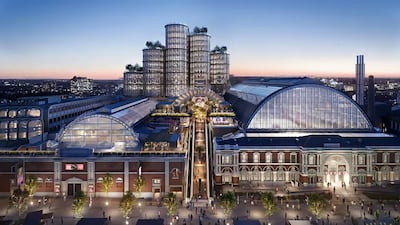

A ribbon of land in the West Kensington area of London is now the largest regeneration area in the UK capital, and is set to affect property prices in the unloved neighbourhood, a report has found.
Within a stone’s throw of each other, three key sites covering about 25 hectares will provide £11.8 billion ($15.9 billion) of new development, creating homes, offices, retail and leisure opportunities.
The scale and value of the unused or derelict land being brought back to life is on a par with the tech company-led centre at King’s Cross (27 hectares, £3 billion) and outstrips Battersea Power Station (17 hectares, £9 billion) and Queensway (two hectares, £23 billion).


Victorian grandeur
Earl’s Court and Olympia each sprang up during the late 1880s during London’s railway-inspired building boom, when grand exhibition centres were all the rage, before falling into decline in recent decades. The third site, West Cromwell Road, was part of a suburb of Italianate villas that eventually became a car park and industrial site when it lost its appeal due to the heaving traffic on the main road into central London.
West Cromwell Road is becoming 100 Kensington, providing 462 new homes.
Earl’s Court, where the famous exhibition centre was demolished between 2014 and 2017, will have 4,000 new homes, offices, three cultural venues and new parks and squares from 2030.
Olympia is being turned into a business and cultural destination with offices, a concert venue, a theatre complex and two international hotels by the end of next year.
The National was given a tour of the redeveloped Olympia, including a car park that is now a Hyatt Regency hotel; office suites that are home to the Premier League and its studios; a "street in the sky" above the original exhibition halls; and several terraces with views across London.
Trevor Morris of SPPARC Architects said the original Olympia was intended as a "People's Palace" to educate the masses, and had now been given a new lease of life to last another 120 years. The team had dealt with a host of heritage restrictions and constraints of giant exhibition spaces, but he said he was proud of what had been achieved as the building was restored.

Price rise
The three areas missed out on the property price booms of other West London neighbourhoods, such as South Kensington and Chelsea.
Research by property analytics company Pricehubble found that along with the generation of jobs and leisure attractions, the regeneration can expect price rises of between 2.2 per cent and 2.9 per cent price annually on top of the 5.2 per cent annual increase the rest of the borough has experienced over 10 years. Battersea’s Nine Elms had an annual 4.5 per cent premium while King’s Cross achieved 2.1 per cent.
The research was commissioned by SevenCapital, a UK developer that is one of several companies involved in the area’s makeover.
Drawing on economic data from property network LonRes, commercial property firm CBRE, Office for National statistics and the local authority, Pricehubble said average apartment prices in West Kensington are currently just over £500,000.
That is substantially lower than the Kensington average of just under £1.25 million, South Kensington (£1.35 million), Belgravia (£2.25 million) and Knightsbridge (£1.56 million) where most homes are pre-1920s mansion blocks, townhouse terraces and villas.
The report says that the workspace, retail and cultural centres being built in the West Kensington regeneration zone will draw thousands of higher-income professionals into the area, with most working within minutes of their home.
Sandra Jones, managing director of PriceHubble, said the scale of the inward investment could “materially reshape” the area’s economy and culture.
“As inner London’s largest regeneration and investment hub progresses between 2026-2041, the West Kensington housing market is exceptionally well placed to benefit from regeneration-led uplift and gradual price convergence with more established parts of Kensington and Chelsea,” she said.
James Moody, chief operating officer of SevenCapital, said: “Historically the area of Kensington to the West of Warwick Road/Redcliffe Gardens has been overlooked, but West Kensington now provides a compelling opportunity in the local market characterised by genuine scarcity, strong occupier demand and long-term capital growth.”

