The inaugural Tehran Art Month started last week against the backdrop of war and increasing sanctions – a reminder of the incredible feats achieved by creative people in times of war. But it was also marked by the silence around the detention of two of the city’s key artistic figures.
The arrest of graphic designers Aria Kasaei and Elly Naghilou in the Iranian capital last month, apparently for meeting two French diplomats to discuss an upcoming cultural project, has left the city’s creative industries in a state of shock and fear.

The pair, their supporters say, had dedicated their careers to promoting Iranian culture and their work had not been political. The French diplomats were expelled, raising tensions with France, which responded in kind.

I met Kasaei in 2016 during a visit to Studio Kargah, the graphic design company he cofounded with Peyman Pourhossein and where Naghilou also worked.
Resistance and coexistence
The art scene in Tehran has long sat in an usual and fragile place: fiercely independent from the Islamic regime’s vision yet tolerated by the authorities who monitored every exhibition and publication. The city’s growing number of galleries and artists also presented their works internationally, exporting their vision of contemporary Iranian culture while also influencing artists across the Middle East.

At the heart of this network, was Studio Kargah. The studio created visual identities for many of the city’s galleries, producing distinct exhibition catalogues. For this work, it is widely credited with helping to drive the art scene in Tehran, and aiding its promotion outside Iran.
On the day of my visit, the studio in a residential neighbourhood in central Tehran was busy, with at least 10 young designers at work. Today the team is said to have reached 30 people. At one end of the room was a library of art books, some produced by the studio and others collected.
Kasaei, who was a student of the pioneering Iranian calligrapher and graphic designer Reza Abedini, expressed a love for old Iranian graphics and illustration, from film and festival posters to children’s magazines. He was also clearly committed to being in Tehran, and he talked about the need to grow artistic collaborations between artists and platforms from across the Middle East.
The year 2016 was a different time for Iran, as an embargo that had plagued the country for 40 years was being lifted following the signing of the Iran nuclear deal. There was hope then that Iran could come out of its economic isolation and that its artistic output would also boom.
The studio was preparing for an exhibition on Iranian childhood at the Tehran Museum of Contemporary Art. The presentation brought together children’s magazines, books, posters and vinyl covers from 1950 to 1980.
Studio Kargah held significant graphic design exhibitions in Tehran based on Kasaei's archival collections. Among these was a 2018 exhibition of posters from Tehran’s Rudaki Hall, the first opera and ballet house in the Middle East.
That same year the studio also presented Soviet posters and visual materials produced for Iranian and Central Asian audiences. Kasaei showed me a collection of posters of the Shiraz Arts Festival, which was held in the southern city for a decade from 1967.
It is this work that supporters of Kasaei say showed his commitment to culture above all, without casting judgment on the major upheavals in Iran’s modern history. “Studio Kargah played a role in revitalising collective memory. They have acted as a bridge between our times and the revolution, always in a beautiful way and without judgment,” said one supporter living outside the country.
Growing pressure
Pressure on Mr Kasaei began following his involvement in the poster design for the internationally acclaimed Iranian film Holy Spider (2022). Based on the true story of a serial killer in Mashhad who targeted sex workers, the film's lead actress Zar Amir Ebrahimi won the Best Actress award at Cannes, following the film’s nomination for a Palme d’Or.
Yet regime officials rejected the creative acclaim and Ms Ebrahimi spoke publicly of the threats she received in Iran following the award.
Likewise, many of the galleries that I visited in 2016 are no longer there, driven out by the country's economic or political pressures, while new ones have emerged.

Tit for tat
The graphic designers' arrests on July 19 were triggered by their meeting, held in Mr Kasaei's home, with French diplomats on that day to discuss the visual identity for the project Villa Zadig, according to supporters of the designers who issued a statement last week.
The two French officials, who were not named by France but included the cultural attache, were also arrested and interrogated, before being expelled from Iran. French Foreign Minister Jean-Noel Barrot condemned their treatment and responded by expelling two Iranian diplomats from France this month.
“I warned that these unacceptable measures would have consequences, and that is unfortunately the case. Two Iranian diplomats in France will be expelled in the near future,” Mr Barrot wrote on X.

Mr Barrot did not mention the meeting with Kasaei and Naghilou in his statement but said that France stood with Iran's civil society.
“The Iranian people, a great people, are the primary victims of this period of extreme tension in the Middle East, caught between the bloody repression of the January 2026 protests and the bombings,” he said.
“It is precisely because France stands alongside the Iranian people, supporting its artists, scientists and researchers, that two French diplomats were scandalously and deliberately assaulted on July 19,” he wrote.
Tehran had accused the diplomats of “unusual” behaviour which led to their questioning and recall. Iranian Foreign Ministry spokesperson Esmaeil Baghaei said the two French staff had violated the Vienna Convention – which defines the rules and privileges of diplomatic missions – by engaging in activities supporting Iranian civil society.
Iran's intelligence ministry has claimed that an initial probe showed the two diplomats were “planning and designing a vast scheme aimed at exerting influence and engaging in foreign interference”.
“Aria and Elly have remained in detention ever since [their arrest] and, to date, have had no access to an independent lawyer,” their supporters said in a statement to AFP.
“We call for any specific charges brought against Aria Kasaei and Elly Naghilou to be made public, for them to be granted immediate access to an independent lawyer and an effective defence, and for their safety and fundamental rights to be guaranteed,” the statement added.
They accused the intelligence ministry of providing a “profoundly misleading picture”.
The studio confirmed Kasaei and Naghilou’s arrest on August 5, urging people to refrain from speculation online. “Based on the contacts we have had with Elly and Aria, we are confident of their health, but we have still not been given any official or reliable information about the reason for their arrest, charges, or when they will be released,” the studio said.
-
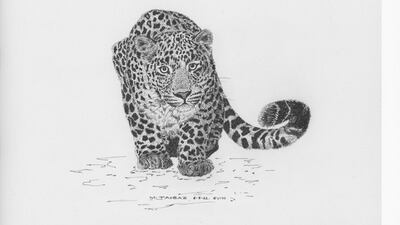
A leopard drawn by Morad Tahbaz during his imprisonment in Evin. Courtesy of Morad Tahbaz -
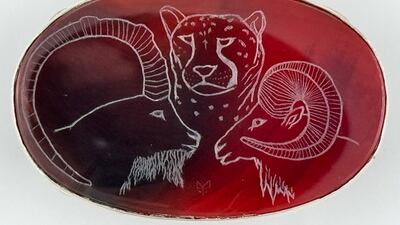
While in prison Morad Tahbaz taught himself how to engrave. Courtesy of Morad Tahbaz -

A wooden carved lion designed and built by Morad Tahbaz while in Evin Prison. Courtesy of Morad Tahbaz. -

A statue of a lion designed and built by Morad Tahbaz while he was imprisonned in Evin. Courtesy of Morad Tahbaz -
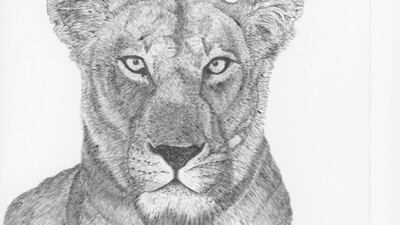
A Lioness drawn by Morad Tahbaz during his imprisonment in Evin. Courtesy of Morad Tahbaz -
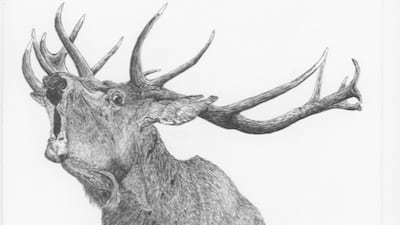
An elk drawn by Morad Tahbaz during his imprisonment in Evin. Courtesy of Morad Tahbaz -

A ram drawn by Morad Tahbaz during his imprisonment in Evin. Courtesy of Morad Tahbaz -

A cheetah drawn by Morad Tahbaz during his imprisonment in Evin. Courtesy of Morad Tahbaz -
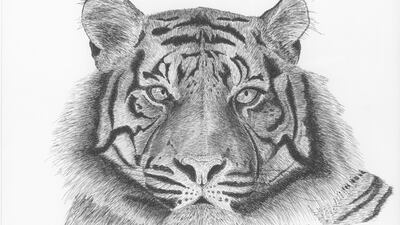
A tiger drawn by Morad Tahbaz during his imprisonment in Evin. Courtesy of Morad Tahbaz -

An owl drawn by Morad Tahbaz during his imprisonment in Evin. Courtesy of Morad Tahbaz


“We hope to see the return of Aria and Elly soon, so that once again, as always and together, we can devote our energy and focus to planning and designing projects that serve the culture, art and historical memory of this land,” they wrote.
“We still believe [that] art is the most raised flag, and culture is the most fundamental infrastructure of Iran.”