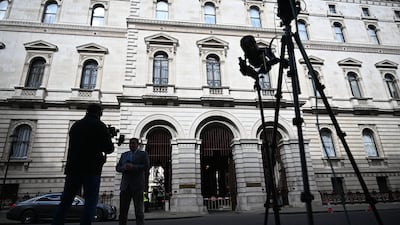
Hamish Falconer, the UK's departing Middle East Minister, has written about his efforts falling short of his hopes as fears circulated in Westminster the post is in line for a downgrade.
British Prime Minister Andy Burnham’s reshuffle this week included moving Mr Falconer to a new brief, while no one else has been allocated the role.
In an open letter to his former staff, Mr Falconer paid tribute to the diplomats he worked with.

“On Iran we worked to keep Britain out of war and defend our Gulf friends, in Lebanon we became one of the country’s most significant humanitarian supporters and in Afghanistan we championed women’s rights even in the darkest moments,” he said.
“Together we did a great deal during my tenure on issues in Palestine: it will remain the privilege of my life to have been the first Middle East Minister to recognise a Palestinian state since the Balfour Declaration [1917].
“I am proud of our efforts to rescue hundreds of people from Gaza, including injured children and young students; and for the first time we sanctioned ministers in the Israeli government for their support for violent settlers in the West Bank.”
He hinted at divisions at the highest level on UK policy while he served Keir Starmer as prime minister for two years from the 2024 election. “Throughout my time, I pressed to go yet further,” he said in the letter posted on X. “Despite that work, the situation remains unbearable and I leave the role marked by what I heard and saw from those who left Gaza, both residents and hostages.”

Mr Burnham is widely expected to bring a change of tone, after he acknowledged previous policy was too slow to recognise the hurt caused by the conflict in Gaza.
“I know that the new Prime Minister is completely committed to working to bring this appalling tragedy to an end and securing a lasting peace for Palestine and Israel,” added Mr Falconer.
Nevertheless the apparent vacuum has raised concerns about a possible demotion of the Middle East brief at the Foreign Commonwealth and Development Office, after Mr Falconer was appointed Minister for Intergovernmental Relations and European Relations.
New juniors
Two parliamentary under-secretary of state posts at the FCDO, the Labour MPs Chris Elmore and Uma Kamaran, have yet to be appointed to a new role, raising the possibility that the Middle East and North Africa brief could be handed to either. Ms Kamaran also holds the role of Assistant Whip, which means she will be more restricted in travelling.
Kirsty McNeill was made Minister for International Development and Africa, and Steven Doughty will remain in his post as Minister for Europe, North America and Overseas Territories.
Permanent under-secretary roles are considered less senior than ministers, though their day-to-day remit may be similar.
In the past few years, the Minister for the Middle East has played a pivotal role in the shaping the UK’s relations with Arab countries, engaging with civil society groups involved in the Israel-Palestine conflict, and with British Syrians following the fall of the Assad regime.
Explaining the role, Nicholas Hopton, a former British diplomat and director of the Middle East Association, said: “The minister is day to day following events in the Middle East, engaging with countries in the region and is a very important figure for the embassies in London.”
The minister is also important for maintaining the economic relationships with these countries, particularly in the Gulf, he added.
“It would be a great pity if that has been demoted and it would not make any sense at this time, given centrality of what’s going on in the region. The UK has a huge amount of interest in what’s going on there and we need a dedicated minister.”

New Foreign Secretary Ed Miliband, a veteran Labour figure, has pledged to end the suffering of Palestinians in the Middle East, by working “tirelessly to seek a sustainable peace in Palestine and Israel, including an end to the terrible suffering of the people of Gaza” and to get “security for the people of Israel”.
He will travel to Qatar this week in his first visit to the Middle East as Foreign Secretary, “with a focus on using the UK’s international standing to deliver on the government’s priority of tackling the cost-of-living crisis”, the FCDO said on Thursday.
Mr Miliband is “stepping up the UK’s engagement to resolve the ongoing conflict in Iran, which is pushing up prices back at home for businesses and families”.
Mr Miliband will meet his counterpart in Doha " to continue work to get the Strait of Hormuz fully open, accelerate steps towards urgent de-escalation and secure a swift resolution to the war”.
The Labour Party is seeking to alter its image on the Israel-Palestine issue, after sustained backlash from its traditional support base over its support for Israel’s military campaign in Gaza at the start of the war.
Mr Burnham apologised for the party’s stance before his appointment, promising to “do better” by putting more pressure on Israel.
Labour MP Kim Johnson wrote to Mr Burnham on Thursday asking him to ban trade from illegal settlements in Israel, impose sanctions and a full arms embargo on Israel, and commit to implementing the recommendations of the International Court of Justice’s July 2024 advisory opinion on the situation in Palestine.

Her letter was backed by 80 MPs and peers, mostly from Labour’s left-wing, independent MPs who took Labour seats at the last general election, and the left-wing Green Party that has surged in popularity after putting the humanitarian crisis in Gaza at the heart of its manifesto.
It urged the government to “decisively change its stance in order to uphold the rights of the Palestinian people and to prevent Israel's continued violations of international law”.
“Now is the opportunity for this government and for you, as the new Prime Minister, to truly turn a new page,” the letter said.
Downing Street and the FCDO said ministerial appointments would be announced in due course and did not comment on the possibility of a demotion.