


A flash telegram sent hours after the SAS stormed the Iranian embassy in London to end a siege warned British ambassadors across the Middle East they should take precautions against possible threats from Iraqi intelligence.
The confidential note sent by the foreign secretary, Lord Carrington, on May 5, 1980, pointed out that Iraqi media was “supportive of the aims of the terrorists” but acknowledged there was “no reason to believe that any reprisals were planned”.
The document forms part of an exhibition, MI5: Official Secrets, the first time the intelligence agency has collaborated on an exhibition exploring its own 115-year history. It is included because it highlights the period when the agency shifted its focus from counter-espionage to counter-terrorism.
Mark Dunton, historian and curator of the exhibition at the National Archives in Kew, south-west London, told The National the telegram gave a “sense of immediacy” regarding the operation, which brought to an end a six-day siege.
Six gunmen had stormed the embassy, taking 26 people hostage, to demand the release of political prisoners in Iran. The SAS eventually entered the building via a balcony after abseiling down the facade, killing five of the gunmen and rescuing 24 of the hostages.
PC Trevor Lock, the lone officer guarding the embassy when the siege broke out, died on Sunday aged 85. He had kept his gun hidden throughout the siege while he acted as an intermediary between the terrorists and security forces.
Mr Dunton said MI5 had formed an important part of the operation by providing intelligence about what was going on inside the building.
“The telegram summarises the state of affairs and was sent to embassies across the Middle East,” he said, pointing out that other telegrams at that time were so contemporaneous they contained incorrect information. The “modern” era of MI5 began in the 1970s, he said, when the agency “changes from countering subversion or espionage to fighting terrorism”.
In pictures – MI5 secrets
-
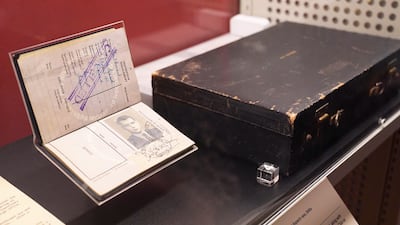
Cambridge spy Guy Burgess's passport and briefcase, which he left behind when he fled to Moscow in 1951, are going on display in the MI5: Official Secrets exhibition at the National Archives in Kew, west London. All photos: PA -
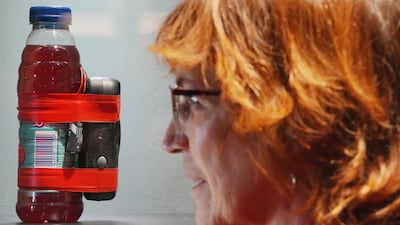
A bottle bomb incorporating an instant camera, recreated by the Bomb Data Centre. It is the first time the MI5 intelligence agency has collaborated on such an exhibition in its 115-year history -
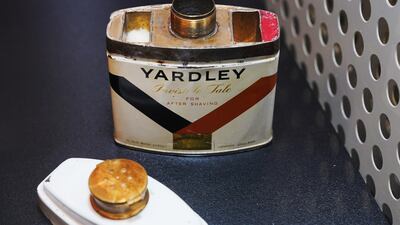
A Yardley talcum powder tin from 1960 used by one of the Portland spy ring to conceal microdot equipment. PA -
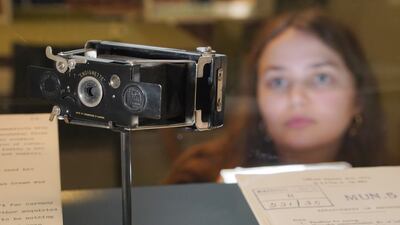
A 1910 Ensignette camera, the first spy camera bought by MI5 -
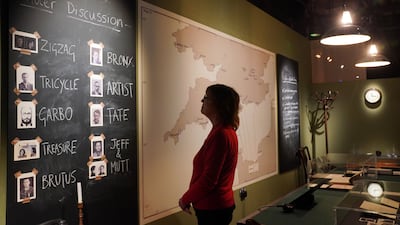
A recreation of the double cross operation room, running double agents during the Second World War, circa 1944 -
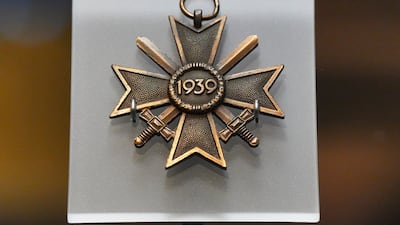
A copy of the German War Merit Cross, or Kriegsverdienstkreuz, dated 1939 -
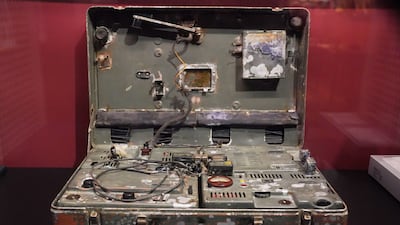
'Flash transmission' radio equipment used by Soviet spies Peter and Helen Kroger


The telegram reads: “The decision to storm the embassy was taken after two hostages had been reported shot, one body had been pushed out of the embassy and further killings threatened. The building was attacked and quickly cleared. We believe all the hostages alive in the building at the time of the assault were released safe, though it appears two were killed before the attack began. Because the embassy was gutted by fire, we cannot give a precise casualty figure.”
The official MI5 file about the siege is not due to be declassified until 2030, under the 50-year rule, but the document “gives a hint” of how MI5 was involved, said Mr Dunton.
The exhibition also features a mortar bomb fired at Downing Street by IRA terrorists and an explosive device created by Al Qaeda terrorists made from a drink bottle and instant camera. “It was part of a plot to blow up seven flights from Heathrow to the US using liquid explosives and is why we had years of limits on liquids at airports,” he added.

Another document from the 1980s included in the exhibition is a note of a phone call between US president Ronald Reagan and UK prime Minister Margaret Thatcher after the Lockerbie bombing, in which Mr Reagan said he was concerned that the “cause might have been sabotage”. MI5 explosives experts identified the circuit board used in the bomb that brought down the plane, killing all 259 on board and 11 people on the ground, which eventually led investigators to Libyan intelligence officer Abdelbaset Al Megrahi, who was found guilty of murder.
In the notes from the conversation, Mrs Thatcher described it as a “terrible tragedy” and reassured the president that “everything possible was being done to deal with the aftermath and to find the causes”, while Mr Reagan thanked her for a message of sympathy she had sent, which would “touch the hearts of the American people”.
Sir Ken McCallum, director general of MI5, said the exhibition was an example of the more open nature of the service. “We'll never be able to talk about everything we do. To do so would give away information that would be useful to the UK's adversaries. However, you've also seen that we are much more open than MI5 was in the past.”

He said a large proportion of MI5’s work is focused on countering terror plots and attacks. “Sadly, the nature of terrorism is such that we know it won't be possible to find and stop every single developing plot. The human cost of terrorism is devastating.
“We owe it to … the public to continually strive to find new ways to stop future atrocities. When I joined MI5 in the mid-90s, the Cold War was over and the threat from Al Qaeda was becoming more of a focus.
“But today, as we have seen with [Russian President Vladimir] Putin's illegal invasion of Ukraine and through attempts to spy on the UK's most innovative companies, we once again face increased threats from state actors who wish to do us harm.
“I can't predict the future, but I know it will bring many more challenges for MI5 and our partners across a broad range of threats.”
One of the highlights of the exhibition is a briefcase belonging to Guy Burgess, part of the notorious Cambridge spy ring that operated at the highest levels of UK intelligence. The case was left at London’s Reform Club in 1951 for fellow spy Anthony Blunt before Burgess fled to the Soviet Union after being exposed. Burgess was a British diplomat and Soviet double agent who fled to Moscow with fellow spy Donald Maclean amid fears they would be discovered.
None of the Cambridge Five were ever prosecuted for spying.
Papers released in January related to the spy ring included the confession by Kim Philby – who led MI6’s Soviet counter-espionage – given in Beirut after decades of suspicion. Also displayed in the exhibition is a letter written by a KGB officer based in Istanbul, Konstantin Volkov, setting out the secrets he could give to the UK. His knowledge had risked unmasking Philby, who informed his KGB handlers and ultimately led to the torture and execution of Volkov and his wife.
Also featured in the exhibition is spy-catching equipment lent by the private MI5 collection alongside files, papers and photographs relating to its formation in the lead-up to the First World War, the fight against fascism in the Second World War and the subsequent Cold War.
One of the more unusual items is a 110-year-old lemon used as evidence against Karl Muller, a German spy, who was executed by firing squad at the Tower of London in 1915. He was using juice from the lemon to write secret messages to inform on British troop movements. A warm iron was passed over a letter to reveal the messages. When he was arrested, the lemon was found in his overcoat.
In total, 20 items were loaned, including MI5’s first camera and a key to the Communist Party of Great Britain’s Westminster branch office.
MI5: Official Secrets runs from April 5 until September 28 at The National Archives in Kew, London. Admission is free.

