Labour leader Keir Starmer visits the BAE Systems submarine academy in Barrow-in-Furness. Getty Images

Keir Starmer commits to UK's 'bedrock' nuclear deterrent


Simon Rushton
  • English
  • Arabic

Strengthening the UK's security and economic growth emerged as key themes in this year's election battle as Labour party leader Keir Starmer called Britain's nuclear deterrent the “bedrock” of his plan to keep the country safe.

Mr Starmer is proposing to use procurement to direct investment to British businesses in the defence sector as a priority.

His defence budget commitment for an incoming Labour-run UK government matches that of Chancellor Jeremy Hunt, as the rise to 2.5 per cent of GDP will depend on whether it fits with the party's fiscal rules, Mr Starmer said.

He also promised to put in place a nuclear deterrent triple lock, if elected at the next general election.

In a “landmark” interview with the Daily Mail, the Labour leader said his party has changed, adding it is “utterly committed” to the nation’s defence and armed forces.

Mr Starmer continued: “Make no mistake, this is a generational, multi-decade commitment.

“Not only is this about defending our land and our Nato allies, it’s also defending our economy – prioritising British jobs, British skills and much-needed economic growth here on our shores.

“I want to see more home-grown involvement in the nuclear submarine supply chain – and our wider defence manufacturing. With Labour, the defence industry will be hard-wired into my national mission to drive economic growth across the UK.”

On Friday, Mr Starmer visited Barrow-in-Furness shipyard in Cumbria, which the party has said would build all four new Dreadnought nuclear submarines.

He is the first Labour leader to visit the shipyard in more than 30 years, and was due to speak to workers, union members and apprentices about increasing jobs and skills at the site and in the wider defence industry.

Defence first for Labour

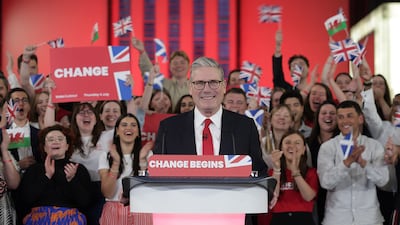
  • Labour leader Keir Starmer celebrates winning the UK general election with a speech at Tate Modern in central London in July. All photos: Getty Images
    Labour leader Keir Starmer celebrates winning the UK general election with a speech at Tate Modern in central London in July. All photos: Getty Images
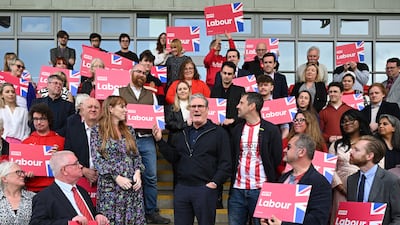
  • Deputy Labour leader Angela Rayner, and Mr Starmer meet party supporters in Harlow in May
    Deputy Labour leader Angela Rayner, and Mr Starmer meet party supporters in Harlow in May
  • London Mayor and Labour incumbent Sadiq Khan, and his wife Saadiya Khan, pose with supporters after Mr Khan was re-elected in May
    London Mayor and Labour incumbent Sadiq Khan, and his wife Saadiya Khan, pose with supporters after Mr Khan was re-elected in May
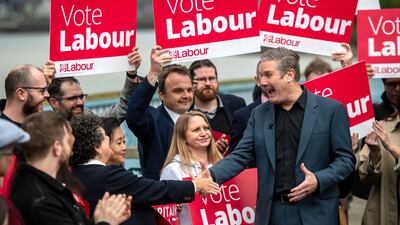
  • Mr Starmer meets and greets supporters in Chatham in 2023
    Mr Starmer meets and greets supporters in Chatham in 2023
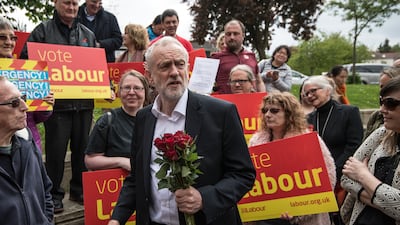
  • Then-party leader Jeremy Corbyn during a 2017 visit to Oxford
    Then-party leader Jeremy Corbyn during a 2017 visit to Oxford
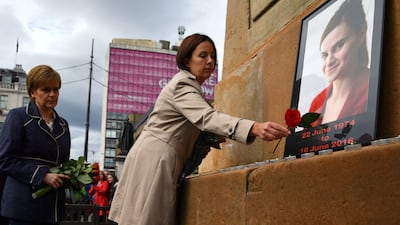
  • First minister of Scotland Nicola Sturgeon, left, and leader of Scottish Labour Kezia Dugdale place roses at a memorial for murdered Labour MP Jo Cox, in Glasgow in 2016
    First minister of Scotland Nicola Sturgeon, left, and leader of Scottish Labour Kezia Dugdale place roses at a memorial for murdered Labour MP Jo Cox, in Glasgow in 2016
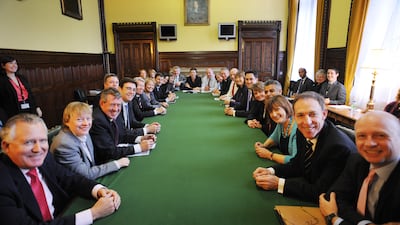
  • Labour leader Ed Miliband, sixth right, holds his first shadow cabinet meeting at the House of Commons in 2010
    Labour leader Ed Miliband, sixth right, holds his first shadow cabinet meeting at the House of Commons in 2010
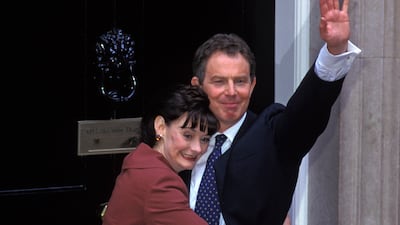
  • Newly elected Labour prime minister Tony Blair stands on the steps of No 10 Downing Street with his wife Cherie in 1997
    Newly elected Labour prime minister Tony Blair stands on the steps of No 10 Downing Street with his wife Cherie in 1997
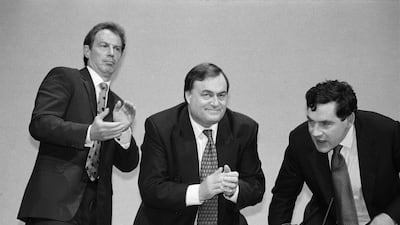
  • Mr Blair, John Prescott and Gordon Brown at the Labour Party Conference in 1997
    Mr Blair, John Prescott and Gordon Brown at the Labour Party Conference in 1997
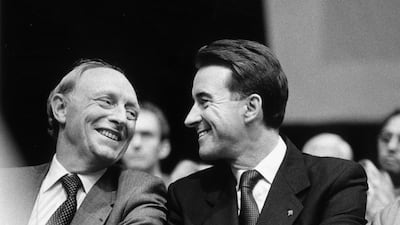
  • Former leader Neil Kinnock, left, shares a joke with Peter Mandelson, a key figure behind the party's 1997 general election landslide victory, at the party conference in 1997
    Former leader Neil Kinnock, left, shares a joke with Peter Mandelson, a key figure behind the party's 1997 general election landslide victory, at the party conference in 1997
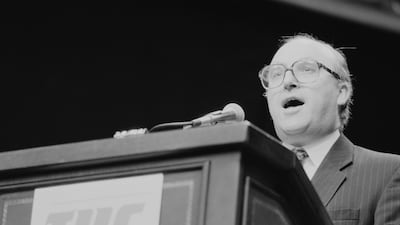
  • Leader John Smith addresses a miners' rally in Hyde Park, London, in 1992
    Leader John Smith addresses a miners' rally in Hyde Park, London, in 1992
  • Mr Kinnock with a group of youngsters publicising Labour's jobs And industry campaign in 1985
    Mr Kinnock with a group of youngsters publicising Labour's jobs And industry campaign in 1985
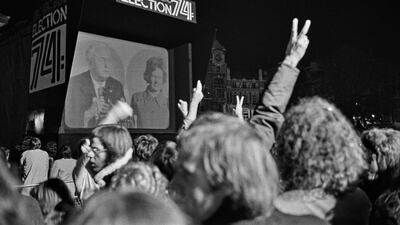
  • BBC TV coverage of the October 1974 general election, with Labour prime minister Harold Wilson and his wife Mary visible on a screen in London
    BBC TV coverage of the October 1974 general election, with Labour prime minister Harold Wilson and his wife Mary visible on a screen in London
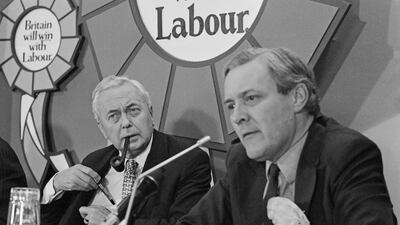
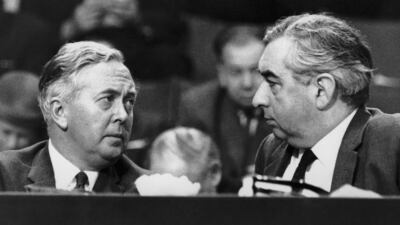
  • Mr Wilson, left, and Labour politician Tony Benn speaking at a press conference during the 1974 general election campaign
    Mr Wilson, left, and Labour politician Tony Benn speaking at a press conference during the 1974 general election campaign
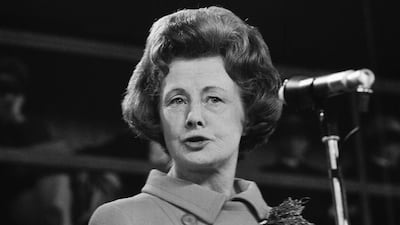
  • Barbara Castle speaking at the Labour Party Conference in 1969
    Barbara Castle speaking at the Labour Party Conference in 1969
  • Mr Wilson waving outside No 10 in 1964
    Mr Wilson waving outside No 10 in 1964
  • Mr Wilson, left, with deputy leader George Brown in 1963
    Mr Wilson, left, with deputy leader George Brown in 1963
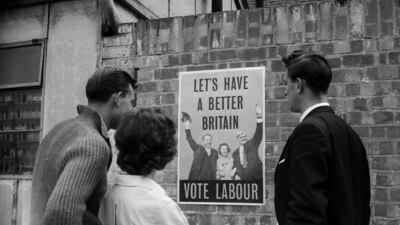
  • A campaign poster issued by the Labour Party depicting leader Hugh Gaitskell arm-in-arm with Barbara Castle and Aneurin Bevan in 1959
    A campaign poster issued by the Labour Party depicting leader Hugh Gaitskell arm-in-arm with Barbara Castle and Aneurin Bevan in 1959
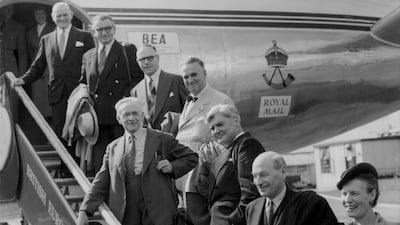
  • Party leader Clement Attlee with a Labour delegation, boarding a plane on their way to China in 1954
    Party leader Clement Attlee with a Labour delegation, boarding a plane on their way to China in 1954
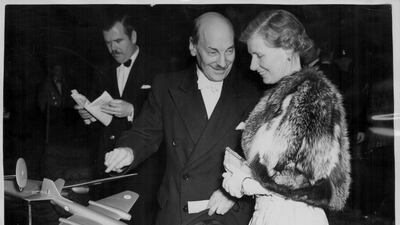
  • Mr Attlee and his wife Violet attending a film premiere in London in 1952
    Mr Attlee and his wife Violet attending a film premiere in London in 1952
  • Members of the Labour cabinet at No 10 in 1929: Clockwise from top left: Tom Shaw, Arthur Greenwood, Noel Buxton, Sidney Webb, Arthur Henderson and prime minister Ramsay MacDonald
    Members of the Labour cabinet at No 10 in 1929: Clockwise from top left: Tom Shaw, Arthur Greenwood, Noel Buxton, Sidney Webb, Arthur Henderson and prime minister Ramsay MacDonald
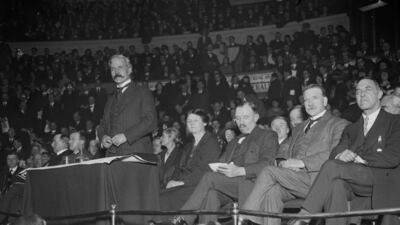
  • Mr MacDonald addressing a Labour victory meeting at the Royal Albert Hall, London, in 1924
    Mr MacDonald addressing a Labour victory meeting at the Royal Albert Hall, London, in 1924
  • From left, Mr Henderson, William Brace, William Adamson, Vernon Hartshorn and James Henry Thomas outside Unity House during a coal workers' strike, in London, 1920
    From left, Mr Henderson, William Brace, William Adamson, Vernon Hartshorn and James Henry Thomas outside Unity House during a coal workers' strike, in London, 1920
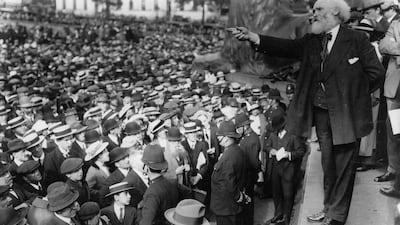
  • Scottish Labour politician James Keir Hardie addressing a peace meeting in Trafalgar Square, London, in 1914
    Scottish Labour politician James Keir Hardie addressing a peace meeting in Trafalgar Square, London, in 1914
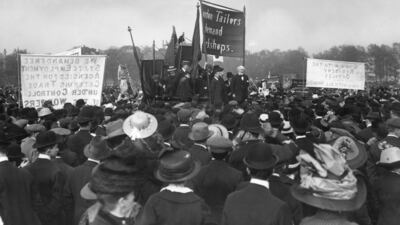
  • Mr Hardie speaks at a tailors' rally on May Day in Hyde Park, London, in 1912
    Mr Hardie speaks at a tailors' rally on May Day in Hyde Park, London, in 1912

Shadow defence minister John Healey and Australian High Commissioner to the UK Stephen Smith also attended.

Mr Starmer said: “The changed Labour party I lead knows that our nation’s defence must always come first. Labour’s commitment to our nuclear deterrent is total.

“In the face of rising global threats and growing Russian aggression, the UK’s nuclear deterrent is the bedrock of Labour’s plan to keep Britain safe. It will ensure vital protection for the UK and our Nato allies in the years ahead, as well as supporting thousands of high-paying jobs across the UK.

“Countless families in Barrow and across Britain have built a secure future over decades of hard work building our defences. I want that to continue for the decades to come.

“That’s why we are fully backing Aukus submarines to be built in Barrow, too. And it’s why Labour will ensure that new UK leadership within Aukus helps make this national endeavour a success for Britain.”

Submarine future

The new submarines will replace the current ones in the early 2030s and carry an estimated cost of £31 billion.

The Labour Party has gone through major changes in terms of its stance on defence, with Mr Starmer's predecessor Mr Corbyn being the vice-president of the Campaign for Nuclear Disarmament (CND).

Shadow armed forces minister Luke Pollard told Times Radio: “You can’t go through the beating that we had in 2019 – the poorest election result for the Labour party since 1935 – and not listen to what the electorate told us.”

He continued: “I know just how important defence is to communities and how much they need to have a Labour party on side.”

Defence Secretary Grant Shapps branded the shipyard visit an “attempted distraction from the Angela Rayner scandal”. The Labour deputy leader is facing a police investigation over the sale of her former council home.

Defence spending 'grotesque'

Meanwhile, the SNP has branded Mr Starmer's defence spending proposals “grotesque” and accused Labour of throwing billions of pounds down the drain.

In March, Prime Minister Rishi Sunak visited BAE Systems Submarines in Barrow with the Chancellor, after declaring a “critical national endeavour” to secure the nuclear industry’s future.

Mr Shapps said Labour is “not the party to be trusted with our nation’s defences”.

He added: “This is just another attempted distraction from the Angela Rayner scandal. If Sir Keir Starmer cannot show leadership on this issue, how can he be trusted to make decision on national security.”

Conservatives and Labour 'offer meaningless talk'

Labour leader Keir Starmer, centre, and shadow defence secretary John Healey, left, at the BAE Systems submarine academy. Getty

SNP defence spokesperson Martin Docherty-Hughes said: “Westminster has already wasted billions of pounds of taxpayers’ money on nuclear weapons and expensive nuclear energy.

“It is therefore grotesque that Sir Keir Starmer is prepared to throw billions more down the drain when his party claim there is no money to improve our NHS, help families with the cost of living or to properly invest in our green energy future.

“This money would be better spent on a raft of other things – not least investing in the green energy gold rush, which would ensure Scotland, with all its renewable energy potential, could be a green energy powerhouse of the 21st century.”

Liberal Democrats leader Ed Davey said both the Conservatives and Labour “only offer meaningless talk” and claimed his party is the only one committed to reversing defence cuts.

Defence union Prospect said all parties should match the 2.5 per cent defence pledge.

General Secretary Mike Clancy said: “We have a world-leading workforce in the defence sector, which delivers jobs and growth for communities up and down the country.

“By committing that more of this money will be spent in the UK, we support both our armed forces and this vital workforce, and we hope all parties will match this pledge.”


Protest for Gaza

How%20to%20avoid%20getting%20scammed
%3Cul%3E%0A%3Cli%3ENever%20click%20on%20links%20provided%20via%20app%20or%20SMS%2C%20even%20if%20they%20seem%20to%20come%20from%20authorised%20senders%20at%20first%20glance%3C%2Fli%3E%0A%3Cli%3EAlways%20double-check%20the%20authenticity%20of%20websites%3C%2Fli%3E%0A%3Cli%3EEnable%20Two-Factor%20Authentication%20(2FA)%20for%20all%20your%20working%20and%20personal%20services%3C%2Fli%3E%0A%3Cli%3EOnly%20use%20official%20links%20published%20by%20the%20respective%20entity%3C%2Fli%3E%0A%3Cli%3EDouble-check%20the%20web%20addresses%20to%20reduce%20exposure%20to%20fake%20sites%20created%20with%20domain%20names%20containing%20spelling%20errors%3C%2Fli%3E%0A%3C%2Ful%3E%0A

Mercer, the investment consulting arm of US services company Marsh & McLennan, expects its wealth division to at least double its assets under management (AUM) in the Middle East as wealth in the region continues to grow despite economic headwinds, a company official said.

Mercer Wealth, which globally has $160 billion in AUM, plans to boost its AUM in the region to $2-$3bn in the next 2-3 years from the present $1bn, said Yasir AbuShaban, a Dubai-based principal with Mercer Wealth.

Within the next two to three years, we are looking at reaching $2 to $3 billion as a conservative estimate and we do see an opportunity to do so,” said Mr AbuShaban.

Mercer does not directly make investments, but allocates clients’ money they have discretion to, to professional asset managers. They also provide advice to clients.

“We have buying power. We can negotiate on their (client’s) behalf with asset managers to provide them lower fees than they otherwise would have to get on their own,” he added.

Mercer Wealth’s clients include sovereign wealth funds, family offices, and insurance companies among others.

From its office in Dubai, Mercer also looks after Africa, India and Turkey, where they also see opportunity for growth.

Wealth creation in Middle East and Africa (MEA) grew 8.5 per cent to $8.1 trillion last year from $7.5tn in 2015, higher than last year’s global average of 6 per cent and the second-highest growth in a region after Asia-Pacific which grew 9.9 per cent, according to consultancy Boston Consulting Group (BCG). In the region, where wealth grew just 1.9 per cent in 2015 compared with 2014, a pickup in oil prices has helped in wealth generation.

BCG is forecasting MEA wealth will rise to $12tn by 2021, growing at an annual average of 8 per cent.

Drivers of wealth generation in the region will be split evenly between new wealth creation and growth of performance of existing assets, according to BCG.

Another general trend in the region is clients’ looking for a comprehensive approach to investing, according to Mr AbuShaban.

“Institutional investors or some of the families are seeing a slowdown in the available capital they have to invest and in that sense they are looking at optimizing the way they manage their portfolios and making sure they are not investing haphazardly and different parts of their investment are working together,” said Mr AbuShaban.

Some clients also have a higher appetite for risk, given the low interest-rate environment that does not provide enough yield for some institutional investors. These clients are keen to invest in illiquid assets, such as private equity and infrastructure.

“What we have seen is a desire for higher returns in what has been a low-return environment specifically in various fixed income or bonds,” he said.

“In this environment, we have seen a de facto increase in the risk that clients are taking in things like illiquid investments, private equity investments, infrastructure and private debt, those kind of investments were higher illiquidity results in incrementally higher returns.”

The Abu Dhabi Investment Authority, one of the largest sovereign wealth funds, said in its 2016 report that has gradually increased its exposure in direct private equity and private credit transactions, mainly in Asian markets and especially in China and India. The authority’s private equity department focused on structured equities owing to “their defensive characteristics.”

Key recommendations
  • Fewer criminals put behind bars and more to serve sentences in the community, with short sentences scrapped and many inmates released earlier.
  • Greater use of curfews and exclusion zones to deliver tougher supervision than ever on criminals.
  • Explore wider powers for judges to punish offenders by blocking them from attending football matches, banning them from driving or travelling abroad through an expansion of ‘ancillary orders’.
  • More Intensive Supervision Courts to tackle the root causes of crime such as alcohol and drug abuse – forcing repeat offenders to take part in tough treatment programmes or face prison.
RESULTS

6.30pm: Handicap (rated 95-108) US$125,000 2000m (Dirt).
Winner: Don’t Give Up, Gerald Mosse (jockey), Saeed bin Suroor (trainer).

7.05pm: Handicap (95 ) $160,000 2810m (Turf).
Winner: Los Barbados, Adrie de Vries, Fawzi Nass.

7.40pm: Handicap (80-89) $60,000 1600m (D).
Winner: Claim The Roses, Mickael Barzalona, Salem bin Ghadayer.

8.15pm: UAE 2000 Guineas Trial (Div-1) Conditions $100,000 1,400m (D)
Winner: Gold Town, William Buick, Charlie Appleby.

8.50pm: Cape Verdi Group 2 $200,000 1600m (T).
Winner: Promising Run, Patrick Cosgrave, Saeed bin Suroor.

9.25pm: UAE 2000 Guineas Conditions $100,000 1,400m (D).
Winner: El Chapo, Luke Morris, Fawzi Nass.

Dengue%20fever%20symptoms
%3Cp%3EHigh%20fever%20(40%C2%B0C%2F104%C2%B0F)%3Cbr%3ESevere%20headache%3Cbr%3EPain%20behind%20the%20eyes%3Cbr%3EMuscle%20and%20joint%20pains%3Cbr%3ENausea%3Cbr%3EVomiting%3Cbr%3ESwollen%20glands%3Cbr%3ERash%26nbsp%3B%3C%2Fp%3E%0A
Jetour T1 specs

Engine: 2-litre turbocharged

Power: 254hp

Torque: 390Nm

Price: From Dh126,000

Available: Now

Real estate tokenisation project

Dubai launched the pilot phase of its real estate tokenisation project last month.

The initiative focuses on converting real estate assets into digital tokens recorded on blockchain technology and helps in streamlining the process of buying, selling and investing, the Dubai Land Department said.

Dubai’s real estate tokenisation market is projected to reach Dh60 billion ($16.33 billion) by 2033, representing 7 per cent of the emirate’s total property transactions, according to the DLD.

Ten tax points to be aware of in 2026

1. Domestic VAT refund amendments: request your refund within five years

If a business does not apply for the refund on time, they lose their credit.

2. E-invoicing in the UAE

Businesses should continue preparing for the implementation of e-invoicing in the UAE, with 2026 a preparation and transition period ahead of phased mandatory adoption. 

3. More tax audits

Tax authorities are increasingly using data already available across multiple filings to identify audit risks. 

4. More beneficial VAT and excise tax penalty regime

Tax disputes are expected to become more frequent and more structured, with clearer administrative objection and appeal processes. The UAE has adopted a new penalty regime for VAT and excise disputes, which now mirrors the penalty regime for corporate tax.

5. Greater emphasis on statutory audit

There is a greater need for the accuracy of financial statements. The International Financial Reporting Standards standards need to be strictly adhered to and, as a result, the quality of the audits will need to increase.

6. Further transfer pricing enforcement

Transfer pricing enforcement, which refers to the practice of establishing prices for internal transactions between related entities, is expected to broaden in scope. The UAE will shortly open the possibility to negotiate advance pricing agreements, or essentially rulings for transfer pricing purposes. 

7. Limited time periods for audits

Recent amendments also introduce a default five-year limitation period for tax audits and assessments, subject to specific statutory exceptions. While the standard audit and assessment period is five years, this may be extended to up to 15 years in cases involving fraud or tax evasion. 

8. Pillar 2 implementation 

Many multinational groups will begin to feel the practical effect of the Domestic Minimum Top-Up Tax (DMTT), the UAE's implementation of the OECD’s global minimum tax under Pillar 2. While the rules apply for financial years starting on or after January 1, 2025, it is 2026 that marks the transition to an operational phase.

9. Reduced compliance obligations for imported goods and services

Businesses that apply the reverse-charge mechanism for VAT purposes in the UAE may benefit from reduced compliance obligations. 

10. Substance and CbC reporting focus

Tax authorities are expected to continue strengthening the enforcement of economic substance and Country-by-Country (CbC) reporting frameworks. In the UAE, these regimes are increasingly being used as risk-assessment tools, providing tax authorities with a comprehensive view of multinational groups’ global footprints and enabling them to assess whether profits are aligned with real economic activity. 

Contributed by Thomas Vanhee and Hend Rashwan, Aurifer

SPECS
%3Cp%3E%3Cstrong%3EEngine%3A%3C%2Fstrong%3E%206-cylinder%203-litre%2C%20with%20petrol%20and%20diesel%20variants%3Cbr%3E%3Cstrong%3ETransmission%3A%20%3C%2Fstrong%3E8-speed%20automatic%3Cbr%3E%3Cstrong%3EPower%3A%3C%2Fstrong%3E%20286hp%20(petrol)%2C%20249hp%20(diesel)%3Cbr%3E%3Cstrong%3ETorque%3A%20%3C%2Fstrong%3E450Nm%20(petrol)%2C%20550Nm%20(diesel)%3Cbr%3E%3Cstrong%3EPrice%3A%20%3C%2Fstrong%3EStarting%20at%20%2469%2C800%3Cbr%3E%3Cstrong%3EOn%20sale%3A%20%3C%2Fstrong%3ENow%3C%2Fp%3E%0A
Updated: April 12, 2024, 2:29 PM