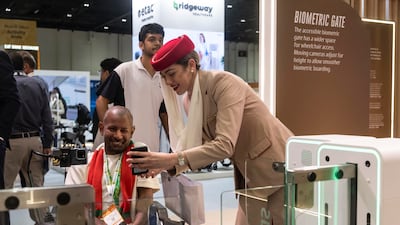

Air travel and health care for people with disabilities are set for dramatic improvements as new global assistive technology raises standards.
From special airport services to fast-track options in healthcare settings, the latest assisted living options were on show at the Dubai AccessAbilities Expo on Monday.
The latest technology was on display to support people with impaired mobility, sight and hearing, and those with intellectual disabilities, while disabled people were invited to try out the latest solutions at Dubai World Trade Centre.

These included an autonomous wheelchair being tested at Dubai International Airport, to carry passengers from check-in to their gate.
The chair is fitted with four light detection and ranging cameras and can be programmed to collect passengers from the lounge and take them on to the plane during boarding.
A manual override allows passengers travelling alone to stop at any point in the airport en route to the departure gates.
The equipment is being tested by Dnata at concourse D in Terminal 1, with airport operators looking to expand the trial to Terminal 3.
Suhail Amshan, senior manager in the office of accessibility and inclusion at Emirates, said the airline was improving access for passengers with disabilities.

“Over the last few years, we've seen a lot more people get comfortable with the idea that they can actually speak about their accommodation requirements and that in itself is huge for us,” Mr Amshan said.
“Coming into the airports can feel a little overwhelming. In the past, people might not have felt comfortable enough to approach anyone from Emirates to make certain accommodations to make their travel slightly more comfortable.”
Emirates has been certified as the world’s first autism-certified airline by the International Board of Credentialling and Continuing Education Standards.
Certification involved the training of more than 30,000 front line staff and cabin crew to understand autism and certain special requirements for air travel. Support included digital sensory guides, sensory products for neurodivergent passengers, such as fidget toys, and tailored assistance.
The airline’s travel rehearsal programmes that allow families to acclimatise to airport procedures before flying have been introduced in about 80 airports since they were launched in 2023.
Emirates has also incorporated business-class lounges, biometric passport scanners and check-in desks designed for wheelchair access.
“The first time that crew interact with a person with a disability, the scenario might not have been something they've been trained for,” said Mr Amshan.
“Everyone has a different requirement and deals with travel in different ways. Our staff are trained to answer all questions and have tools on their hands and resources for them to constantly be able to customise solutions for that person. There are lots of things that we are still not familiar with or are aware of. It is an ever-evolving space from our perspective.”
Changing standards
According to the US digital accessibility services company Onward Accessibility, the Middle East is home to more than 50 million people with disabilities, representing a significant demographic.
The mobility aids market alone is expected to reach $1.1 billion by 2031 and the global assistive technology market for people with disabilities and older people is projected to reach $98.7 billion by 2033.
Dubai Health Authority presented its Sanadhum initiative during the exhibition.
The regulatory and awareness project aims to strengthen health centres' compliance with special requirements for people of determination, including provisions of the Dubai Universal Design Code and health policies.
It includes field inspection campaigns across all health services to verify their readiness and ensure ease of access and priority. The DHA hopes it will contribute to a safer and more accessible healthcare environment for all.
“Providing comprehensive health care goes beyond developing infrastructure and services,” said Asma Al Sharif, chief executive of DHA’s Health Regulatory Sector.
“It extends to building an integrated health system that considers the needs of people of determination and ensures they can access services efficiently, with dignity and independence.”

People with disabilities represent about 10 to 16 per cent of the population of any society. About 1.3 billion people worldwide live with some form of disability, including more than 50 million people in the Middle East, the World Health Organisation estimates.
Global studies indicate 3.5 billion people will need assistive technology by 2030, while only 10 per cent have access to the products they need.
Other technology on show at the exhibition included AI-powered smart glasses offering real-time translation and assistance for people with visual disabilities.
Elsewhere, advanced electronic prosthetic limbs designed to replicate natural movement and provide users with greater independence were demonstrated.
Ghassan Suleiman, chief executive of the AccessAbilities Expo, said the event had evolved into a global platform for exchanging expertise and helping to shape the future of accessibility and inclusion as it enters its eighth year.
“Technological developments such as artificial intelligence, virtual reality, augmented reality and the Internet of Things have accelerated innovation across the sector,” he said. “This has helped improve the quality of life of millions of people around the world.”

