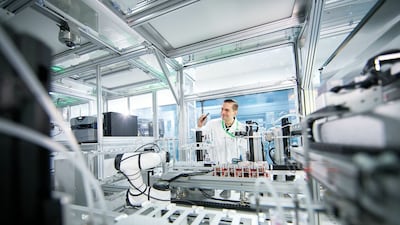
Researchers in the UAE have used artificial intelligence to develop a pain killer that they believe could be more effective than morphine.
Insilico Medicine, a clinical-stage biotechnology company with scientists working in Abu Dhabi's Masdar City, created the pill to treat acute and chronic pain. The drug, known as ISM9528, has produced promising during results initial trials and the next step is to test it on humans.
Nine out of 10 potential drugs that reach the human testing stage fail to be approved, health experts say. But there has been cause for optimism among the Insilico team. “To see a non-opioid candidate outperform morphine in preclinical models is unprecedented,” Alex Aliper, president and co-founder of the company, told The National.

Insilico believe the drug could be used as an alternative to opioid medication, reducing the risk of dependence and addiction. When asked about reported side effects, Mr Aliper said it was "so far, so good". Tests showed a "very clean profile on several species in preclinical studies – we will conduct an extensive safety evaluation in further clinical trials".
The company said the global pain medicine market was worth more than $100 billion. There is a significant need for effective non-addictive treatments, it added.
“If you have a safe, non-addictive way to treat pain, that’s a game changer,” Mr Aliper said.
The Insilico team in Abu Dhabi are also in the early stages of developing a drug that they hope could be used to treat a number of cancers, including glioblastoma, which aggressively attacks the brain.
The researchers work at Insilico’s AI and drug discovery centre in Masdar City. Most of the company’s AI team is based in Abu Dhabi, with other offices in Boston, Montreal, Hong Kong and Shanghai.
“Developing ISM9528, a potential treatment for pain, right here in Abu Dhabi demonstrates how the UAE's thriving innovation ecosystem has made huge leaps over the past few years," said Ahmed Al Suwaidi, Insilico’s associate director of strategic partnerships and business development for Middle East. The company is using "advanced locally based AI capabilities to develop ground-breaking, real-world medical solutions that address a critical global health care challenge", he added.

Insilico’s executives described the development of the two drugs as a significant regional milestone, as the discovery of novel medicine had historically been concentrated in a small number of countries. They said the Abu Dhabi team showed how the UAE could expand drug discovery capabilities and develop medicine for global use.
Insilico was founded in 2014 and began developing its AI platform that year. It launched the first end-to-end AI-driven platform Pharma.AI, in 2020.
The platform helps researchers identify biological mechanisms linked to disease, select a target and design molecules that could act on it. Researchers then synthesise selected molecules and test them in labs and preclinical models.
New horizons
The company said it normally took about 12 to 18 months after starting a project to nominate a preclinical candidate, compared with about five years in traditional drug discovery processes. A preclinical candidate is the term for a potential new drug chosen to undergo safety testing, before being tested on humans.
Insilico said it was on track to nominate about one candidate a month this year, while large pharmaceutical companies typically nominate four or five a year. The National reported this month about how the company was working to develop a drug to tackle blood cancer.
The company believes the use of AI helps to reduce the number of research cycles and narrows down which molecules to make and test. “It’s like having a more precise way to model biology and chemistry at your disposal,” Mr Aliper said. “You have an intelligent system designing molecules for you, with your guidance.”
Insilico estimates that its approach could bring the cost of early drug discovery down from tens of millions of dollars to millions. Mr Aliper said that could make it more viable to pursue treatments for rare diseases that have attracted less investment.
But AI does not shorten the human trial process, the company added. Clinical trials can take about a decade to complete, depending on the disease, and are subject to regulatory review.
“The analogy we use is there is a highway,” Mr Aliper said. "You can overtake cars on the highway, move really fast, but when you reach downtown, that is clinical trials. You need to move with the speed of traffic.”

