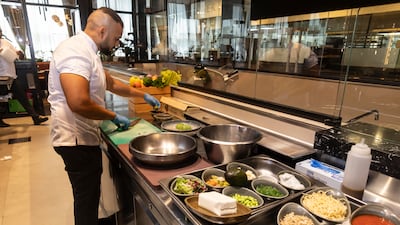
Restaurants in hotels and tourist areas in Abu Dhabi must offer a minimum number of healthy options on their menus under a mandate that comes into force on Thursday.
The new law, enforced by the Department of Culture and Tourism – Abu Dhabi in partnership with the Abu Dhabi Public Health Centre, requires each menu category to contain at least one healthy item as defined by ADPHC's approved SEHHI criteria.
SEHHI foods are low in fat, sugar and salt, and higher in nutritional value. For children's menus, at least half of all items listed must be healthy.

The implementation period started on July 1, giving establishments a three-month grace period to adjust their menus and offerings.
“Healthy menu items must be clearly identified on menus using the approved SEHHI logo, in accordance with guidance issued by ADPHC,” said the circular released by the DCT in June.

This move follows a broader trend of putting healthier choices at the forefront of daily life.
From January 1 next year, supermarkets will need to remove junk food from high-volume and high-visibility areas, and last year a restriction was placed on advertising junk food and unhealthy beverages in public spaces.
Healthy living
Abu Dhabi's Department of Health launched Healthy Living Abu Dhabi last year, a comprehensive programme with the goal of preventing diseases and improving residents' health. From food labels to community exercise initiatives, the emirate hopes to educate and provide resources to help people improve their lifestyle habits.
Operator Accor runs several Abu Dhabi hotels, including Rixos, Fairmont, Sofitel and Novotel, and has initiated its Plant Forward project, in which menus prioritise vegetables, grains, legumes and whole foods while allowing meat, fish or dairy in moderation.
Victoria Sertic, senior vice president of brand loyalty at Accor, said choice remains a key component of any hotel stay. “People are making more choices about wellness, but when it comes to going to a restaurant, they still want that enjoyment, discovery and great food,” she said.
“We’re not preaching veganism or taking away quality and excitement from the plate, but giving our chefs a much bigger creative canvas in their dishes. People actually want to choose those dishes because they're delicious, not because we're saying that it's good for them.”
Abu Dhabi can lead the way
As part of its global goals, the group aims for at least 25 per cent plant-based menu options across participating hotels, scaling towards a target of 35 per cent by 2030. It aims to reduce carbon, water and land footprints, and to add healthier menu choices for guests.
“With Novotel's food approach, it's connecting healthier choices with a broader brand philosophy around this balanced living concept,” said Ms Sertic. “Also, transparency is increasingly what customers want and what matters, and we need credibility.
“It's not just about sugar, salt or calorie count; the shift is actually broader, and Abu Dhabi can lead the acceleration for us in this space. Our hotels are very conscious of waste and reducing waste and we are not limiting choice. It's about finding the balance between an occasional splurge, but the rest of the time living on an even keel with a healthy diet.”
Customer-led
The Radisson Hotel Group is also looking to expand menus across its chain to cater for more health-conscious guests.
Joseph Chalfoun, the Radisson Hotel Group's area restaurants and bars director for the Middle East, Africa, South-East Asia-Pacific, India and Greece, welcomed the initiative. “This formalises the direction our guests have been signalling for some time,” he said.
“We have already renewed our breakfast and banqueting standards since 2023 to increase the range of vegetarian and vegan foods, and availability of gluten-free and dairy alternative products. The worst outcome would be a 'healthy corner' on the menu that nobody orders.”
Mr Chalfoun said children's menus have also been overhauled to steer away from the usual nuggets-and-fries formula. “Parents actively want and seek better options, and smaller portions of well-made adult dishes,” he said.
“Guests in the UAE are more informed about what they eat. Whether they are residents dining out, business travellers who want to stay sharp through a day of meetings, or families on holiday.”

