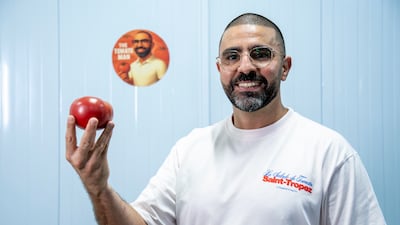

Eight hundred kilograms of premium tomatoes were at risk of going to waste when orders to Yassine Azzouni's Dubai business collapsed in the opening days of the Iran war.
With restaurants and hotels closed, the Algerian-Canadian supplier invited friends and relatives to collect the produce for free from his warehouse. And what began as an effort to save the tomatoes soon became a lifeline for his business.
Friends shared photos of the distinctive heart-shaped tomatoes on social media, prompting dozens of residents to ask whether he could deliver directly to their homes.

Mr Azzouni, known among Dubai chefs as the Tomato Man, began selling to the public instead of relying solely on the hospitality industry.
“The kindness of people helped us spread the word,” said Mr Azzouni. “My friends were kind enough to share my story across social media. I want to thank this amazing community, thank every single one who spread the word and supported us.
“People started to reach out to us on social media and on WhatsApp. People asked, 'Why do you only sell this to restaurants? Why don't you sell to us?' So the idea came from the community.”
One hand doesn't clap, two hands clap
Samiha Belmans was among the Dubai residents encouraged to try the tomatoes by a friend. She was sold on the first bite.
“When you like something, you have to share,” said Ms Belmans. “For me, it was a pretty tomato that you can only get when you go to a five-star or a Michelin restaurant and now we are lucky to get it inside our homes.”

Mr Azzouni supplies pink paradise tomatoes, a Japanese variety grown in Uzbekistan, at about Dh45 ($12.25) per kilo. Ms Belmans was happy to support a local business and pay for tomatoes that she said taste amazing.
“What came out of this is we felt we can stick together, help each other, always push for the next idea, don't feel stuck,” she said. “Someone else in his situation could have stayed stuck but he stayed positive, he found another idea. But also to do that, you need to have a community to help you. One hand doesn't clap, two hands clap. This is the spirit of Dubai, to stay united.”
Taste of home
Mr Yassine’s traditional customers, the chefs, also backed him by giving his details to people who asked about the tomatoes.
“We got a lot of questions, people really wanted to buy it for their own homes so we recommended Yassine to our customers,” said chef Milan Jurkovic of 21 grams Bistro in Dubai.

The chef typically orders about 10kg of tomatoes every three days to serve as a classic salad with sea salt and olive oil.
“I have goosebumps because it's not easy to find a beautiful tomato,” he said. “This tomato from the Tomato Man really reminded me of what we have back home in Serbia. The sweetness, umami, it touches all your taste buds, there is acidity and a savoury flavour. It reminds me about home. For me, this sentiment is very important because food brings people together, makes memories.”
Direct supplies opened a new path for Mr Azzouni’s two-year-old business that moved from taking orders manually to an online portal.
“Every single challenge is an opportunity,” he said. “The online store became our new revenue stream. Now we’re working hard, looking for ways locally to produce the same quality tomato or maybe even better.”
‘Kept us going’
Mr Azzouni’s experience is one example of how UAE businesses have adapted during the conflict, and how residents are sticking together to help them survive.
The family-run Golden Chariot confectionery and catering company in Dubai's Karama area supplied cafes, small supermarkets and people’s homes when orders flatlined in the first months of the war.
“Our customers kept us going, they kept ordering from us through the conflict,” said Anna Rodrigues, who manages the 20-year-old business with her parents.

“Even when corporate catering slowed down, regular customers stayed loyal. We work on word of mouth, with catering you need to be referred and trusted.”
The menu features cinnamon buns, mini cheese pizzas, mushroom pies, cheese canapés and fresh fruit tarts. Business has picked up over the past month after schools opened and the forecast is for steady growth.
“Now it’s really our time, business is almost 95 per cent back,” she said. “Things have stabilised also because it’s no longer distance learning for schools and the exhibition season has kick started.”
They shut the kitchen, completed renovations over the summer and shifted back to the core business to focus on catering for parties, schools and business events.
“We are looking forward to the rest of the year as the country pushes forward, things will bounce back. We have seen that after a low, there will be a high, there is always a coming back up.
“September is the start of the festive season with Indian festivals in October, then people start prepping for Christmas and the New Year. Things are looking up.”

